
Foreign shareholding hit a record high of 34.7%, and the yen “continued to fall” or reverse the flow of capital in Japanese stocks
The Zhitong Finance App learned that the yen has continued to fall recently, causing widespread concern among investors — if the depreciation trend does not change, it may eventually weaken the key driving the Japanese stock market to record highs — overseas capital inflows.
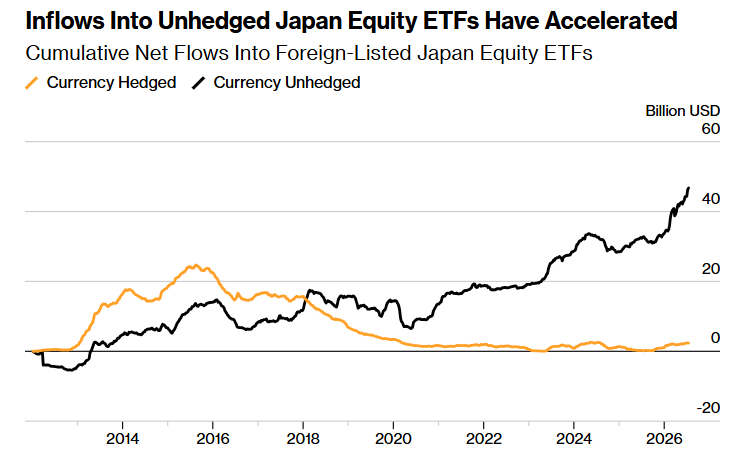
Judging from surface data, overseas traded open index funds (ETFs) still show strong demand for Japanese stocks from international investors. Compiled data shows that in recent years, the attractiveness of ETFs investing in the Japanese stock market in an unhedged manner has continued to rise, with a cumulative net inflow of 47 billion US dollars; while similar exchange-rate hedged products have shown a trend of capital outflows.
However, strategists warn that this situation could change rapidly. Pension funds and asset management institutions that only go long usually do not offset exchange rate risks. As the yen weakens further, their return on investment becomes more and more fragile. The market is beginning to question: How much more will the yen fall before exchange rate losses overshadow the appeal of Japanese stocks themselves?
“Exchange rate risk is one of the core concerns facing Japanese stocks today,” said Chad Kay, co-head of Japanese stock strategy at Comgest Asset Management in France. Although Japan is still an important global destination for investors seeking AI-themed exposure outside the US, the continued depreciation of the yen has become increasingly difficult to ignore for funds that are largely unhedged against exchange rate risks.
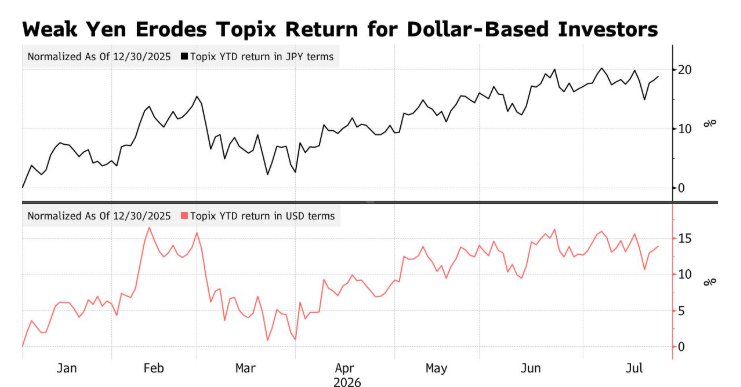
So far this year, the Eastern Stock Exchange Index has accumulated a cumulative increase of 19%, setting a new historical record. However, in dollar terms, the increase narrowed to about 14%. The reason is that the exchange rate of the yen against the US dollar has fallen below the 163 mark, hitting its lowest level since 1986. Continued widening interest spreads and market concerns about Japan's fiscal outlook are the main factors suppressing the yen.
The rising influence of overseas investors has made the exchange rate effect even more impossible to ignore. According to exchange data, by the end of March, overseas capital held 34.7% of the Japanese stock market, a record high, compared to 30.2% five years ago. Since Sanae Takaichi won the Liberal Democratic Party presidential election in October last year and became prime minister, overseas funds have accumulated net purchases of over 12 trillion yen (about 74 billion US dollars) of Japanese spot stocks.
The composition of this round of foreign investment is also significantly different from the past. Nomura Singaporean senior cross-asset strategist Yoshitaka Suda pointed out that in the early days of former Prime Minister Shinzo Abe's administration, foreign capital inflows mainly came from short-term capital, and such funds usually hedge against exchange rate risks. However, the dominant force in this round of growth is long-term investors such as pension funds, which often do not hedge against exchange rates. “From the perspective of capital flow, the positive impact of the depreciation of the yen on Japanese stocks is no longer as clear as in the past.”
Of course, the depreciation of the yen still supports the profits of exporting companies. Professional estimates show that if the yen remains at its current low level, major Japanese car companies could increase their additional profits by more than 900 billion yen in total.
However, Kazunori Construction, chief strategist at Daiwa Asset Management, said, “As the yen falls to a historic low, the market generally believes that its depreciation trend shows no signs of stopping. This may cause investors who have not hedged exchange rate risks to suspend purchases until the exchange rate stabilizes.”
Overall, the depreciation of the yen has changed from a “clear advantage” to a “double-edged sword” for Japanese stocks — while boosting export profits, it is gradually weakening actual returns from unhedged overseas capital, which in turn may shake an important cornerstone of this bull market.