
The wave of AI computing power drove CPU demand to “take off”, and doubts about the OEM business completely dissipated. Intel (INTC.US) Q2 revenue welcomed the strongest growth rate in 15 years
The Zhitong Finance App learned that after the US stock market on Thursday EST, global semiconductor giant Intel (INTC.US) handed over a report card that far exceeded market expectations. Not only did second-quarter revenue and profit surpass Wall Street estimates, but its performance guidance for the third quarter also crushed analysts' predictions, showing that the wave of AI-driven data center spending is accelerating the revival process of this established chip giant.
According to financial reports, for the second fiscal quarter ending June 27, Intel achieved revenue of 16.13 billion US dollars, up 25.4% year on year, the strongest quarterly revenue growth rate since 2011; adjusted earnings per share were 0.42 US dollars, and adjusted gross margin reached 41.8%, a significant increase of 12 percentage points over the same period last year. As a comparison, the market's original average expected revenue was only US$14.42 billion, earnings per share of US$0.21, and gross margin of 38.8%. Management emphasized that this is the seventh consecutive quarter where the company's results have exceeded financial guidance, and demand from all business units continues to exceed growing supply.
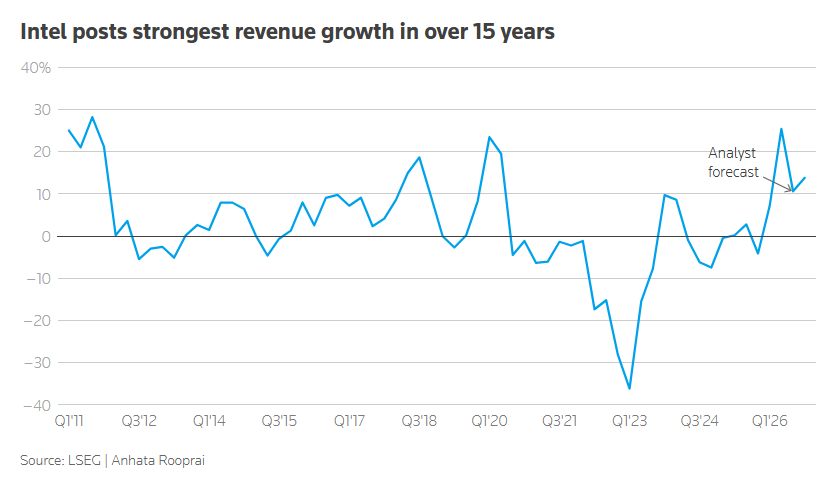
What made investors even more excited was the guidance for the third quarter. Intel expects revenue for the quarter to reach 15.8 billion US dollars to 16.8 billion US dollars. Even at the lower end of this range, it easily surpassed analysts' average estimate of 15.1 billion US dollars; adjusted earnings per share are expected to be 0.38 US dollars, which is also far higher than the market's forecast of 0.27 US dollars.
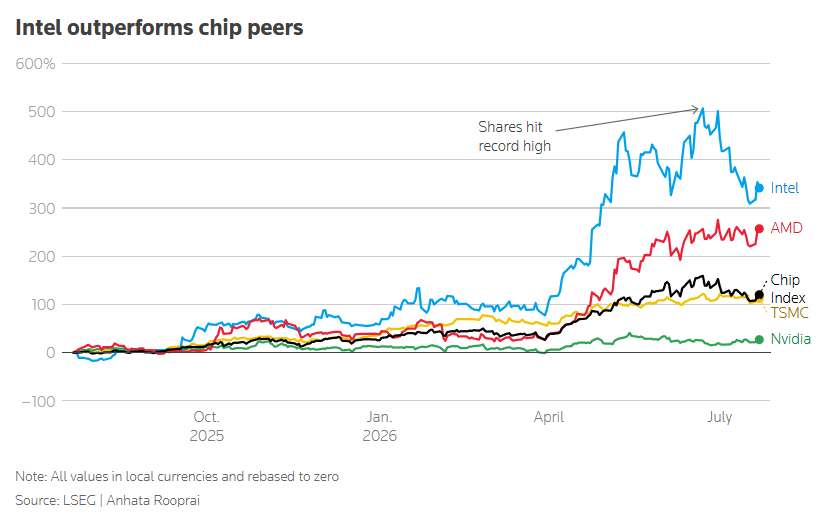
After the financial report was announced, Intel's stock price once surged more than 13% during after-hours trading, and the increase has narrowed since then. Although Intel's stock price has fallen by more than 25% since hitting a record closing high on June 22 due to the overall sell-off in the chip sector, the cumulative increase during the year is still over 170%.
Agentic AI detonates new demand for data center CPUs
The biggest highlight of this financial report is that the shift in the focus of the AI industry is causing Intel's core product, the central processing unit (CPU), to reoccupy the center of the stage. As the industry shifts from training large models to large-scale deployment of “agentic AI” (Agentic AI) that can perform tasks autonomously, demand for general-purpose CPUs has experienced a blowout.
In the second quarter, the revenue of Intel's data center and AI business division reached 6.3 billion US dollars, a sharp increase of 59% over the previous year. The growth rate was more than double the company's overall revenue, which was higher than the market forecast of 5.37 billion US dollars. CEO Lip-Bu Tan (Lip-Bu Tan) put it bluntly: “In data centers, CPUs are taking off.” He said demand is outstripping Intel's increasing supply capacity, and these are all “sweet annoyances.” In a conference call, Chen Liwu added that the year-on-year growth of server CPUs in the second quarter set a record, and the Xeon 6 product line is becoming one of the fastest climbing products in the company's history.
This shortage of supply also prompted the company to drastically raise its capital expenditure plan. Chief Financial Officer David Zinsner (David Zinsner) revealed that due to surging demand, Intel has raised this year's capital expenditure budget from $18 billion to $20 billion. Sinsner further revealed that capital expenditure in 2027 will be “significantly increased” compared to 2026, and the vast majority will be invested in the US factory network. The company is locking in equipment purchase orders, speeding up clean room construction, and ensuring the supply of substrates and memory.
Sinsner also said that the company has signed long-term agreements for three to five years with customers for chips such as data center CPUs and XPUs. Some contracts also lock in procurement volume and prices, which provides greater predictability for future revenue. By the end of the quarter, the company had about 30 billion US dollars in cash and 10 billion US dollars in credit lines. Sinsner did not rule out the possibility of issuing additional shares in the future, but said there are currently no specific plans.
Foundry business “dispels doubts”, 14A process wins breakthrough customers
The OEM business revival strategy that Chen Liwu promoted after taking office also sent a more clear positive signal this quarter. Intel Foundry Services (Intel Foundry Services) achieved revenue of 5.8 billion US dollars in the second quarter, an increase of 31% year over year, higher than analysts' expectations of 5.55 billion US dollars.
In terms of advanced manufacturing processes, Chen Liwu made it clear during the conference call that Intel has “fully committed” to mass production using its most advanced 14A manufacturing process in 2028. Last year, the company warned that if it couldn't find important customers or was forced to abandon 14A, it would cause the US to withdraw from the race to manufacture the world's fastest chip. Now Chen Liwu said that seeing customer participation in the 14A process continues to increase, “I am increasingly confident that 14A will become a highly competitive process.”
Behind this confidence is the actual settlement of heavyweight customers. Intel has successfully received an order from Tesla (TSLA.US) to manufacture Musk's next-generation AI chip for the “Terafab” project. Furthermore, in April of this year, then-President Trump announced that Apple (AAPL.US) had agreed to contract its processor to Intel. Although neither party has officially confirmed the deal so far, market expectations are already heating up.
Chen Liwu revealed that the company's design service revenue increased nearly threefold year-on-year, and announced a partnership with FTNT.US (FTNT.US) to develop security processors, reflecting its ASIC strategy; Sinsner said the ASIC business's annualized revenue is approaching 2 billion US dollars, while Chen Liwu pointed out that target market opportunities are expected to exceed 100 billion US dollars. In addition, the advanced packaging technology EMIB-T has strong customer interest, the backlog of orders continues to grow, and yield and reliability standards have been met. The company is committed to improving it to high yield and high quality to support large-scale mass production by customers in 2027.
Bob O'Donnell, president and chief analyst at Technalysis Research, commented: “Since Chen Liwu took over, there have been lingering concerns that have cast a cloud of uncertainty over the OEM business. Now all those doubts have been dispelled.”
The PC business has transformed to high-end, and the company is still in the middle of recovery
In terms of the personal computer (PC) business, revenue for the quarter reached 8.9 billion US dollars, which was also higher than market expectations of 7.89 billion US dollars. Despite a year-on-year decline in PC chip shipments, the average selling price increased significantly, reflecting Intel's active contraction from the entry-level low-end chip market to refocus on high-end devices.
Since taking office for more than a year, Chen Liwu has actively improved the company's financial health and successfully introduced strategic investments from the federal government, Nvidia (NVDA.US), and SoftBank (SFTBY.US). Intel is still seen as a key player in the US government's blueprint for returning chip manufacturing to the mainland. Although it has been postponed several times, its large-scale manufacturing site project in Ohio is still an iconic project for the US to reshape the semiconductor supply chain.
Analysts generally gave positive reviews of Intel's latest developments. Seaport Group analyst Jay Goldberg said that Intel still needs to continue to prove itself on a long-term basis, but the latest financial report certainly sends a positive signal. “The company's recent strong momentum will support improvements in its long-term fundamentals.”
Shay Bolor, chief market strategist at the technology research institute Futurum Group, believes that if Intel can turn the current shortage of data center chips into sustainable revenue growth, improve the economic model of the foundry business, and finally announce a list of external customers sufficient to verify the next stage of its manufacturing transformation, there is still room for further revaluation of its stock price.