
SpaceX Has a $1.6 Trillion Opportunity That May Eclipse Its AI Business
Key Points
Orbital AI data centers remain speculative, but Starlink is already profitable and growing rapidly, with a huge $1.6 trillion broadband and mobile connectivity market.
Direct-to-cell service faces technical, regulatory, and competitive hurdles, so investors should watch Starlink Mobile's rollout.
Most of the buzz lately around Space Exploration Technologies (NASDAQ: SPCX) centered on its artificial intelligence (AI) ambitions, including the Grok chatbot it absorbed and its plans for data centers in orbit. Those headlines are exciting.
But the initial public offering (IPO) from SpaceX (as the company is also known) points to a prize that could ultimately matter more: a connectivity opportunity that the company pegs at roughly $1.6 trillion.
Missed Nvidia in 2009? This Rare Signal Is Flashing Again. In 2009, a "Double Down" signal flashed for a little-known chipmaker called Nvidia. For the first time in years, that same "Total Conviction" signal is flashing for a company 1/100th the size of Nvidia. Continue »
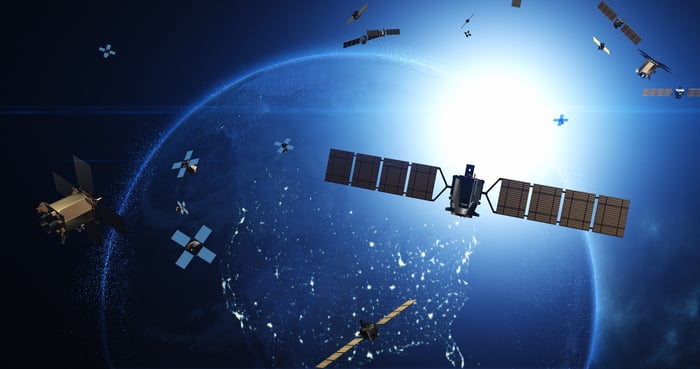
Image source: Getty Images.
The connectivity opportunity
That $1.6 trillion figure comes from Starlink, SpaceX's satellite internet business, and it breaks down into two pieces. The company sees about $870 billion in fixed broadband -- beaming internet to homes and businesses the ground network cannot easily reach -- and roughly $740 billion in mobile services.
Starlink is already the workhorse of SpaceX, serving more than 10 million customers and generating the bulk of the company's revenue. The next leg of growth is Starlink Mobile, the effort to connect ordinary smartphones directly to satellites and, in time, challenge traditional wireless carriers around the world.
Why it may eclipse the AI business
Here is why I think connectivity could overshadow the AI story. The vision for an orbital data center is genuinely bold, but it is years away, unproven at scale, and still burning cash.
Starlink, by contrast, is real, growing fast, and already profitable. Connecting the billions of people who lack reliable internet, plus giving every phone a signal in dead zones, is a tangible, enormous market that SpaceX is capturing right now. When one business is a working, cash-generating machine and the other is a promising experiment, the working one usually deserves the spotlight.
The catch worth naming
I would keep the trillion-dollar figure in perspective, though. That $1.6 trillion is a long-term addressable market, not revenue that SpaceX will book anytime soon. Skeptical analysts note that spectrum limits, cell-site capacity caps, and the physics of beaming data to unmodified phones could hold realistic mobile revenue to a small fraction of the headline number for years.
Wireless carriers are also banding together to blunt Starlink's reach, and rivals like AST SpaceMobile are chasing the same satellite-to-phone dream. Turning a giant market into actual profit will take enormous capital and flawless execution.
The takeaway for investors
SpaceX's AI vision will keep grabbing attention, but connectivity may quietly be the engine that powers the company's long-term value. For investors weighing the stock, Starlink and its push into mobile look like the more grounded reasons to be interested, not the orbital data centers everyone is talking about. I would watch the direct-to-cell rollout closely, because that is where a chunk of this $1.6 trillion opportunity either becomes real money or stays a slide in a pitch deck.
Micah Zimmerman has no position in any of the stocks mentioned. The Motley Fool has positions in and recommends AST SpaceMobile. The Motley Fool has a disclosure policy.