
Kevin Warsh Said the Fed Has "No Tolerance" for Inflation and Is Charting a "New Course" on Monetary Policy. J.P. Morgan Analysts Expect Rates to Hold Steady Through 2026.
Key Points
In testimony before Congress, new chair Kevin Warsh reiterated a firm anti-inflation stance.
But he didn't give any indication whether the Fed was ready to hold or hike over the next few meetings.
J.P. Morgan analysts think the Fed will hold until well into 2027.
Kevin Warsh made his first appearance before Congress as the new Federal Reserve chair this week. He sent a fairly clear message about inflation. What he didn't do, however, is offer any clear signals about the central bank's outlook or what it might do with interest rates moving forward.
Here are four takeaways from Warsh's latest commentary, along with what J.P. Morgan's research team had to say about it.
Missed Nvidia in 2009? This Rare Signal Is Flashing Again. In 2009, a "Double Down" signal flashed for a little-known chipmaker called Nvidia. For the first time in years, that same "Total Conviction" signal is flashing for a company 1/100th the size of Nvidia. Continue »
1. Warsh draws a hard line on inflation but says nothing about rates
Perhaps Warsh's sharpest comment came when he told committee members that the Fed has "no tolerance for persistently elevated inflation" and shares "a resolute commitment to restoring price stability." If the Fed has a dual mandate, it seems pretty clear that he's only focused on one of them right now. But just as he didn't offer his own dot plot projection, he also didn't offer clues to whether or when the Fed might make a rate change. The takeaway is that investors shouldn't expect clear signals from the Fed going forward.
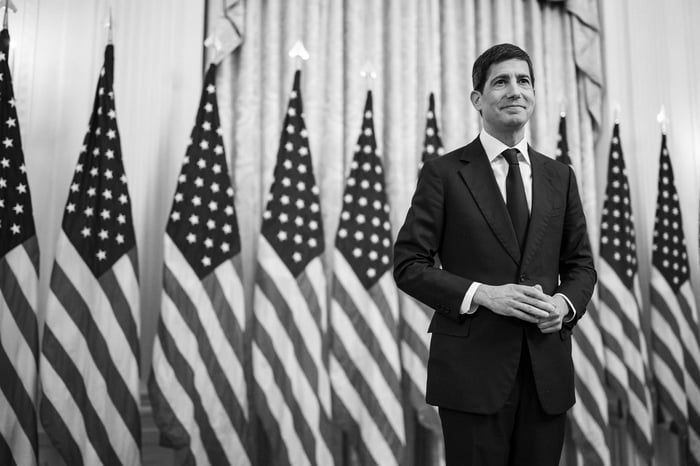
Federal Reserve Chair Kevin Warsh. Image source: Official White House Photo by Daniel Torok.
2. Inflation cooled in June, but the job isn't done yet
Headline inflation fell 40 basis points from May, bringing the annualized rate to 3.5%. Core inflation held steady at 2.6% year over year. Both numbers are still well above the Fed's target. Warsh emphasized that this is just one month of data. For anyone thinking that inflation is coming back under control, he said, "That is not my view." It's clearly going to take several more months of data before Warsh feels comfortable taking his foot off the brakes.
3. Fed policymakers are split, which could mean more policy shifts
The Fed's dot plot indicated that about half of the 19 Fed policymakers expected higher rates by year-end. The other half favors holding steady or cutting rates. That's part of the reason why the markets are a little hesitant right now. Usually, there's consensus on the direction policy is headed. Today, we just don't know for sure. Warsh has some work to do in the months ahead.
4. The Iran conflict is still a big inflation risk
Oil prices have whipsawed ever since the beginning of the conflict. Even after a supposed ceasefire agreement, tensions remain high, pushing prices back up. Energy is the biggest driver of inflation right now, and it's unclear when the war will end.
That actually makes the Fed's job tougher. Policy changes are meant to address broad inflation problems, not one driven by just one area of the economy. And it's twice as difficult to adjust policy based on geopolitics rather than true supply and demand.
J.P. Morgan analysts don't see a rate hike until the second half of 2027
J.P. Morgan doesn't seem fully on board with what Warsh is selling. Analysts expect the Fed to hold rates steady through the end of 2026, with the next move being a rate hike in the third quarter of 2027. Warsh's "no tolerance" policy may favor rate hikes sooner, especially if energy prices remain elevated. But the uncertainty could instead result in a wait-and-see approach.
JPMorgan Chase is an advertising partner of Motley Fool Money. David Dierking has no position in any of the stocks mentioned. The Motley Fool has positions in and recommends JPMorgan Chase. The Motley Fool has a disclosure policy.