
Bank of Montreal (TSX:BMO) Stock Stays Fully Priced On A New Credit Facility
After a strong five year run that has seen Bank of Montreal stock deliver a total return of 149.2%, the current Excess Returns intrinsic value estimate and market multiples both indicate the shares are now trading around what the models suggest is a fair level rather than an obvious bargain.
- Over 5 years, Bank of Montreal has returned 149.2%, which puts current investors in the position of weighing fresh upside against the gains already booked.
- The newly arranged revolving credit facility with Evolve Royalties can support fee and interest income, but the need to assess credit quality and potential losses remains a central risk for how the market prices the stock.
- A low overall valuation score, with only 1 of 6 checks screening as attractive, suggests Bank of Montreal does not screen as a clear bargain on the broader set of valuation metrics.
For investors, the debate is whether Bank of Montreal's recent performance and current intrinsic value estimate leave enough room for a favorable risk reward trade off from here.
Find out why Bank of Montreal's 65.8% return over the last year is lagging behind its peers.
Is Bank of Montreal Fairly Priced on Excess Returns?
The Excess Returns model examines whether Bank of Montreal is expected to earn more on its equity base than the return shareholders require. For BMO, the model uses a book value of CA$119.96 per share and a stable EPS estimate of CA$15.79 per share, based on weighted future Return on Equity estimates from 9 analysts. Those earnings are compared to a cost of equity of CA$9.30 per share, implying an excess return of CA$6.49 per share on an average Return on Equity of 13.26% and a stable book value of CA$119.10 per share.
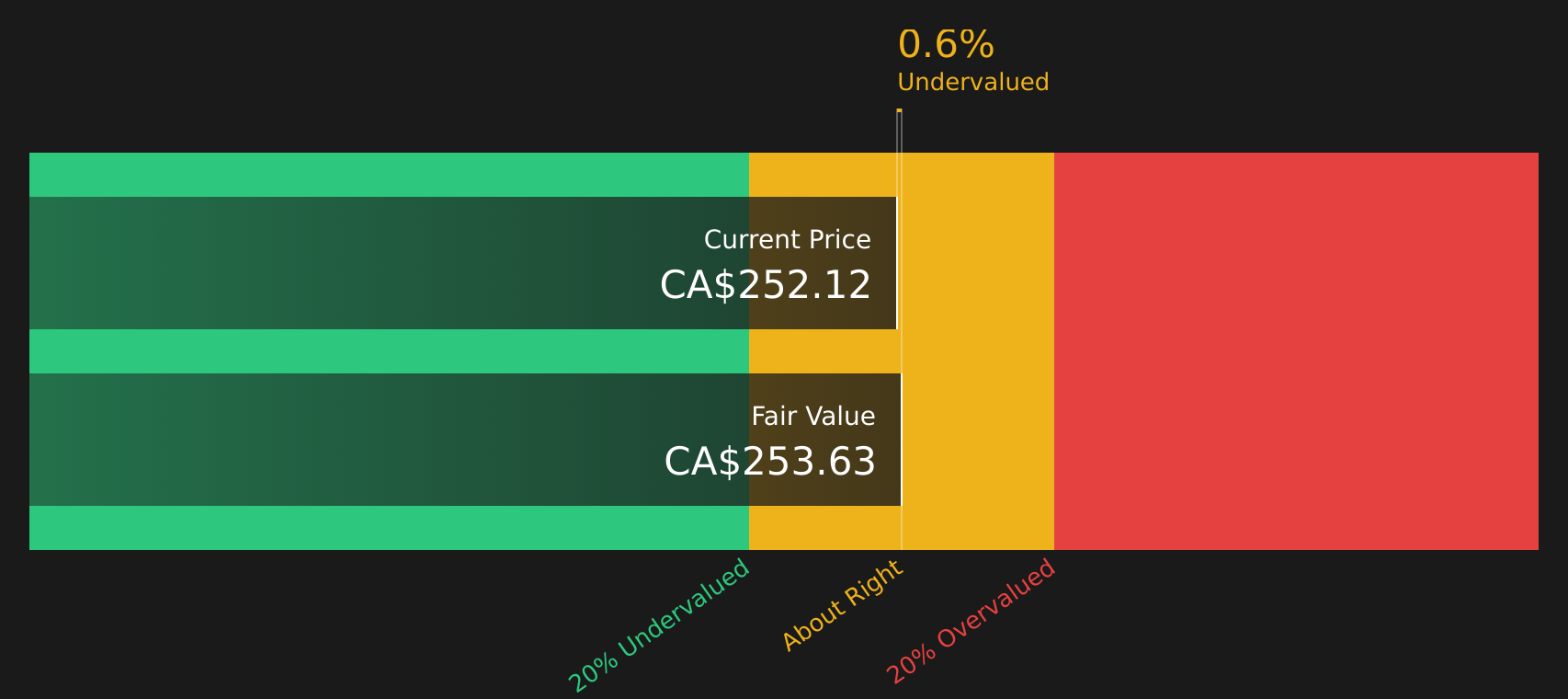
On these assumptions, the Excess Returns framework points to an intrinsic value of about CA$253.39 per share, which is only around 1.0% above the current share price. As a result, Bank of Montreal screens as roughly fairly valued on this model. Because the new revolving credit facility with Evolve Royalties adds another source of fee and interest income without materially changing the equity base today, the small valuation gap suggests the market is already pricing in a moderate contribution from such lending activity.
Overall, Bank of Montreal stock comes out as about fairly valued on the Excess Returns model, with the current price sitting very close to the estimated intrinsic value.
Bank of Montreal is fairly valued according to our Excess Returns, but this can change at a moment's notice. Track the value in your watchlist or portfolio and be alerted on when to act.
Is Bank of Montreal Fairly Priced on Earnings?
P/E is usually the cleanest starting point for a mature, profitable bank like Bank of Montreal because earnings and regulatory capital are already in focus for investors. Bank of Montreal currently trades at about 18.9x earnings, compared with an industry average P/E of roughly 11.7x for Banks and a peer group average around 18.0x.
The fair P/E ratio suggested by the model for Bank of Montreal is 18.6x, only slightly below the current level. That small gap indicates the stock is priced close to what the model implies when it factors in the company’s profile, earnings outlook and risk. Even with the revolving credit facility for Evolve Royalties adding another line of business, the current P/E suggests the market is already largely reflecting these prospects in the share price.
Overall, Bank of Montreal appears roughly fairly valued on its P/E multiple, with the market pricing the stock close to the model’s fair ratio and in line with similar peers.

See what the numbers say about this price — find out in our valuation breakdown.
The Bank of Montreal Narrative: What Would Justify Today's Price?
Simply Wall St Narratives for Bank of Montreal pick up where the valuation models leave off by spelling out which combinations of growth, margins and earnings would need to hold for the stock to be worth meaningfully more or less than today’s price. Each narrative ties a fair value estimate to a particular set of potential catalysts and risks for Bank of Montreal, so you can track over time which broad storyline is coming through in the actual results.
Add your own narrative on Bank of Montreal and be one of the first voices in the Simply Wall St community to lay out a clear, number-driven view on whether the Evolve Royalties revolving credit facility ultimately delivers on its potential.
Share how you see Bank of Montreal's risk and reward from here, and track over time how your thesis holds up as new results and developments come through.
Do you think there's more to the story for Bank of Montreal? Head over to our Community to see what others are saying!
The Bottom Line
For Bank of Montreal, both the Excess Returns intrinsic value estimate and the earnings multiple view point to a stock that is priced about right rather than clearly cheap or expensive. The intrinsic value sits only slightly above the current share price, and the P/E ratio is close to the model’s fair level and broadly aligned with peers. With a low overall valuation score, the main question for investors is whether future credit performance, including exposures such as the Evolve Royalties facility, justifies paying roughly fair value for the risk profile from here.
This article by Simply Wall St is general in nature. We provide commentary based on historical data and analyst forecasts only using an unbiased methodology and our articles are not intended to be financial advice. It does not constitute a recommendation to buy or sell any stock, and does not take account of your objectives, or your financial situation. We aim to bring you long-term focused analysis driven by fundamental data. Note that our analysis may not factor in the latest price-sensitive company announcements or qualitative material. Simply Wall St has no position in any stocks mentioned.
Have feedback on this article? Concerned about the content? Get in touch with us directly. Alternatively, email editorial-team@simplywallst.com