
Siemens Energy Stock And 2 More Global Green Energy Stocks Facing BRI Pressure
China’s record BRI green energy funding and a surge of private capital into overseas projects are quietly reshaping where risks and opportunities sit across global markets. As oil and gas prices react to the Iran conflict and more countries look to Chinese cleantech and infrastructure money, some stocks may find fresh demand while others face tougher competition or margin pressure. This article breaks down three stocks exposed to these fast moving headlines, with one that could benefit from the shift and two where the new wave of BRI capital may now be a clear headwind.
Siemens Energy (XTRA:ENR)
Overview: Siemens Energy is a global energy technology company based in Munich that supplies gas and steam turbines, grid equipment, industrial electrification solutions, and wind turbines, along with long term service and digital support for utilities, industrial customers, and infrastructure projects worldwide.
Operations: Siemens Energy generates most of its revenue from Gas Services (€12.8b), Grid Technologies (€12.1b), and Siemens Gamesa (€10.1b), with smaller contributions from Transformation of Industry (€5.7b) and a reconciliation adjustment.
Market Cap: €129.4b
Siemens Energy sits at the intersection of global electrification and the Iran driven spike in fossil fuel prices. However, the surge in Chinese BRI green energy funding could increasingly squeeze it out of emerging market projects where price often outweighs brand and service depth. The company reports strong order momentum in gas and grid equipment and a large service backlog that supports earnings quality. At the same time, it is carrying a rich P/E, a heavy reliance on external borrowing, and a wind division that is still working through past problems. With analysts divided on how quickly margins and cash flow can align with the share price, investors face the possibility of paying a premium while Chinese cleantech competition and project execution challenges intensify.
Siemens Energy’s rich P/E, heavy borrowing and unresolved wind issues could be masking something investors are underestimating. Before assuming the backlog offsets these pressures, review the DCF valuation analysis for Siemens Energy.
Schneider Electric (ENXTPA:SU)
Overview: Schneider Electric is a French energy management and industrial automation company that provides equipment, software, and services to control, monitor, and optimize power use in buildings, factories, data centers, transport infrastructure, and utilities worldwide.
Operations: Schneider Electric generates most of its revenue from Energy Management at €33.1b, with a smaller but meaningful contribution from Industrial Automation at €7.0b across global markets.
Market Cap: €150.6b
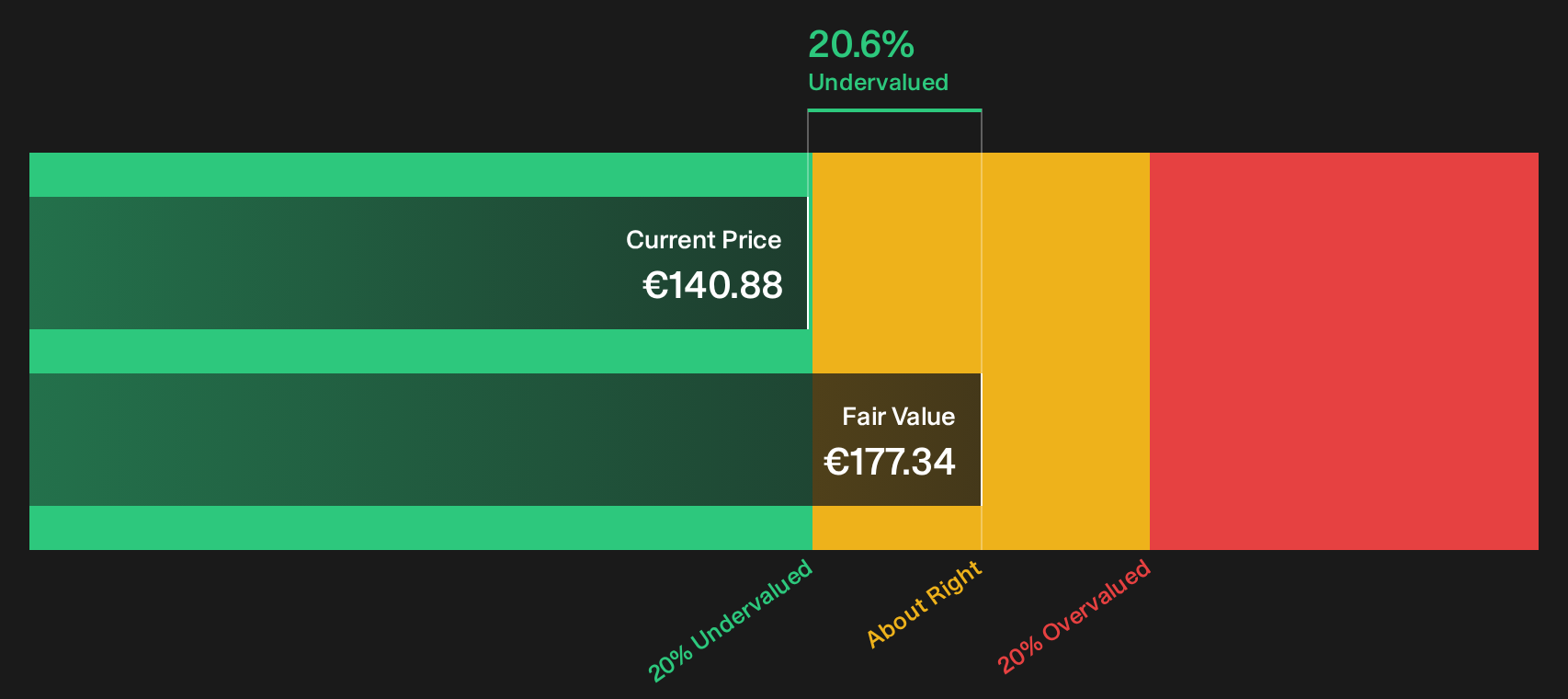
Schneider Electric is attracting attention for its push into AI data centers, software, and EV charging, but the risk side of the story is easy to overlook. The company is priced on a rich 36.2x P/E, carries a high debt load, and has recently seen margins slip, with net profit margin down to 10.4% and earnings declining 2.5% over the past year, even as management pay moved higher. At the same time, surging Belt and Road green investment and aggressive Chinese private players in developing markets could pressure growth in regions where Schneider wants to sell energy management and renewables solutions. Investors weighing this stock need to consider whether the AI and software narrative is sufficient in the context of valuation stretch, balance sheet risk, and intensifying competition from BRI backed cleantech.
Schneider Electric’s 36.2x P/E, slipping margins and rising debt suggest the story may be decoupling from the AI and software hype. Before assuming the growth case still holds, read the 1 key reward and 1 important warning sign

Goldwin (TSE:8111)
Overview: Goldwin is a Tokyo based apparel company that designs, manufactures, and sells sportswear and outdoor clothing, including jackets, shirts, pants, swimwear, footwear, bags, and accessories under its own brands and global labels such as The North Face, Helly Hansen, Speedo, and Allbirds.
Operations: Goldwin generates all of its ¥137,516m in revenue from the sporting goods related business in Japan.
Market Cap: ¥314.7b
Goldwin appears distinct in this green energy and infrastructure list because it is a consumer stock with earnings tied to sports and outdoor demand. It is priced at about 34.6% below an internal fair value estimate, with net margins around 17.5%. Analysts currently forecast earnings growth of about 6.04% a year and set a consensus price target above the current share price. Investors also need to weigh an unstable dividend record and relatively inexperienced management, with average tenure near 1.1 years. Recent board changes and fresh guidance indicate a business that is still evolving, which may be appealing for those who believe customers will continue to pay for its premium brands in Japan.
Goldwin’s mix of premium brands, a 17.5% net margin and a share price sitting about 34.6% below an internal fair value estimate hints at a story many investors may be underestimating. Start with the analyst forecasts for Goldwin and see what the recent board changes could really mean for where this stock goes next.

Take Control of Your Investment Journey
If Siemens Energy or any of these companies have caught your attention, register for FREE with Simply Wall St and add your companies to a Watchlist to monitor the share price against the fair value and track any new developments as they happen. Once you've made your move, manage your holdings with our Portfolio Command Center that filters out the noise to deliver only the most critical, actionable updates. Throughout your journey, our Community allows you to filter the best ideas from thousands of investor perspectives. By uncovering hidden catalysts and risks early, you'll accelerate your decision-making and stay one step ahead of the market.
Seeking Alternatives Before Momentum Flies Past?
Fresh stock ideas do not stay under the radar for long. Before the next breakout gathers momentum and ideal entries are gone, scan these curated lists and review them early.
- Track higher-yield opportunities that still look resilient by running through a curated group of 458 dividend fortresses built to emphasize consistency while others are focused on falling payouts.
- Review potential candidates early by scanning 506 high quality undiscovered gems that remain under the radar for now, before broader attention narrows your entry window.
- Focus on sturdier balance sheets with a pre-filtered list of solid balance sheet and fundamentals (418 results) so you can better manage the risk of holding fragile stocks when momentum changes.
This article by Simply Wall St is general in nature. We provide commentary based on historical data and analyst forecasts only using an unbiased methodology and our articles are not intended to be financial advice. It does not constitute a recommendation to buy or sell any stock, and does not take account of your objectives, or your financial situation. We aim to bring you long-term focused analysis driven by fundamental data. Note that our analysis may not factor in the latest price-sensitive company announcements or qualitative material. Simply Wall St has no position in any stocks mentioned.
Have feedback on this article? Concerned about the content? Get in touch with us directly. Alternatively, email editorial-team@simplywallst.com