
Marathon Petroleum (MPC) Stock Could Be 22% Below Fair Value Despite Earnings Focus
Marathon Petroleum stock has delivered a very large 5 year return, yet its valuation checks send mixed signals, with a Discounted Cash Flow (DCF) intrinsic value estimate pointing to upside while market based multiples lean expensive.
- Over the past 5 years, Marathon Petroleum has returned roughly 5.3x an initial investment, which puts extra focus on whether recent gains leave much room for further value.
- Upcoming earnings expectations for the largest refining system in the U.S. can support the intrinsic value case, while any disappointment on cash flow or refining margins may challenge the current valuation.
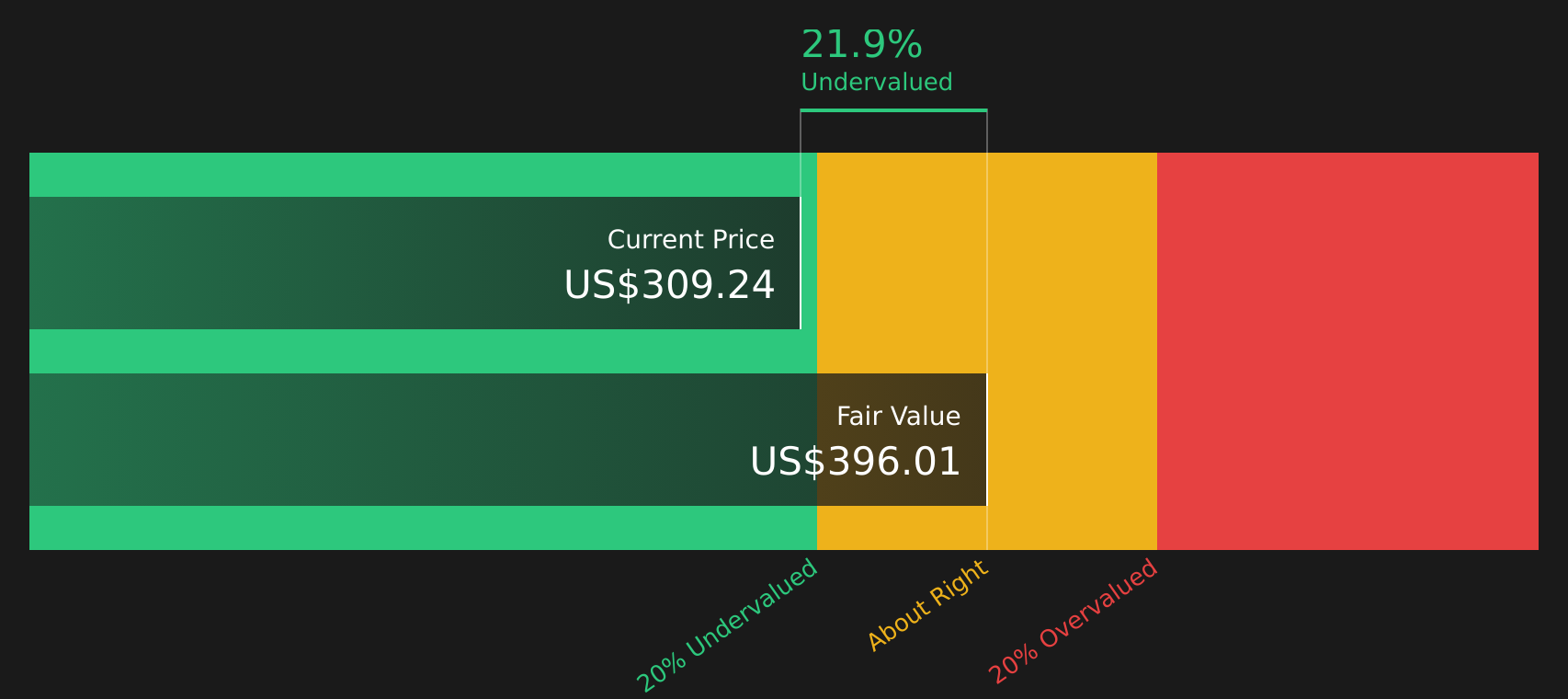
- Based on Simply Wall St's broader checks, Marathon Petroleum scores 2 out of 6 on valuation, which suggests the stock does not screen as a clear bargain overall even though the DCF view indicates it may be undervalued by 21.9%.
For investors, the debate is whether Marathon Petroleum's strong share price run already reflects its fundamentals, or if the intrinsic value estimate still offers a margin of safety.
Does Marathon Petroleum Look Undervalued on Cash Flow?
The Discounted Cash Flow (DCF) model here focuses on what Marathon Petroleum can generate in free cash flow over time and discounts that back to today. On the latest twelve month numbers, the company produced about $6.7b in free cash flow, and the model assumes these cash flows ease back rather than compound rapidly, reflecting a more mature, cyclical refiner profile.
On those assumptions, the DCF model lands on an estimated intrinsic value of about $396 per share, which implies the stock is 21.9% below the current market price on this basis. Because the projections build in declining future cash flows, this gap is not driven by aggressive growth assumptions, but by the scale of cash Marathon Petroleum is already producing today. With earnings in focus around the upcoming report, expectations for significant EPS growth help explain why some investors may see the current price as not fully reflecting that cash generation.
Overall, the DCF workup suggests Marathon Petroleum stock currently screens as undervalued relative to its projected cash flows on these assumptions.
Our Discounted Cash Flow (DCF) analysis suggests Marathon Petroleum is undervalued by 21.9%. Track this in your watchlist or portfolio, or discover 49 more high quality undervalued stocks.
Is Marathon Petroleum Getting Expensive on Earnings?
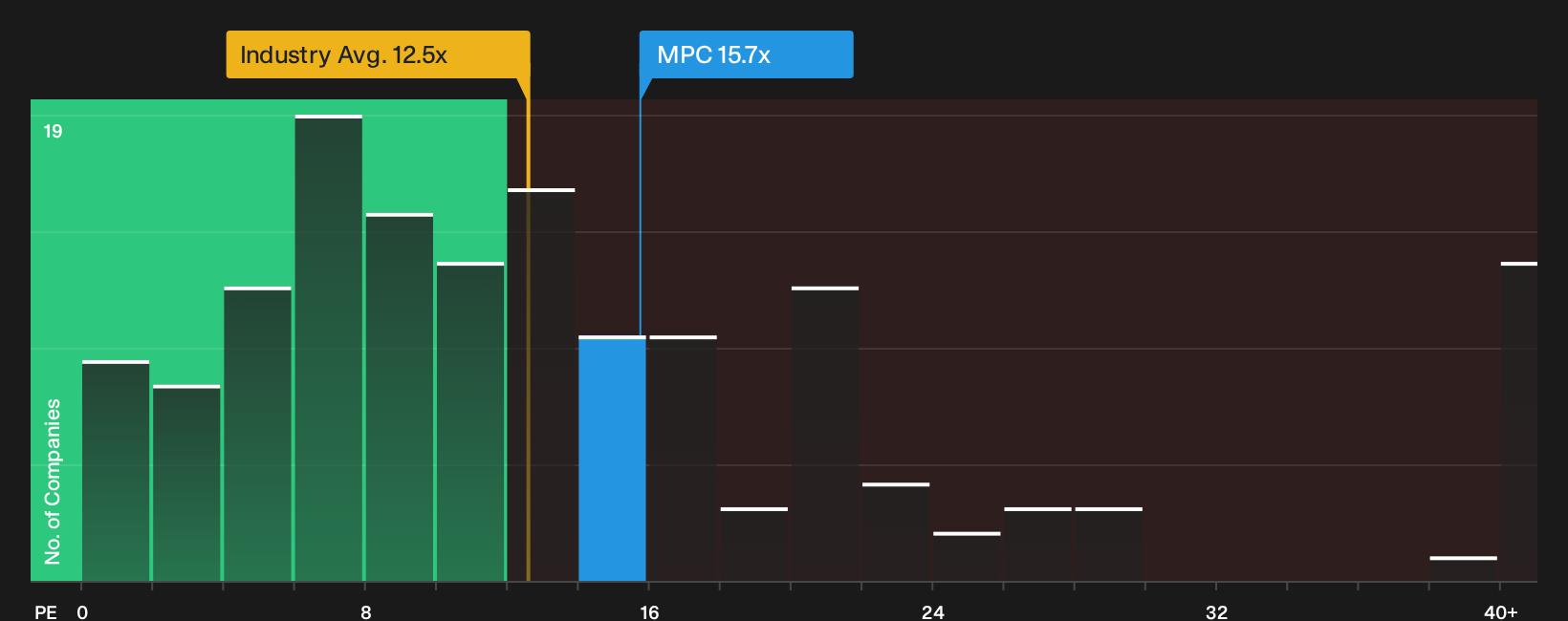
The P/E ratio is a useful yardstick for Marathon Petroleum because earnings remain a key focus for a refiner with a large, established asset base. Right now the stock trades on a P/E of about 19.5x, compared with an Oil and Gas industry average of roughly 14.3x and a peer group average near 18.4x. This indicates that the market is assigning a clear premium to Marathon Petroleum's earnings.
Simply Wall St's fair P/E ratio for Marathon Petroleum is 17.0x, which is the level suggested after accounting for its size, sector, profitability and risk profile. Set against the current 19.5x, the stock is trading above that fair multiple. The gap points to investors paying up for the earnings stream at today's price.
Taken together, the P/E workup indicates that Marathon Petroleum stock currently screens as overvalued on an earnings multiple basis.
See what the numbers say about this price — find out in our valuation breakdown.
The Marathon Petroleum Narrative: What Would Justify Today's Price?
Simply Wall St Narratives pick up where this valuation puzzle for Marathon Petroleum leaves off by spelling out the specific combinations of growth, margins and earnings that would need to play out for the stock to be worth materially more or less than it is today on the market. Each narrative links its valuation view to a clear path for Marathon Petroleum's future growth, profitability and risks, giving you a concrete reference point you can revisit as new information arrives.
Community views on Marathon Petroleum sit far apart, with one camp seeing underappreciated cash engines and the other flagging late cycle risk.
Bull case: roughly fairly valued
"MPLX plans to direct about 90% of US$2.4b of growth capital into Natural Gas and NGL services in the Permian and Marcellus, areas linked to rising LNG exports and power demand…"
Read the full Bull Case to see why Marathon Petroleum could be undervalued
Bear case: 6% overvalued
"Marathon Petroleum's revenues remain heavily exposed to declining long-term demand for petroleum products due to accelerating electrification and decarbonization trends in transportation, which could structurally erode volumes for gasoline, diesel, and jet fuel production…"
Read the full Bear Case to see why Marathon Petroleum could be overvalued
Do you think there's more to the story for Marathon Petroleum? Head over to our Community to see what others are saying!
The Bottom Line
For Marathon Petroleum, the Discounted Cash Flow (DCF) work points to meaningful intrinsic value upside, while earnings multiples suggest the stock already trades at a premium. That split, alongside weaker broader valuation checks, reflects a refiner that generates strong cash today but carries elevated expectations after a very large multi year move. The central issue is whether current refining margins and cash generation can be sustained enough to justify that premium. From here, the key question for you is whether the discount implied by the intrinsic value estimate signals a potential opportunity, or whether the market is correctly accounting for long term demand and cycle risks.
This article by Simply Wall St is general in nature. We provide commentary based on historical data and analyst forecasts only using an unbiased methodology and our articles are not intended to be financial advice. It does not constitute a recommendation to buy or sell any stock, and does not take account of your objectives, or your financial situation. We aim to bring you long-term focused analysis driven by fundamental data. Note that our analysis may not factor in the latest price-sensitive company announcements or qualitative material. Simply Wall St has no position in any stocks mentioned.
Have feedback on this article? Concerned about the content? Get in touch with us directly. Alternatively, email editorial-team@simplywallst.com