
The Federal Reserve's meeting this week became an “interest rate showdown”: interest rate hike expectations soared, political games and soaring oil prices reversed the inflation narrative
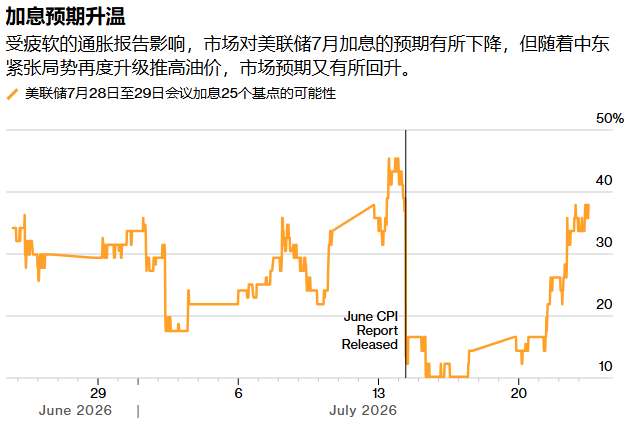
The Zhitong Finance App learned that just two weeks ago, the market was still betting that the Federal Reserve would end its interest rate hike cycle and start cutting interest rates as early as October. However, with renewed fighting in the Middle East driving up oil prices, the Trump administration's announcement of a new round of global tariffs, and the AI investment boom continuing to drive demand, the Federal Reserve's July 28-29 policy meeting evolved from a “regular meeting” to the most controversial interest rate political showdown in 2026. According to federal funds futures, the probability of a 25 basis point rate hike this week has risen to about 36%, and when the June CPI data was released two weeks ago, this probability dropped to 10%.
From “10%” to “38%”: An inflation narrative reversed by geopolitics
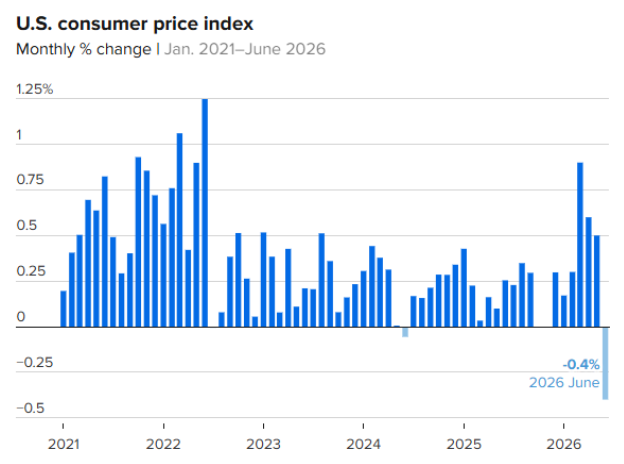
On July 14, the US Department of Labor released the June CPI data: CPI rose 3.5% year on year, significantly down from 4.2% in May, down 0.4% month-on-month, the biggest month-on-month decline since April 2020; core CPI remained flat month-on-month, the smallest increase since January 2021. This data once convinced the market that the Federal Reserve could continue to stand still, and signs of cooling inflation once lowered the market's bet on the July rate hike to about 10%.
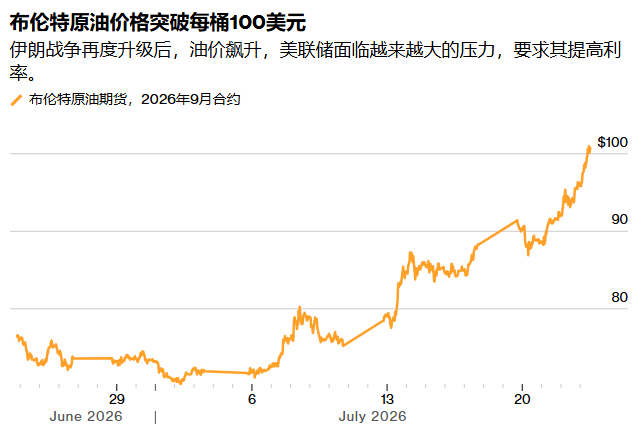
However, it is only data that is cooling down, not trends. After the fragile cease-fire agreement between the US and Iran broke down, the situation in the Middle East escalated again. On July 24, Brent crude oil surpassed $100 per barrel in the intraday period, with a cumulative increase of 25% since the June Federal Reserve meeting. The rise in oil prices quickly spread to gasoline and diesel prices, putting pressure on both consumers and US industry costs. Meanwhile, the Trump administration announced new tariffs of 10% to 12.5% on 60 countries on July 24 as an alternative to the Supreme Court's previous rejection of the “Liberation Day” tariffs. Furthermore, investment in AI continues to be strong, driving related demand growth. The combination of three factors reversed the market's judgment on cooling inflation.
PGIM's chief US economist Robert Sockin described this week's conference as “almost five or five.” Neil Dutta, chief economist at Pantheon Macroeconomics, put it bluntly that the July rate hike would allow the Federal Reserve to gain “future flexibility” and avoid being forced into a corner in September. “You have to look for opportunities in consensus, and I think this might be the time,” Dutta wrote in the July 22 report.
Federal Reserve's internal divisions: hawkish power has accumulated to critical mass
The fundamental reason why this meeting is so difficult to predict is that differences within the Federal Reserve are rapidly widening.
Since taking office in May, Federal Reserve Chairman Kevin Walsh has completely abandoned the forward-looking guidance approach that his predecessor Powell used for a long time. He made it clear that every future policy meeting will change “in real time”, and investors should not rely on the central bank's path hints. When testifying in Congress earlier this month, Walsh vowed “zero tolerance” for continued high inflation, but gave few clues about the policy path.
“There is no forward-looking guidance, which means we will frequently see probability distributions of 20%, 30%, and 40%,” said Jim Bianco, president of Bianco Research. According to CME Group data, the trading volume of federal funds futures before this meeting was 50% higher than at the time of the July 2025 resolution. This unusually active trading “stems from increasing discussions in the market about whether the probability of interest rate hikes is accurate, and behind it is Walsh's high level of vigilance about inflation.”
Walsh has expressed hope for a full “family dispute” within the Federal Reserve. Now, the debate is heating up.
The hawkish camp is rallying. Dallas Federal Reserve Chairman Lori Logan called for a slight rate hike earlier this month on the grounds that she believes inflation cannot continue to return to the Fed's 2% target. Cleveland Federal Reserve Chairman Beth Hammark also expressed similar views, saying that the responsibilities of the Federal Reserve “do not conflict” and that inflation is currently more worrying than employment. Both have the right to vote on this week's interest rate resolution, and if officials choose to keep interest rates unchanged, they are likely to vote against it. Minneapolis Federal Reserve Chairman Neil Kashkari is also likely to join the opposition. Citi expects that if there are more than two negative votes, it will be interpreted by the market as a stronger hawkish signal. The agency predicts that there will be at least two negative votes this week.
However, the hawks have yet to gain the upper hand, and the dovish camp has a different opinion. Citibank economist Veronica Clark said that given the moderate inflation data for June, officials may prefer to keep interest rates unchanged. Influential voices such as New York Federal Reserve Chairman John Williams tend to wait until September to make a decision. According to the French Foreign Trade Bank report, recent weak employment and inflation data has secured valuable policy space for the Federal Reserve. It is expected that the Federal Reserve will keep interest rates unchanged this week and throughout 2026.
William Inglich, an economist at Yale University and a former senior Federal Reserve official, admits: “There are reasons to support interest rate hikes and keep interest rates unchanged.”
The game between politics and credibility: raise interest rates now or wait until September?
Behind this policy debate, complex considerations of politics and credibility are also hidden. Joseph Lavorgna, a former Trump administration treasury official and current US chief economist at SMBC Nikko Securities, pointed out that this month's interest rate hike may be less expensive than the political cost of raising interest rates closer to the November midterm elections. If interest rate hikes are postponed until September or even October for the first time, “What would that look like? Why don't you act now.”
Walsh may have described interest rate hikes as a move to curb inflation expectations and thereby lower long-term interest rates to appease the president. Lavorgna pointed out that Walsh could explain to Trump that raising interest rates now will help curb inflation expectations and lower long-term market interest rates — a “win-win”.
The test facing Walsh is that he vowed in Congress to use central bank tools to stabilize prices, but he has been slow to reveal the specific usage plan. As BlackRock previously pointed out, Walsh “recognises that credit remains the central bank's most powerful policy tool” — but “ultimately these words need to be supported by action.” This time, the market is waiting for him to respond with action.
Financial institutions' “double-sided bet”: the market has stopped forecasting and is preparing for two outcomes
Policy uncertainty is triggering a rare “double-sided bet” in the financial system. Pradeep Bhatia, CEO of Derivative Path Inc., said, “About one-third of the banks we work with are preparing for further interest rate hikes, while the rest are hedging the risk of interest rate cuts. This fragmentation shows that the market is no longer trying to predict the Fed's actions, but is beginning to prepare for both outcomes.”
Asset prices already reflect this nervousness. The 10-year US Treasury yield once surpassed 4.71%, the highest since January 2025; the yield on 30-year Treasury bonds hovered around 5.18%, the highest in nearly 20 years. According to CME data, the probability that the Federal Reserve will keep interest rates unchanged in July is 63.7%, and the probability of raising interest rates by 25 basis points is 36.3%. For the September meeting, market expectations were even more hawkish. Market expectations for the September rate hike are even stronger — the probability of a September rate hike has risen to about 80%.
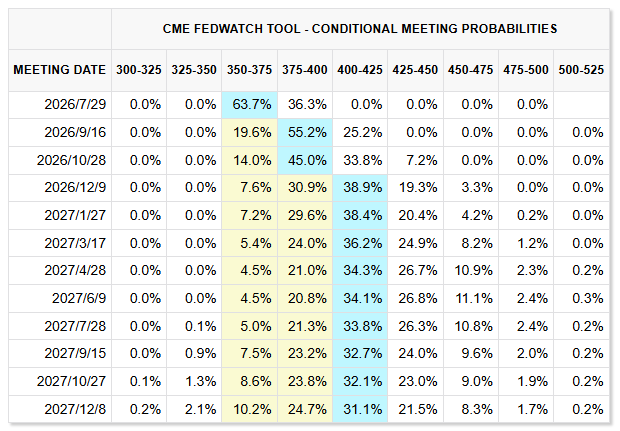
However, according to a survey of 76 economists, all respondents expected the Federal Reserve to keep the benchmark interest rate unchanged in the 3.5% to 3.75% range at the July 28-29 meeting. Most of the 104 economists think there will be no rate hikes this week. This rare divergence between economists and market pricing is itself the best footnote to policy uncertainty. Goldman Sachs pointed out that the risk of escalating the situation in the Middle East continues to dominate market sentiment.