
You can bet on popular stocks such as Nvidia and SpaceX without buying stocks! CME restarts single-share futures retail leverage tools and expands again
The Zhitong Finance App learned that investors will soon have another way to bet on the hottest stocks from Nvidia (NVDA.US) to SpaceX (SPCX.US) without directly trading any stocks. The Chicago Mercantile Exchange Group (CME) will launch a single-stock futures product on Monday, allowing investors to hedge or speculate on more than 50 of the largest US companies. These contracts do not require investors to master complex knowledge of options trading, but they can provide leverage and will be settled in cash based on the closing price of the relevant stock.
The world's largest derivatives exchange is betting on two trends — the rise of retail trading and the current limited supply of popular IPOs in the market — that will drive the success of single stock futures. The tool was not widely adopted in the US market after it was first launched 24 years ago, and CME believes this launch may have different results.
“This has the potential to bring a large number of new traders to our ecosystem,” Tim McCourt, CME's global head of equities, forex and alternatives, said in a phone interview. He said the exchange's target customers include retail investors and institutional investors such as asset managers. CME has partnered with more than 35 intermediaries for retail investors to help promote this futures product; it will be a new risk management tool for institutional investors.
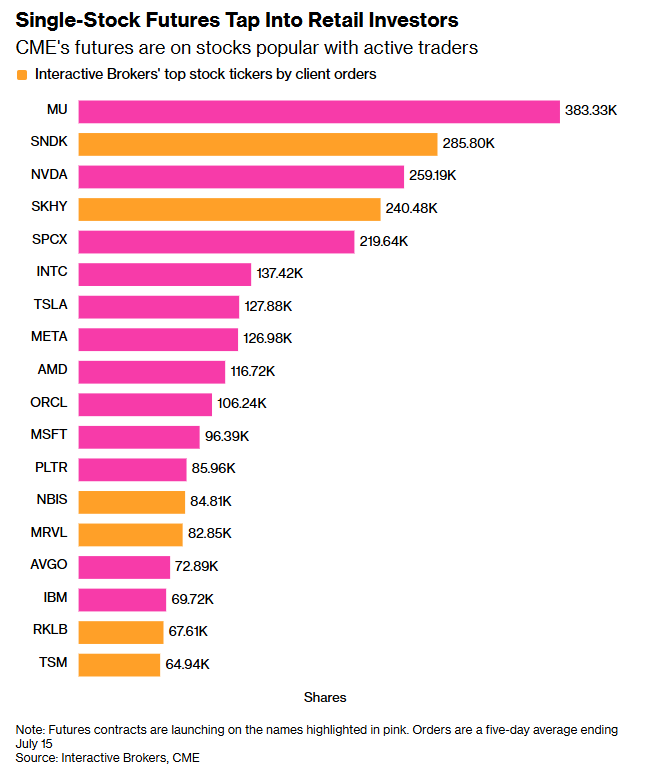
Single stock futures target retail investors
Unlike options, single stock futures can provide leveraged exposure without investors understanding complex concepts such as the “Greek alphabet” (a system of parameters used to quantify financial risk in options trading, including core indicators such as Delta and Gamma) — these variables determine how changes in stock prices, volatility, timing, and interest rates affect derivatives pricing.
One application scenario for single stock futures is to help investors gain long or short exposure to companies whose stocks are undersupplied. Recently, during SpaceX's initial public offering (IPO), there was a limited supply of popular stocks. Investors who fail to obtain popular IPO stock placements may be able to use futures in the future to increase their exposure to related investments with higher capital efficiency.
Futures are simpler than options, which may make them more appealing to retail investors. Martin French, CEO of futures broker NinjaTrader, said retail investors tend to trade financial instruments they understand. “There may be investors who are confused about all these Greek letters and related concepts and think futures are an easier way,” he said. “The extent to which retail investors participate in the market is different now, so there may be many changes in single stock futures this time around.”
This launch comes at a time when CME is facing a sensitive market environment. The war in the Middle East benefited the Brent crude oil trading system under the Intercontinental Exchange Group (ICE), while CME's West Texas Intermediate Crude Oil (WTI) futures business faced competitive pressure. Meanwhile, overseas derivatives trading platforms such as Hyperliquid Strategies Inc. are rapidly growing in trading volume, while Kalshi Inc. and Polymarket are dominating the emerging prediction market sector.
Longer transaction times
CME's single stock futures will offer 23 hours of trading time every day, five days a week, far longer than the stock market's usual 9:30 a.m. to 4:00 p.m. EST trading session. These quarterly futures contracts will be divided into two sizes: the larger contracts will launch 55 varieties, each corresponding to 100 shares, similar to the size of a typical options contract; the other 22 micro futures contracts will correspond to 10 shares. The latter will include the “Big Seven” technology companies, as well as 15 other companies such as Micron (MU.US), Pfizer (PFE.US), and Walmart (WMT.US).
Futures products are very common in global stock indices and commodity markets, but the development process of single stock futures in the US has been very tortuous. This type of contract was banned for almost 20 years. It wasn't until the relevant regulatory agreement was signed in 2000 that the regulators established their supervisory framework and approved the transaction rules in 2002. They were eventually traded later that year, but never attracted enough market interest, and eventually gradually withdrew from the market in 2020.
Shortly thereafter, regulators lowered the minimum capital requirement for investors to trade single stock futures, hoping to re-develop the market. CME must also obtain approval from the US Securities and Exchange Commission (SEC) and the Commodity Futures Trading Commission (CFTC) to launch related products.
CME Chairman and CEO Terry Duffy said on the company's quarterly earnings call on July 22: “When we first launched this type of product, we completely failed. But the world has changed since 2000.”
Single stock futures are booming in markets such as India
Single stock futures have been successful in markets such as India. These products are used to establish leveraged directional positions, hedge stock portfolios, or profit from arbitrage opportunities. Single stock futures are also an important basic tool for arbitrage funds. This type of fund usually buys stock in stock and sells futures contracts at the same time to capture the price premium between the two.
In Europe, financial institutions use single stock futures to improve balance sheet efficiency, particularly during quarter-end and year-end regulatory reporting periods. Jeremy Cohen, global head of derivatives broker Stellar Securities, said such products are also being used to manage long positions, hedge the risk of short positions, and manage net dividend risk.
However, like any financial instrument, newly launched contracts are risky. Matt Cashman, head of investor education at the American Options Clearing Corporation (OCC), pointed out that when trading outside of normal trading hours — including within a few minutes of the company's announcement of financial statements — market trends may be very unstable.
Also, there is the issue of commissions. Unlike stock or options trading, many platforms for retail investors generally do not charge transaction fees, but instead earn revenue by selling order streams to market makers; however, in the futures market, retail traders usually pay commissions.
Stewart Kaiser, head of US stock trading strategy at Citigroup, believes that the key to ultimately determining the success of this product may depend on the agency that promotes the transaction. “Retail investors are used to getting leverage through call options or leveraged ETFs,” he said. “If futures were to enter this field, it would probably be necessary to rely on discount brokers to promote this product and allow customers to trade.”