
Why You Might Be Interested In Silver Life Co., Ltd. (TSE:9262) For Its Upcoming Dividend
Readers hoping to buy Silver Life Co., Ltd. (TSE:9262) for its dividend will need to make their move shortly, as the stock is about to trade ex-dividend. The ex-dividend date is usually set to be two business days before the record date, which is the cut-off date on which you must be present on the company's books as a shareholder in order to receive the dividend. The ex-dividend date is an important date to be aware of as any purchase of the stock made on or after this date might mean a late settlement that doesn't show on the record date. Accordingly, Silver Life investors that purchase the stock on or after the 30th of July will not receive the dividend, which will be paid on the 29th of October.
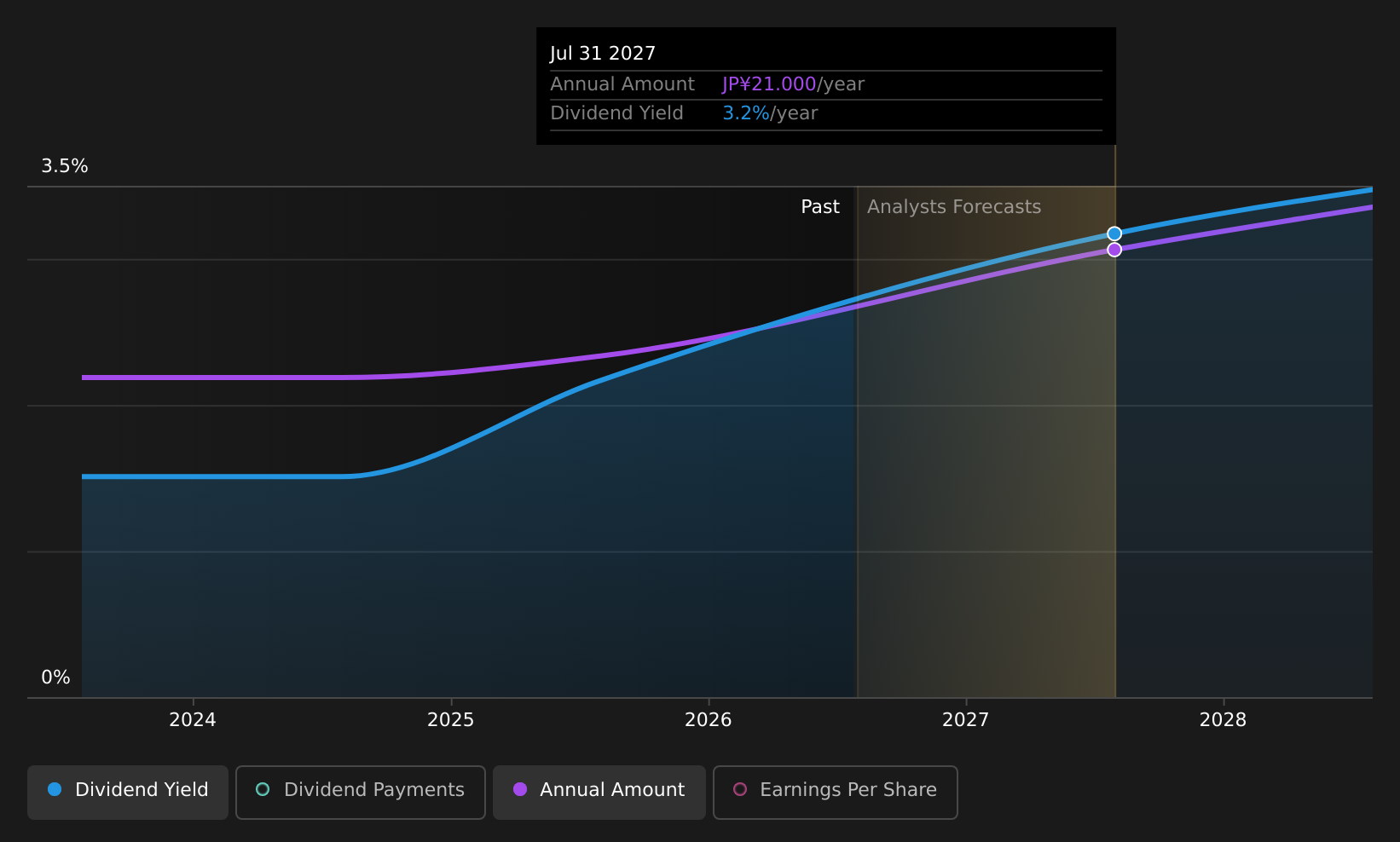
The company's next dividend payment will be JP¥18.00 per share, and in the last 12 months, the company paid a total of JP¥18.00 per share. Last year's total dividend payments show that Silver Life has a trailing yield of 2.7% on the current share price of JP¥662.00. We love seeing companies pay a dividend, but it's also important to be sure that laying the golden eggs isn't going to kill our golden goose! So we need to check whether the dividend payments are covered, and if earnings are growing.
Dividends are usually paid out of company profits, so if a company pays out more than it earned then its dividend is usually at greater risk of being cut. Silver Life is paying out just 22% of its profit after tax, which is comfortably low and leaves plenty of breathing room in the case of adverse events. Yet cash flows are even more important than profits for assessing a dividend, so we need to see if the company generated enough cash to pay its distribution. The good news is it paid out just 22% of its free cash flow in the last year.
It's encouraging to see that the dividend is covered by both profit and cash flow. This generally suggests the dividend is sustainable, as long as earnings don't drop precipitously.
View our latest analysis for Silver Life
Click here to see how much of its profit Silver Life paid out over the last 12 months.
Have Earnings And Dividends Been Growing?
Companies with consistently growing earnings per share generally make the best dividend stocks, as they usually find it easier to grow dividends per share. If earnings fall far enough, the company could be forced to cut its dividend. With that in mind, we're encouraged by the steady growth at Silver Life, with earnings per share up 2.5% on average over the last five years. Growth has been anaemic. Yet with more than 75% of its earnings being kept in the business, there is ample room to reinvest in growth or lift the payout ratio - either of which could increase the dividend.
The main way most investors will assess a company's dividend prospects is by checking the historical rate of dividend growth. Since the start of our data, four years ago, Silver Life has lifted its dividend by approximately 4.7% a year on average. We're glad to see dividends rising alongside earnings over a number of years, which may be a sign the company intends to share the growth with shareholders.
Final Takeaway
Is Silver Life worth buying for its dividend? Earnings per share have been growing moderately, and Silver Life is paying out less than half its earnings and cash flow as dividends, which is an attractive combination as it suggests the company is investing in growth. It might be nice to see earnings growing faster, but Silver Life is being conservative with its dividend payouts and could still perform reasonably over the long run. Overall we think this is an attractive combination and worthy of further research.
In light of that, while Silver Life has an appealing dividend, it's worth knowing the risks involved with this stock. For example - Silver Life has 1 warning sign we think you should be aware of.
A common investing mistake is buying the first interesting stock you see. Here you can find a full list of high-yield dividend stocks.
Have feedback on this article? Concerned about the content? Get in touch with us directly. Alternatively, email editorial-team (at) simplywallst.com.
This article by Simply Wall St is general in nature. We provide commentary based on historical data and analyst forecasts only using an unbiased methodology and our articles are not intended to be financial advice. It does not constitute a recommendation to buy or sell any stock, and does not take account of your objectives, or your financial situation. We aim to bring you long-term focused analysis driven by fundamental data. Note that our analysis may not factor in the latest price-sensitive company announcements or qualitative material. Simply Wall St has no position in any stocks mentioned.