
From a tenfold increase to a depletion of transactions, disassembling Songjing Technology (01079) “downwards” the chess game
In the Hong Kong stock market in July 2026, Songjing Technology (01079) was staging an astonishing capital drama series.
Judging from market trends, the stock price has dropped from a 52-week high of HK$0.750 to around HK$0.200 today, and the market value has evaporated by more than 70%. What's even more bizarre is the volume — from 8.228,500 shares on the day Songjing Technology announced on July 17, it plummeted to 894,000 shares on July 24, with a turnover of less than HK$190,000.
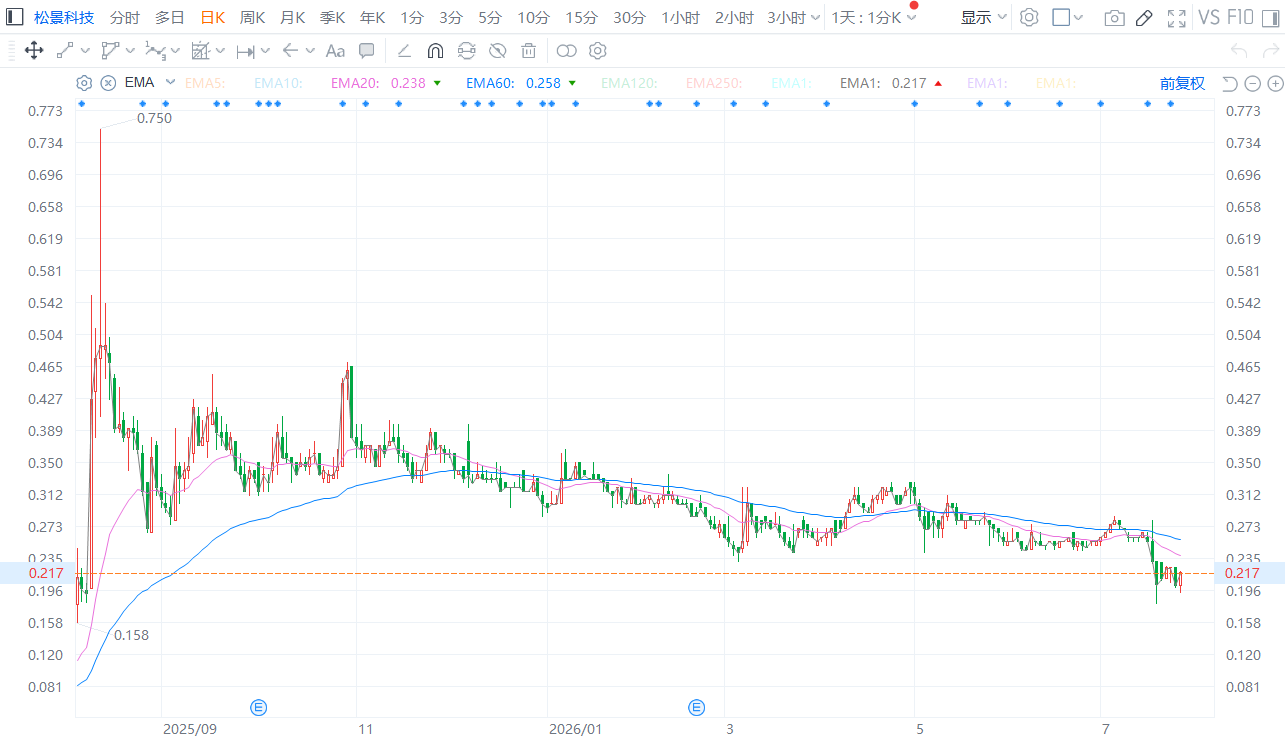
(Market source: Futu)
Stock prices are falling, volume is shrinking, fundamentals are poor, and stocks still need to be supplied. Songjing Technology knocked down this combo, and retail investors fled in panic, but is there another game of chess behind this?
Fundamental review: losses are the norm, there is no inflection point in operation, only shell value support remains
According to reports, Songjing Technology is a typical electronic component distribution shell stock in Hong Kong stocks. Its main business is divided into two major segments: the distribution of its own video card hardware and third-party computer accessories. The plastics trade business has long been shut down. More than 90% of its revenue depends on homogenized electronic distribution trade, and the fundamentals have been structurally stiff for a long time.
Specifically, on the one hand, the profit side continues to lose blood, and gross margin is on the verge of profit and loss line.
According to financial data, the company's revenue for the 2025 fiscal year (12 months ended June 30, 2025) was HK$303 million, and a net loss due to mother was HK$17.128 million, which changed from a slight profit in the previous year to a substantial loss. In the mid-fiscal year 2026 (the six months ended 31 December 2025), the company's current revenue was HK$121 million, net loss to mother was 7.963 million, gross profit was only HK$1.306 million, and gross margin was as low as 1.08%.
Regarding the reason for the loss, the company explained that it was mainly “fierce market competition, and sales volume of computer parts and consumer electronics products from other manufacturers and trade in plastic raw materials decreased”. In recent years, along with the heated competition in the PC hardware and storage component distribution industry, upstream supply and downstream customers have extremely strong bargaining power, and the sales difference has been continuously compressed. Even if the scale of revenue is increased, profits cannot be increased.
As the main business's ability to make its own hematopoiesis has been drastically reduced, the company's operating cash flow also continues to be negative, and daily operations are highly dependent on capital market fund-raising such as placement and stock provision to continue its life. As of fiscal year 2025 and mid-fiscal year 2026, the company's net cash from operating activities was HK$148.91 million and HK$83.286 million, respectively.
On the other hand, although the asset structure is safe, there is no asset appreciation logic.
Looking at the asset structure, in fiscal year 2025 and mid-fiscal year 2026, the company's balance ratio was 6.765% and 6.725%, respectively
The balance ratio of the company does not exceed 7%. At the same time, the company also holds 10 million levels of cash on its books. In the mid-fiscal year 2025 and 2026, the company's cash at the end of the period was HK$6852.2 and HK$16.415 million, respectively. There was no risk of debt default or liquidation. This is also the only margin of safety for this stock.
However, it should be noted that the company's current assets are only used for preparation and daily expenses. There are no heavy assets such as minerals, core technology, or scarce land, and there is almost zero room for asset appreciation. The valuation anchor is not the operating value of the enterprise, but the value of the Hong Kong stock market.
In addition to this, Songjing Technology's shares are highly concentrated, and the actual controller has absolute control over the conversation. In August 2025, natural person Yu Wei acquired 53.89% of the shares at HK$0.068 and became the absolute controlling shareholder, triggering a comprehensive tender offer to complete the actual control change. Under a highly concentrated equity structure, there are very few chips in circulation in the secondary market. This also means that the company's stock price can be easily manipulated. It can not only boost stock price speculation in the short term, but also complete phased trading with very little capital.
In summary, from a fundamental point of view, Songjing Technology has not experienced any favorable catalysis. There are no business transformation, mergers, acquisitions and restructuring announcements, or profit improvements brought about by rising industry sentiment. Stock prices cannot be driven by performance in the medium to long term. I'm afraid all market fluctuations are led by capital finance technology.
Market perspective: The speculation has come to an end, and countless negative falls have become the norm, and stock supply has become the core anchor point of decline
In fact, in combination with market language, the conjecture that Songjing Technology's market fluctuations are dominated by capital, finance, and technology is not fabricated out of thin air.
Zhitong Finance has observed that with self-control players taking the lead and resuming trading, Songjing Technology has gone through a complete three-stage market evolution of hype, shrinking and silence, and falling into the dark.
Phase 1: In August 2025, Songjing Technology's actual controller took the lead and resumed trading. The short-term stock price soared from HK$0.068 to HK$0.75, an increase of 1003%, and the trading volume continued to expand for many days. This is a standard speculation market after the change in control of Hong Kong stocks. The capital was used to complete a round of high-ranking shipments with “new real controller transformation expectations”.
Phase 2: Hype declined in the second quarter of 2026, and trading volume shrank rapidly. The April high of HK$0.32 opened a downward channel; before the stock offering announcement was issued on July 16, the average daily turnover was less than HK$1 million, and liquidity was significantly depleted.
Phase 3: The decline accelerated after the stock supply was implemented. On July 17, the volume plummeted 9.41% to HK$0.231, with a single-day turnover of HK$8.22 million, then returned to zero volume. The trading volume was less than 500,000 shares on most trading days in late July, and the turnover rate was below 0.05% for a long time. As of July 24, the stock price fell to HK$0.202, and the three-month decline from May to now has been over 32%.
Looking at the market and news, there are two main reasons for Songjing Technology's massive decline. The details are as follows:
First, market capital is expected to offer shares at a discount to dilute equity and withdraw voluntarily. The company's current share offering plan is to allocate 1 new share for every 2 shares, at a share price of HK$0.15, at a discount of 41.18% compared to the announced daily market price of HK$0.255. After the issuance of the new shares, the total share capital expanded by 33%, and the shares of the original shareholders were passively diluted. In a context where retail investors are generally unable to add capital to participate in share supply, the secondary market naturally uses falling stock prices early to reflect dilution shortfalls; second, the circulation market is too scattered, and there is a lack of underwriting capital. There are no institutional positions in this stock, and only a small number of retail holdings remain; the depth of pending orders is extremely shallow, and a small amount of sell-off can drive the stock price down. An insignificant decline is an inevitable result of the end of speculation on petty stocks.
It is worth noting that this wave of market evolution of Songjing Technology can also be described as being highly compatible with the classic “downturn” financial logic of Hong Kong penny stocks.
In other words, the actual controller of the company held more than 53% of the shares, completed some of the high level hype in the early stages, and now they seek to increase their holdings at a low cost by offering shares at discounted prices. By continuing to suppress stock prices in the secondary market, the market price is approaching HK$0.15, greatly weakening retail investors' willingness to subscribe. Most abandoned shares will be taken over by actual controllers, which not only reduces their own holding costs and further consolidates their controlling interests, but also makes the motivation for deliberate price pressure sufficiently realistic and reasonable.
So, after the end of this stock offering, will Songjing Technology usher in a rebound in the market?
According to the fixed script of the Hong Kong stock fine price capital operation (first suppressing the stock price, then initiating a share offering, then experiencing a brief rebound, then merging shares, and finally starting a new round of share supply), it is likely that there will be a wave of phased rebound after the end of Songjing Technology's stock offering. However, historical data shows that the rebound of similar penny stocks after being offered was mostly a weak recovery after an overrun decline. The magnitude was limited, making it difficult to reproduce the previous sharp rise.
epilogue
Overall, Songjing Technology's stock price has plummeted in this round. There are both objective factors of poor stock supply dilution and weak fundamentals, as well as subjective motivations for actual controllers to use market advantages to deliberately reduce prices and complete stock supply increases at low cost. The conjecture of “a short-term rebound after bottoming out” has reasonable logic, but the level of rebound cannot be overestimated.
For investors in the secondary market, the stock is essentially a shell game dominated by capital finance. There is no basis for value investment. The technical rebound is only driven by short-term events, and the medium- to long-term stock price trend is always determined by the actual controller's subsequent capital operation.