
Is the Federal Reserve's hawkish turn undervalued? Castle Securities bucked the trend and bet on an unexpected interest rate hike this week to strengthen its anti-inflation reputation and break the “shackles” of forward-looking guidance
The Zhitong Finance App learned that the Federal Reserve will hold an interest rate meeting from July 28 to 29 local time (that is, this Tuesday and Wednesday), and will announce interest rate decisions on Wednesday. The market generally expects the Federal Reserve to keep the benchmark interest rate unchanged. According to the CME “FedWatch (FedWatch)” tool, the probability that the Fed will keep interest rates unchanged in July is 63.7%, and the probability of raising interest rates by 25 basis points is 36.3%.
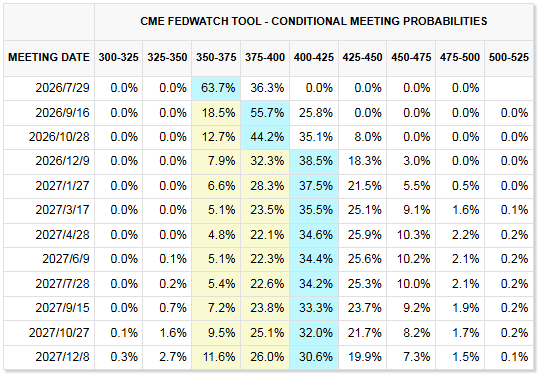
Castle Securities, however, anticipates that the Federal Reserve will raise interest rates this week — an unexpected move that will strengthen Federal Reserve Chairman Kevin Walsh's credibility in dealing with inflation. Frank Flite, head of macro strategy at the company, said in a report that the 25 basis point rate hike on Wednesday will reinforce Walsh's repeated commitment to restore price stability, while also showing that policymakers no longer rely on clearly signaling every policy action to the market in advance.
Flite said, “The market may have once again underestimated the extent to which the Fed's policy stance has turned hawkish,” and that this week's rate hike “will clearly end the era of forward-looking guidance,” while further highlighting the independence of the Federal Reserve.
As the Federal Reserve is about to hold an interest rate meeting, the market still has major differences over whether the Fed will raise interest rates this month. Judging from market expectations before the Federal Reserve's decision in recent years, it is not common for there to still be such a high level of uncertainty when a policy meeting is so close. Since becoming the chairman of the Federal Reserve in May of this year, Walsh has stated many times that he hopes to abolish the Federal Reserve's long-standing practice of hinting at interest rate paths in advance through forward-looking guidelines. He believes that in the context of rapid changes in the economic environment, early release of policy signals may limit the flexibility of decision makers.
Although it is still uncertain whether to raise interest rates this week, traders have now fully taken into account the expectation that the Federal Reserve will raise interest rates in September. However, according to Fright, taking action this week will have a greater impact than waiting until September to raise interest rates, because it will change the market's expectations about how the Fed will deal with inflation.
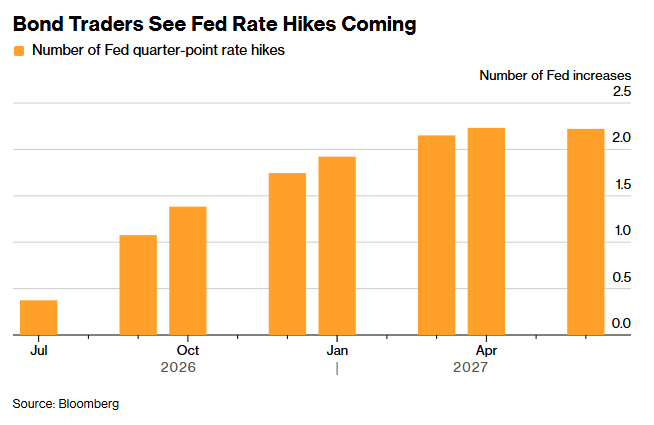
Fright said that in addition to strengthening the Federal Reserve's credibility in fighting inflation, an unexpected interest rate hike will also affect companies' pricing decisions and workers' wage requirements, thus playing a role before inflation solidifies further, and may reduce the amount of austerity needed in the future.
Although recent weak employment data and inflation data once lowered market expectations for a rate hike in July, Flite believes that these data should not exceed the impact of broader evidence — that is, the risk of inflation is still high and the labor market remains stable.
Meanwhile, the geopolitical situation in the Middle East remains highly unstable. International oil prices fell on Monday as the US suspended its daily crackdown against Iran. However, despite the recent easing of tension, oil prices have risen by about 20% since this month because the Iran-backed Houthis threatened to transport Saudi oil exported through the Red Sea. Fright added that the rise in energy prices in recent weeks may be a key factor driving the Federal Reserve's interest rate hike.