
The self-defense circuit ushered in an explosion, and China Antibody-B (03681) anchored growth opportunities with differentiated advantages
Standing at the crossroads of innovation, the global autoimmune disease drug market is in a critical cycle of pattern restructuring and value realization. On the one hand, the scale of BD transactions in the global self-defense sector continues to break through in 2025. On the other hand, the supply of innovation pipelines for multinational pharmaceutical companies is insufficient and patent cliff pressure continues to increase, and overseas pharmaceutical companies seeking high-quality innovative assets have become a definite trend.
In this context, China's BioTech, which has FIC and BIC attributes, has transformed into a core source of global innovation supply. Among the targets for multinational pharmaceutical companies to introduce self-exempt pipelines in 2025, China's share of innovative assets continues to rise. As a result, the self-defense circuit has become the most promising BD circuit in the biomedical field.
The Zhitong Finance App observed that such changes in the industry have provided a key opportunity for China's Antibody-B (03681), an innovative pharmaceutical company that has been deeply involved in the self-defense circuit for many years. Judging from the company's series of actions over the past year, its strategic focus and pipeline promotion have shown a clear sense of card space and clear potential for growth.
The free circuit ushered in an explosion of value, and early SM17 data showed great potential
In recent years, the global innovative drug market has gradually picked up after cyclical adjustments, and BD trading activity has continued to rise. What is particularly noteworthy is that the field of immunity is becoming the most explosive supertrack after tumors. Currently, the global self-defense market has long been dominated by three companies, Sanofi, AbbVie, and Johnson & Johnson, but traditional blockbuster products are facing patent expiration and biosimilar shocks one after another, and the competitive logic of the industry is shifting from stock single product sales to source target innovation.
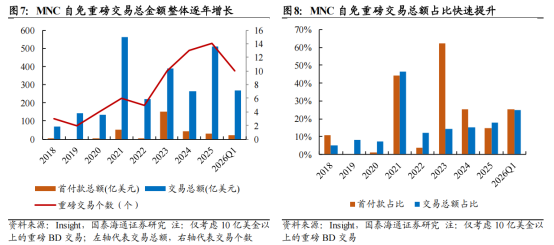
Catalyzed by industry trends, leading multinational companies are confirming the long-term value of segmented racetracks with continued heavy financial layout. In late June, AbbVie announced the acquisition of clinical-stage biotechnology company Apogee Therapeutics for US$10.9 billion in cash at a price of US$135.11 per share, a premium of nearly 60% over the closing price before the news. This is AbbVie's biggest merger and acquisition in the five years since it acquired Erjian for 63 billion dollars in 2019. It is also the most expensive merger and acquisition in the global innovative drug sector in the first half of 2026.
According to public information, Zumilokibart, the number one core asset acquired this time, is a subcutaneously injectable long-term IL-13 monoclonal antibody modified by an FC-phase Yte amino acid mutation, which is expected to be used to treat atopic dermatitis (AD). It has a half-life of 77 days in the body, and can achieve a long-term maintenance dosing regimen every 3 months for a maximum of 6 months.
From the perspective of market demand, the number of patients with atopic dermatitis is large, unmet demand is huge, and there is plenty of room for growth on the segmented circuit. According to Frost & Sullivan data, there are about 600 to 700 million patients worldwide and 67 million domestic patients. It is estimated that the number of AD patients will further increase to 755 million in 2030. Existing clinical drugs either have slow effects in relieving itching, do not completely remove skin damage, or have shortcomings in safety. Therefore, products that can simultaneously relieve itching quickly, repair skin damage, and have good drug safety will have a significant competitive advantage.
Who Will Become the Self-Defense Medicine King in the Post-Dupixent Era? The OX40/OX40L was previously a very promising direction.
However, on January 30, 2026, Amgen terminated the development and commercialization cooperation with Kyowa Kirin around Ox40 monoclonal antibody RocatinLimab based on “product portfolio strategic priorities”, and the withdrawal of global rights was independently promoted by Kyowa Kirin; it is widely believed in the industry that RocatinLimab did not show an advantage in cross-trial comparison with Dupixent, and that the commercialization prospects were only “moderate”, which was the core motivator for Amgen to leave the market. On July 24, Sanofi also announced the termination of clinical development of the Ox40L monoclonal antibody amLiteLimab in moderate to severe atopic dermatitis (AD), on the grounds that “evidence of overall efficacy and safety has been formed up to now, and does not support further development”, and clearly determined that the drug cannot bring meaningful clinical improvements to the existing standard treatment for AD — it is worth noting that all three phase III clinical trials of amlitelimab have reached the main endpoints under the US review scale. Long-term extension of ESTURARY also showed no recurrence due to lack of “clinical differentiation advantages” “Having voluntarily abandoned the child, the cumulative signal of two cases of Kaposi sarcoma worsened the situation.
The two major multinational pharmaceutical companies have successively broken down the OX40/OX40L “upstream T-cell regulation” path, which just highlights the difficulty of developing a self-defense drug that is both effective in relieving itching, strong skin damage repair, and good drug safety.
As the world's first humanized monoclonal antibody targeting IL-17RB receptors, SM17 forms a fundamental difference from mainstream self-immune drugs at the target mechanism level. Most mainstream products on the market act on downstream inflammatory factors such as IL-4/IL-13 and IL-17A/F, while IL-25 is an alerone at the top of the type II inflammatory pathway. By blocking its receptors, SM17 can simultaneously inhibit Th2, Th17, and skin tissue secretion core pathways. It blocks the inflammatory cascade response at the source and has core advantages in terms of efficacy rate and dosage.
Clinical data further confirm the differentiated efficacy of the product. In the field of atopic dermatitis, SM17's completed phase 1b proof-of-concept clinical trial achieved breakthrough results: among patients treated with high-dose SM17 (600 mg), more than 90% achieved NRS-4 response, more than 70% achieved EASI75 response, and more than 40% achieved IGA 0/1 response. Furthermore, there were no serious adverse events throughout the test period, which showed the good safety of the SM17. These data suggest that SM17 has the potential to become the best-in-class treatment with excellent efficacy and good safety in the AD field.
In terms of clinical progress, the SM17 atopic dermatitis indication phase II clinical trial completed the first patient administration in April 2026. Currently, clinical progress is progressing smoothly. Enrollment is expected to be completed in the second half of 2026, and key top-line data will be read out in the first half of 2027. It is worth noting that this phase II trial plan has been approved by the FDA, and in the future, international multi-center phase III clinical trials can be carried out directly based on this. In addition, the company is also simultaneously promoting small phase II clinical trials for white Australian and New Zealand subjects. Chinese data+overseas data will greatly enhance the BD value of the SM17 pipeline.
However, the value of SM17 goes far beyond atopic dermatitis, and its upstream target mechanism gives it the ability to expand indications far beyond conventional single-channel drugs. In the first quarter of 2026, IND for inflammatory bowel disease was approved by the NMPA. The disease field includes indications such as Crohn's disease and ulcerative colitis, marking the expansion of SM17's core indications from skin diseases to the field of digestive tract self-protection with huge unmet needs, significantly broadening the market imagination space for SM17. Currently, Chinese antibodies are preparing domestic+overseas clinical research on IBD.
If SM17's phase II data can continue the bright performance of phase 1b and add to the simultaneous progress of IBD clinical trials, it can be expected that the drug will greatly increase its appeal for cooperation among multinational pharmaceutical companies.
The R&D pipeline has blossomed more, consolidating the long-term development platform
Looking at the R&D pipeline, Chinese antibodies have built a pipeline that includes a variety of early drug candidates with global pioneering or best-in-class potential. In addition to SM17, Chinese antibodies also have a differentiated layout in fields such as skin immunity and osteoporosis.
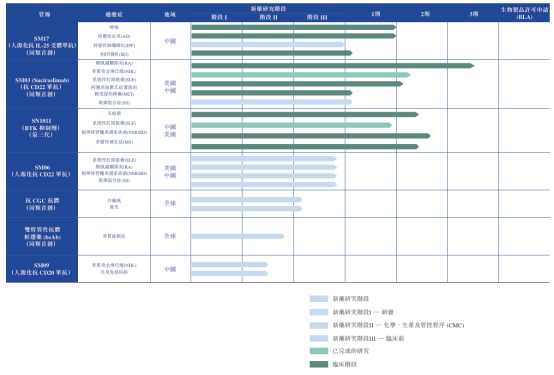
Source: China Antibody Report 2025
Recently, the immunotherapy circuit for vitiligo and alopecia areata has ushered in three landmark events, providing a strong reference for the “anti-CGC antibody”, a more upstream immunomodulatory mechanism: Teva released its IL-15 monoclonal antibody TEV-408 phase 1b vitiligo data on July 7, 2026. F-VASI 50 reached 42%, F-VASI 75 reached 21%, and was injected subcutaneously every quarter. With positive data, it will advance phase 2b in 2026Q4 and receive funding of up to $500 million from Royalty Pharma — this means The clinical value of the IL-15 pathway in vitiligo has been double verified by capital and data. Immediately after July 27, ArgenX announced the acquisition of Forte Biosciences for about $22. The core asset FB102 was the first anti-CD122 (IL-2Rβ/IL-15Rβ) antibody. Its vitiligo phase 1b data showed that F-VASI50 in the severe subgroup reached 58.8% — the market is willing to pay a high premium for the “IL-15 pathway targeting T cells/NK cells.” At the same time, Q32BIO's anti-IL-7Rα monoclonal antibody bempikibart achieved an average SALT improvement of 35.3% in stage 2a of alopecia areata, 40% of patients achieved SALT-20, and no adverse events above grade 3, once again confirming the logic that “regulating adaptive immunity (IL-7/TSLP) can balance efficacy and safety”.
Together, these three things point to a trend: the treatment paradigm for skin diseases is shifting from broad-spectrum suppression of JAK to precise biologics targeting the gammac family cytokine pathway (IL-2/IL-7/IL-15, etc.). However, hC2 (anti-common gammac-chain antibody) independently developed by Chinese antibodies is at the top of this paradigm - gammac is a common subunit of various key cytokine receptors such as IL-2, IL-4, IL-7, IL-9, IL-15, and IL-21. By selectively blocking gammaC-dependent cytokine signals, hC2 can simultaneously regulate multiple immune disease pathways described above, rather than targeting only a single node like TEV-408, FB102, and bempikibart. This “one arrow, multiple arrows” mechanism shows potential for differentiation in both vitiligo and alopecia areata: humanized animal model data presented at the SID annual meeting in May 2026 showed that hC2 significantly reduced hair loss (p<0.001) in alopecia areata models, significantly reduced skin depigmentation (p<0.05) in vitiligo models, and decreased skin infiltration with adjuvant/cytotoxic T cells (p<0.01); preliminary toxicology studies in non-human primates also showed good tolerability. Pre-clinical results related to alopecia areata were published in the top dermatology journal JID in June 2026, and the company plans to accelerate clinical research in humans next.
In the field of osteoporosis, the bispecific antibody (targeting RANKL/osteosclerosis protein SOST) independently developed by Chinese antibodies is currently undergoing CMC optimization and showing differentiated biomarker changes in monkeys. In terms of market potential, the number of patients with osteoporosis worldwide exceeds 200 million, and the drug market is expected to grow to 14.8 billion US dollars by 2034.
Up to now, the development progress of anti-CGC antibodies and anti-osteoporosis antibodies has also been closely followed up by the market. As the rich R&D pipeline enters a critical stage in 2027, the company is expected to accelerate major BD cooperation and provide a driving force for continuous innovation for the company's long-term development.
Strategic Reshaping: Go to battle lightly, focus on global innovation
In the past year, in addition to core product development, the most iconic change in Chinese antibodies was the active adjustment of development strategies. In the second half of 2025, the company clearly switched from a traditional full-industry chain model to an asset-light Biotech route, and re-anchored resources in the development, external licensing, and global cooperation of first-in-class and best-in-class early pipelines.
In the first quarter of 2026, Liang Fang, who has more than 20 years of experience in drug development and investment, joined the company as chief operating officer and was promoted to executive director in July. At the same time, the size of the BD team and clinical team continued to expand. The company's R&D pipeline strategy focuses more on prioritizing efficiency — prioritizing screening optimal indications and concentrating resources to promote core varieties. This kind of “subtraction” focus is often more strategic value for an innovative pharmaceutical company that has multiple innovation pipelines at the same time.
In July 2026, the company announced the sale of a complete set of properties and production facilities in the Suzhou Industrial Park for RMB 280 million. From a strategic perspective, this is a key step for Chinese antibody management to promote operational efficiency and focus on R&D and BD. At a time when the CDMO industry chain is highly mature, self-built production capacity is not an optimal solution for clinical-stage Biotech. Monetizing fixed assets to feed back clinical progress in the core pipeline in exchange for higher financial flexibility and flexibility is a rational choice in line with the current industry environment.
Taken together, Chinese antibodies are at a critical stage in the transition from early-stage biotech to an innovative platform with global BD competitiveness. Its core pipeline's differentiation mechanism and excellent clinical data from the source already have clear global competitiveness, and strategic focus on trade-offs and resource optimization have also freed up more financial and operational space for subsequent development.
Predictably, in an industry environment where the self-exemption circuit continues to flourish and overseas pharmaceutical companies increase their introduction of innovative assets from China, Chinese antibodies rely on scarce FIC and BIC pipelines, clear asset-light development routes and senior management teams to continue to seize global BD cooperation opportunities. Its innovative value is expected to continue to be unleashed, and it is worth investors' close attention.