
Basic Semiconductors (09971) Shenzhen packaging production line base ushered in significant progress betting on the automotive and AI computing power double incremental market
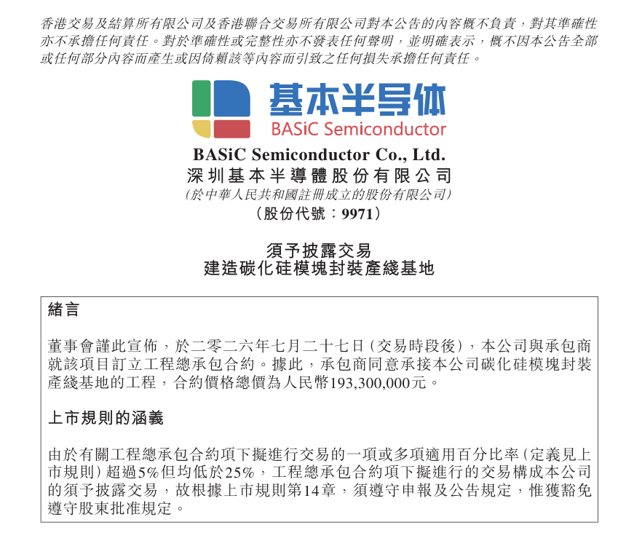
The Zhitong Finance App learned that on July 28, 2026, Shenzhen Basic Semiconductor Co., Ltd. (09971) issued an announcement stating that the company signed a general contracting contract for the silicon carbide module packaging production base project with China Construction Second Engineering Bureau Co., Ltd., marking that this “China's first silicon carbide chip share” company, which has just been listed on the main board of the Hong Kong Stock Exchange, is rapidly taking a key step in capacity expansion with capital assistance.
According to the announcement, the project is located in Pingshan District, Shenzhen. The total contract price for the project is RMB 193,300,000 (tax included), and the total construction area is 593,575,400 square meters. According to reports, this project was registered as a construction project by the Shenzhen Development and Reform Commission in April of this year. The board of directors of basic semiconductors believes that the conclusion of a general contract for project engineering will help achieve the company's future operation strategy and support the company to meet the growing demand in downstream markets such as new energy vehicles, intelligent computing centers, and photovoltaic energy storage.
The silicon carbide industry is booming, and when listed, production will expand to seize the AI high-growth market
It is worth noting that basic semiconductors are now speeding up production capacity construction after listing, which coincides with a profound cyclical reversal and a boom in price increases in the silicon carbide industry.
On the silicon carbide supply side, small to medium production capacity continues to clear. The capacity utilization rate of leading substrate manufacturers has generally exceeded 90%, and the supply of some high-end products is tight. On the demand side, AI data centers are becoming a strong growth pole for the silicon carbide industry. According to QYResearch, the global silicon carbide AI server power supply market is expected to reach US$9.249 billion in 2032, with a compound annual growth rate of 22.0% during the 2026-2032 period. Industry analysts pointed out that the current growth rate of demand for silicon carbide on AI tracks has surpassed that of new energy vehicles, and silicon carbide is moving from “automobile-specific” to “global penetration.”
Driven by scarce supply and demand, international leaders such as Infineon and ST Semiconductors took the lead in initiating price adjustments. Domestic substrate and device manufacturers followed suit, and the entire industry entered an upward cycle of price increases. Recently, Basic Semiconductor issued a voluntary announcement announcing that prices for some products will be adjusted starting from the third quarter of 2026, with a maximum increase of no more than 25%. The launch of basic semiconductors immediately initiated plans to expand production. This pace not only reflects its accurate investigation and judgment of industry trends, but also shows its forward-looking nature in terms of production capacity layout.
Changxin Technology's listing sparked a capital feast, and “Tsinghua” hard technology companies ushered in a new picture of expansion
Recently, leading domestic technology companies have been heavily capitalized, and many leading companies with “Tsinghua DNA”, such as Changxin Technology and Zhongji Xuchuang, have successively ushered in key points, reflecting the overall boom in the industry and the continued optimism of the capital market.
Changxin Technology landed on the Science and Technology Innovation Board of the Shanghai Stock Exchange on July 27. It surged 465.82% on the first day of listing, with a total market capitalization exceeding 3.28 trillion yuan, ranking first among A-shares. The company expects net profit to reach 50 billion yuan to 57 billion yuan in the first half of 2026, an increase of more than 22 times over the previous year, making it the number one memory chip manufacturer in China and the fourth largest in the world. Optical module leader Zhongji Xuchuang followed suit. It is expected to land on the Hong Kong Stock Exchange on July 30 to raise HK$54.5 billion, making it the largest IPO in Hong Kong in seven years. The company is one of the first companies in the world to achieve large-scale mass production of silicon optical modules, and is the world's largest supplier of silicon optical modules in 2025 in terms of revenue.
It is worth noting that the core founding teams of these companies all graduated from Tsinghua University and have rich overseas study and research experience. They are “Tsinghua” startups like basic semiconductors. Compared to Changxin Technology and Zhongji Xuchuang, which have already reached maturity, basic semiconductors are still in a stage of rapid growth, but similar Tsinghua heritage and entrepreneurial genes have provided them with a reference for the development path of leading companies on the third-generation semiconductor circuit.
Against the backdrop of continued growth in downstream market demand, the basic semiconductor production capacity card strategy is expected to seize opportunities in the automotive and AI computing power dual incremental markets where the penetration rate of silicon carbide continues to increase.