
General Motors (GM) Stock May Be 37% Undervalued Following Raised 2026 Guidance
General Motors stock has delivered a 133.9% return over the past three years, yet the valuation picture remains split, with the Discounted Cash Flow (DCF) intrinsic value pointing to upside while traditional market multiples suggest the shares are not obviously cheap.
- A 133.9% gain over three years puts General Motors among the stronger performers in its peer group and raises the question of how much of that progress is already reflected in the price.
- Recent news on higher earnings expectations, a refocus on higher margin vehicles, and growth in software and defense businesses can support cash flow over time. However, EV related charges, legal claims over alleged engine defects, and exposure to shifting auto demand remain key risks for valuation.
- The Discounted Cash Flow (DCF) estimate suggests General Motors trades at roughly a 37.0% discount to intrinsic value. Yet with only 2 of 6 valuation checks screening as attractive, the stock does not currently screen as a clear bargain on the broader metrics.
The issue now is whether the DCF implied discount or the less supportive valuation checks offer the better guide to where General Motors should trade from here.
Does General Motors Look Undervalued on Cash Flow?
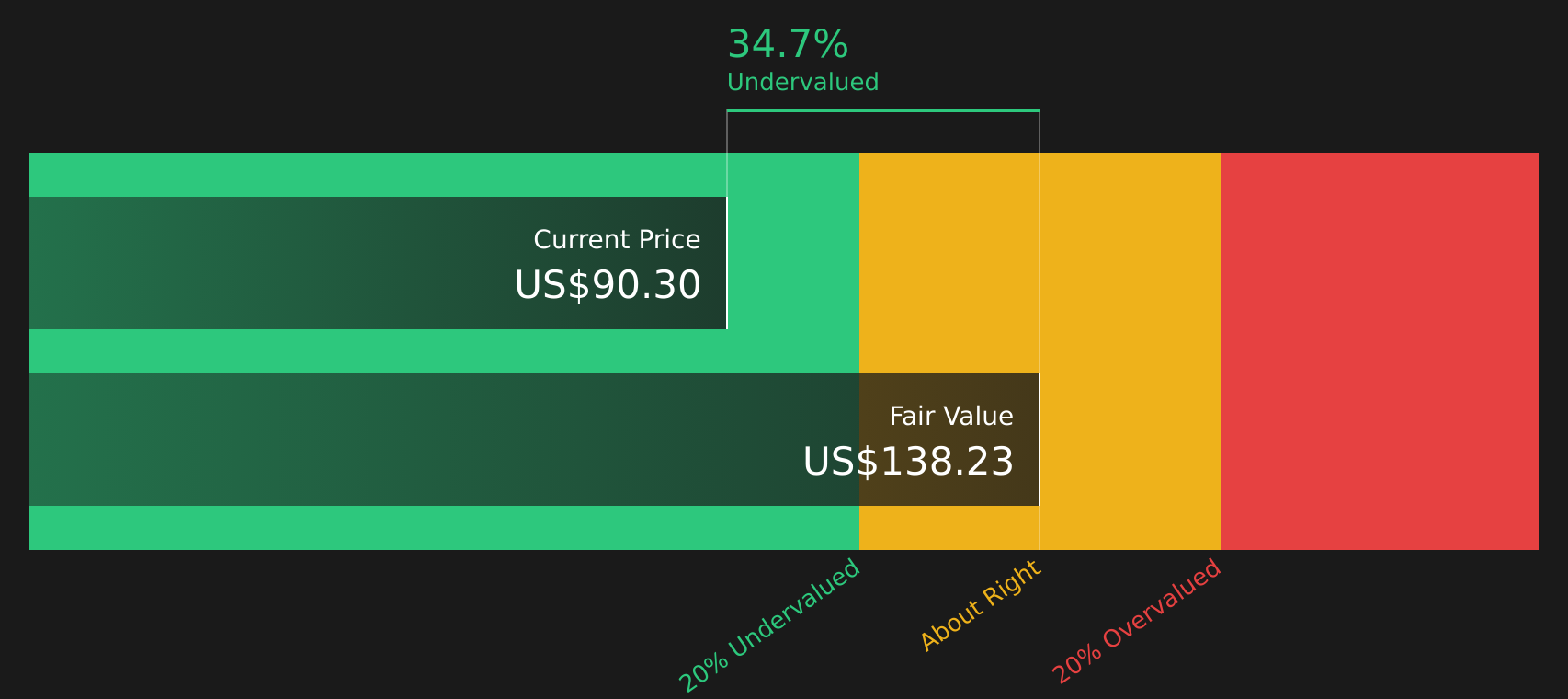
The Discounted Cash Flow (DCF) model uses General Motors cash flow projections to estimate what the stock might be worth today. For GM, the latest twelve month free cash flow sits at about $13.1b, and the DCF framework assumes these cash flows continue as a growing, but relatively mature, stream over time.
On that basis, the model arrives at an intrinsic value of about $138 per share, which is around 37.0% above the current share price. On this measure, the stock screens as undervalued. Because GM has recently recorded sizeable EV related charges while also lifting 2026 earnings guidance, the gap between the DCF value and the market price can reflect investors weighing those long term cash flows against nearer term execution and regulatory risks.
Overall, the DCF work suggests General Motors stock currently looks undervalued relative to the cash flows analysts expect it to generate.
Our Discounted Cash Flow (DCF) analysis suggests General Motors is undervalued by 37.0%. Track this in your watchlist or portfolio, or discover 51 more high quality undervalued stocks.
Does General Motors Look Pricey on Earnings?
P/E is often the go to gauge for General Motors because earnings are a key focus for auto investors. GM currently trades on a P/E of about 41.1x, compared with an auto industry average near 13.2x and a peer group average of roughly 28.5x.
The fair P/E ratio implied by the model is about 29.2x. That sits much closer to peers than to the current multiple. This means the market price embeds a sizeable premium to what the model suggests would be reasonable given GM’s risk profile and business mix. This gap sits alongside the company’s recent mix of higher earnings guidance and EV related charges, and leaves the stock looking expensive on earnings even after factoring in those expectations.
On the P/E multiple alone, General Motors stock currently screens as overvalued relative to both its own fair ratio and the wider auto sector.

See what the numbers say about this price — find out in our valuation breakdown.
The General Motors Narrative: What Would Justify Today's Price?
Simply Wall St Narratives for General Motors aim to bridge the gap between the DCF upside and the richer P/E multiple by spelling out which future paths could reasonably support either outcome. Each narrative links General Motors' current price to specific assumptions about revenue growth, margins and earnings. Where a single ratio or model gives one number, these narratives clarify the underlying story so you can watch how it plays out over time.
Community views on General Motors sit far apart, with some investors focused on emerging cash flows and others worried about the cost and risk of the transition.
Bull case: 8% undervalued
"The growing monetization of software and services such as Super Cruise and OnStar, evidenced by $4 billion in deferred revenue and rapid subscriber growth, creates higher-margin recurring revenue streams..."
Read the full Bull Case to see why General Motors could be undervalued
Bear case: 30% overvalued
"EVs are still margin-dilutive for GM, as battery costs, manufacturing inefficiencies, and supply chain constraints continue to pressure profitability..."
Read the full Bear Case to see why General Motors could be overvalued
Do you think there's more to the story for General Motors? Head over to our Community to see what others are saying!
The Bottom Line
For General Motors, the Discounted Cash Flow (DCF) work points to meaningful upside, while the current P/E suggests the stock is overvalued relative to sector peers and its own fair ratio. That split reflects a market that is cautious on growth expectations and headline risks, even though long term cash flows screen as attractive. Broader valuation checks remain weak. The key question is whether higher margin, software and defense driven earnings can come through strongly enough to close the gap. The crux from here is whether current discounts reflect opportunity or a fair penalty for EV related and legal execution risks.
This article by Simply Wall St is general in nature. We provide commentary based on historical data and analyst forecasts only using an unbiased methodology and our articles are not intended to be financial advice. It does not constitute a recommendation to buy or sell any stock, and does not take account of your objectives, or your financial situation. We aim to bring you long-term focused analysis driven by fundamental data. Note that our analysis may not factor in the latest price-sensitive company announcements or qualitative material. Simply Wall St has no position in any stocks mentioned.
Have feedback on this article? Concerned about the content? Get in touch with us directly. Alternatively, email editorial-team@simplywallst.com