
US Stock Forecast | Futures of the three major stock indexes had mixed ups and downs, and global chip stocks experienced “Black Tuesday” SK Hynix (SKHY.US) released financial reports after the market
Pre-market market trends
1. Before the US stock market on July 28 (Tuesday), futures for the three major US stock indexes had mixed ups and downs. As of press release, Dow futures were up 0.69%, S&P 500 futures were up 0.02%, and NASDAQ futures were down 0.89%.

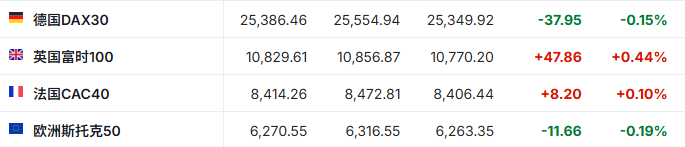
2. As of press release, the German DAX index fell 0.15%, the UK FTSE 100 index rose 0.44%, the French CAC40 index rose 0.10%, and the European Stoxx 50 index fell 0.19%.
3. As of press release, WTI crude oil fell 0.98% to $81.80 per barrel. Brent crude oil fell 1.44% to $84.63 per barrel.

Market news
Global chip stocks hit “Black Tuesday”: South Korea's Kospi crash triggered a meltdown, and Nvidia's “$750 billion deal” triggered an AI bubble panic. As investors' concerns about whether the artificial intelligence (AI) boom continued to heat up and market sentiment continued to deteriorate, global chip stocks experienced a further sell-off on Tuesday. South Korea's benchmark stock index, the Korea Composite Index (Kospi), fell by more than 10%, triggering a 20-minute trading suspension mechanism on the Korea Exchange. The Nikkei 225 Index, which has a high weight on Japanese chips, and the Taiwan Weighted Index (Taiex) both fell by about 4%. This decline reflects growing market concerns about overcrowded stock positions and rising corporate debt levels during the AI construction cycle. Nvidia (NVDA.US)'s new round of transactions involving more than 750 billion US dollars has further raised market concerns about whether AI demand is being artificially boosted. At the same time, the progress made by Chinese competitors in the field of technology is putting additional pressure on an already overvalued market.
Fitch issued the most direct warning: the correction in the AI market is becoming a major global credit risk. Rating agency Fitch warns that the AI boom and possible pullback risks are becoming major global credit risks, increasing concerns about soaring technology valuations and investing in unprecedented spending ahead of time when future returns are uncertain. So far, no other major rating agency has made such a direct statement. In its global risk outlook for the third quarter, Fitch said that the credit environment is still mainly affected by two major short-term risks: growing vulnerability to market adjustments related to artificial intelligence, and continued uncertainty related to the US-Iran conflict. Rating agencies have reiterated recent warnings from global regulators that the AI boom is increasingly intertwined with economic growth and capital markets, particularly in the US, increasing the risk of any large-scale sell-off. Fitch said, “The scale of investment in artificial intelligence is such that the economy and the capital market as a whole are quite exposed to this adjustment.”
Is the Federal Reserve's hawkish turn undervalued? Castle Securities bucked the trend and bet on an unexpected rate hike this week to strengthen its anti-inflation reputation and break the “shackles” of forward-looking guidance. The Federal Reserve will hold an interest rate meeting from July 28 to 29 local time (that is, this Tuesday and Wednesday), and will announce interest rate decisions on Wednesday. The market generally expects the Federal Reserve to keep the benchmark interest rate unchanged. Castle Securities, however, anticipates that the Federal Reserve will raise interest rates this week — an unexpected move that will strengthen Federal Reserve Chairman Kevin Walsh's credibility in dealing with inflation. Frank Flite, head of macro strategy at the company, said in a report that the 25 basis point rate hike on Wednesday will reinforce Walsh's repeated commitment to restore price stability, while also showing that policymakers no longer rely on clearly signaling every policy action to the market in advance. Flite said, “The market may have once again underestimated the extent to which the Fed's policy stance has turned hawkish,” and that this week's rate hike “will clearly end the era of forward-looking guidance,” while further highlighting the independence of the Federal Reserve.
South Korea promised to take more steps to curb demand for leveraged ETFs. Korea Financial Services Committee Chairman Lee EOG-weon said that if the latest restrictions fail to achieve the expected results, South Korea will be prepared to take more measures to curb investors' demand for leveraged ETFs, including setting investment limits for individual investors. The Financial Services Commission said in a statement that if these measures, which have been in effect since July 31, fail to sufficiently curb demand, regulators will consider further tightening investment requirements. The Financial Services Commission also said that discussions are underway to speed up the process of increasing the minimum number of trading units previously planned. Lee met with investment industry managers on Tuesday to discuss leveraged ETFs. Plans under consideration include: requiring regular mandatory online training, including simulated trading courses; and limiting individual investment amounts in leveraged ETFs to a specific percentage of total invested assets.
The downturn in the South Korean stock market prompted retail investors to switch to US stocks, with net purchases exceeding 5 trillion won this month. According to reports, as the South Korean stock market continues to be sluggish, investors in South Korea have once again turned to US stocks, with net purchases of US stocks exceeding 5 trillion won this month. According to data from Seibro, the securities information portal of the Korea Securities Depository and Settlement Agency, between the 1st and 27th of this month, the total net purchases of US stocks by investors in South Korea reached US$3,589.9 billion, which is about 5.5 times the net purchase amount for the full month of June. As of the 23rd, net purchases were only US$2,5302.6 million, but increased by US$1,0597.3 million in the following two trading days. Retail capital is mainly concentrated in semiconductors and technology stocks. The product with the most net purchases this month was the Direxion Daily Semiconductor Bull 3X ETF (SOXL.US), which tracks the Philadelphia Semiconductor Index, with a net purchase amount of US$1,759.9 billion. SK Hynix (SKHY.US) ADR also continues to be sought after. As of the 27th, the net purchase amount had risen to US$812.38 million.
Oman proposed to Iran a plan for the management of the Strait of Hormuz: regional co-management, voluntary user funding. According to reports, sources in the Gulf region said that Oman has proposed to Iran a plan to establish a common regional mechanism to manage the Strait of Hormuz and collect voluntary fees. The plan proposed by Oman has received regional support. The plan is based on the Malacca Straits model, that is, using voluntary funding from relevant parties in the Strait for navigation assurance, environmental protection, search and rescue operations, etc. According to the plan, Iran will not control the Strait of Hormuz alone.
Individual stock news
The “most profitable quarter in history” crashed into a 30% drop in a single month! SK Hynix's earnings report may become a “life and death symbol” for the AI storage supercycle. SK Hynix, which will release its first financial report since the NASDAQ listing on July 28 after the US stock market was listed, is now the focus of investors' attention. Wall Street generally expects the company's second-quarter revenue to reach 84.12 trillion won (US$57.6 billion), GAAP earnings per share (EPS) of 80,145.08 won, and non-GAAP EPS of 70,975.39 won, equivalent to GAAP earnings per share of approximately $4.87. As a leading manufacturer of high-bandwidth memory (HBM), SK Hynix is entering one of the most profitable quarters in its history as a leading manufacturer of AI-driven storage upward cycles. However, after a rapid rise in the previous period, SK Hynix's stock price recently experienced a sharp correction, falling by more than 30% in the past month. The market is closely watching whether this financial report can revive confidence.
Is the AI “asset-light” strategy working? Apple (AAPL.US) overtook Nvidia to reclaim world number one SpaceX (SPCX.US) but dropped by a Tesla. On Monday, Apple overtook Nvidia at the close and topped the list of companies with the highest market capitalization in the world for the first time since April 2025. The iPhone maker closed with a market value of 4.95 trillion US dollars on the same day, while the market value of AI chip giant Nvidia was 4.77 trillion US dollars. The gap between the two was about 180 billion US dollars. Nvidia's stock price plummeted 5% on Monday, dragging its market value down to $4.77 trillion. The AI chip sector as a whole came under pressure on the same day, mainly because investors were concerned about the high costs brought about by large-scale investment in AI infrastructure. Meanwhile, Apple's stock price rose 1%, and the market capitalization rose to 4.95 trillion US dollars. The market is eagerly awaiting its high-profile earnings report to be released on Thursday. Since taking the market capitalization title from Microsoft in June 2025, Nvidia has remained at the top of the list, and briefly touched the $5 trillion market capitalization mark in October last year. Since entering 2026, Nvidia's stock price has only increased by 4%, while Apple's increase has reached 24%. Apple significantly outperformed the market. The logic behind it was that investors affirmed its strategy of restraining AI capital expenditure — Apple preferred leasing computing power rather than building its own infrastructure, which gave the market confidence in its financial discipline.
$14 billion landed at the Texas Data Center Campus! Meta (META.US) takes on asset management giant BlackRock (BLK.US) to launch another AI infrastructure arms race. On Tuesday, Meta Platforms and BlackRock, the world's largest asset management giant, jointly announced that the two sides will jointly develop and operate a data center campus in El Paso, Texas. The overall development cost of the project is about US$14 billion. Recently, BlackRock completed pricing for a $12.5 billion bond tailored for the data center, marking the basic settlement of the funding puzzle for this major AI infrastructure project. According to the two parties' disclosure, BlackRock's fund will hold 80% of the shares in the joint venture project, while Meta will retain ownership of the remaining 20%. To match this shareholding structure, Meta will receive an additional $1 billion in cash allocations. In terms of assets and capital investment, Meta will contribute about 2.3 billion US dollars worth of land and construction assets; BlackRock will provide about 4.9 billion US dollars in cash. A significant portion of BlackRock's corresponding investment will be settled through external debt issuance through its special purpose carriers — that is, the recently completed $12.5 billion debt financing.
Amazon (AMZN.US) has comprehensively adjusted its AI strategy and phased out various basic models for internal development. According to people familiar with the matter, Amazon is comprehensively adjusting its AI strategy, phasing out various basic models developed internally, and restructuring the relevant teams. The company no longer diversifies its resources into models covering various types of text, images, and video, but instead concentrates on engineering talent and limited computing resources to focus on its top priority strategic projects to compete in cutting-edge technology. In the midst of this adjustment, Amazon is gradually stopping the development and update of most of its flagship models, including the high-end Premier and Omni models, the Reel model for video generation, and the Canvas image generation model. People familiar with the matter added that these models are currently in a “KTLO (maintain basic operation)” state, that is, they only maintain minimal operation and no major functional iterations are carried out.
Rumor has it that Nvidia signed a $50 billion Texas data center lease, which may pave the way for AI computing power expansion. According to reports, Nvidia has signed a 15-year lease agreement for a data center in Texas, with a contract value of about 19.6 billion US dollars; if the option to renew the contract is exercised, the total value of the 30-year lease period will reach 50 billion US dollars. The facility is being developed by Hut 8 (HUT.US), has a planned capacity of 1 gigawatt (GW), will deploy hundreds of thousands of Nvidia graphics processors (GPUs), and has implemented power supply guarantees. Hut 8 revealed last week that the contract value for its Beacon Point campus in New York County, Texas was $19.6 billion (including a 3.0% annual rent increase) during the 15-year basic lease period; if customers exercise the full renewal option, the total value for 30 years will rise to $50.2 billion. At the time, Hut 8 did not reveal the identity of the tenant, but only referred to it as an “existing investment-level customer”. It will install computing equipment in the park to support large-scale AI training and operation. According to foreign media confirmation, the tenant is Nvidia. Hut 8 was originally a Bitcoin miner and later transformed into AI data center development. The park is designed according to the Nvidia DSX AI factory reference architecture and is specifically built for gigawatt-scale AI infrastructure. Hut 8 announced on July 20 that the Beacon Point Park has been fully commercialized for lease.
Throw away food and bet on personal care to pay off! Unilever's (UL.US) Q2 sales growth hit a ten-year high, following the trend and raised its annual performance guidelines. Benefiting from strong demand in key markets such as India, Indonesia, and Latin America, international consumer goods giant Unilever handed over its best quarterly sales report in more than 10 years in the second quarter, and raised its full-year results guidance in line with the trend. Boosted by this favorable trend, Unilever's stock price hit its biggest intraday rise in two years. According to data released by the company on Tuesday, in the second quarter ending June 30, Unilever's basic sales increased 5.8% year over year, far higher than analysts' previous forecast of 4.3%, and overall turnover also climbed 3.8% to 13 billion euros (US$14.78 billion). Among them, it is worth noting that the company's product sales increased by 5.5% during the quarter, the highest in more than ten years. As a result, Unilever also raised its annual sales growth forecast from 2% to 3%.
Get rid of the burden of Amazon's low prices! United Parcel Service (UPS.US) focused on high-margin business results and raised annual revenue to US$91.2 billion. United Parcel raised sales expectations for the full year, indicating that the courier company is benefiting from strong pricing capabilities as it strives to shift its focus from low-margin e-commerce packages to more profitable packages. According to financial reports, the company's second-quarter revenue reached US$22.8 billion, up 7.5% year over year, exceeding expectations of US$960 million; adjusted earnings per share were US$1.76, higher than the forecast of US$1.67. United Parcel said in a statement releasing its quarterly earnings report on Tuesday that this year's revenue will reach about US$91.2 billion, higher than the previous forecast of US$89.7 billion. This figure broke analysts' average estimate of $90.4 billion. The company expected adjusted earnings per share of $7.22, which also exceeded expectations.
Barclays (BCS.US) trading business has increased dramatically, yet it is still left behind by Wall Street. According to the latest financial report released by Barclays Bank, profit before tax for the second quarter reached 3.3 billion pounds (about 4.4 billion US dollars), up from 2.5 billion pounds in the same period last year. Against the backdrop of increased market volatility, the trading business became a major highlight, and revenue in US dollars increased 17% year over year. Among them, income from bond trading remained flat, but revenue from the stock market increased sharply by 44%, and this is an area where the bank is focusing its efforts in breaking away from the traditional position of debt experts and seeking transformation. However, this achievement is still difficult to match with American peers. According to data from Citibank analysts, commodity and bond trading revenue of US peers jumped 14%, while stock business revenue soared 71%. Part of the gap stems from strategic choices. Under the leadership of CEO Venkata Krishnan, Barclays has always intended to control the size of the investment banking division and prioritize the development of more stable revenue sources such as hedge fund loans. Furthermore, the bank plans to invest up to £300 million in the second half of this year to streamline technology platforms and processes. This news appears to be putting pressure on stock prices. As of press release, the US stock fell more than 6% in the premarket. Chief Financial Officer Anna Cross said that related expenses will effectively reduce costs over the long term.
Price increased+combination optimization, Coca Cola (KO.US) Q2 net revenue and profit both exceeded expectations. Coca Cola's profit and revenue increased in the second quarter thanks to increased sales of concentrates, optimized product pricing, and improved sales mix. The beverage giant announced on Tuesday that earnings per share for the quarter were $1.03, up 16% year over year. Excluding one-time items, adjusted earnings per share were 97 cents, higher than analysts' general expectations of 93 cents. Revenue for the quarter increased 7% to $13.4 billion, higher than analysts' expectations of $13.17 billion. Revenue growth was mainly driven by a 4% year-on-year increase in concentrate sales (concentrate products sold to bottling partners), while price and product mix factors contributed to a 2% increase. CEO Henrique Braun said that the consumer market landscape is dynamic and customer needs continue to evolve. In terms of outlook, Coca Cola raised its full-year adjusted earnings per share growth forecast, up from 8% — 9% to 9% — 10%.
Key economic data and event forecasts
20:15 Beijing time: The US ADP employment week announced changes for the week ending July 11.
20:30 Beijing time: The initial monthly rate of wholesale inventory in the US in June.
22:00 Beijing time: US July Conference Consumer Confidence Index.
04:30 Beijing time the next day: Changes in US API crude oil inventories for the week ending July 24.
Performance Forecast
Wednesday morning: SK Hynix, Seagate (STX.US), NXP (NXPI.US), Visa (V.US), Ford (F.US)
Wednesday pre-market: Nomura (NMR.US), Deutsche Bank (DB.US), UBS (DB.US), New Oriental (EDU.US), Procter & Gamble (PG.US), UMC.US