
After losing 15 billion dollars and withdrawing, Bane left Kioxia's ultimate torture: How to avoid being left behind in the “money-burning game” of Samsung and SK Hynix?
The Zhitong Finance App learned that the fate of Japanese chipmaker Kioxia (Kioxia) has ushered in a dramatic reversal in the global investment boom set off in the field of artificial intelligence hardware. With OpenAI's ChatGPT and other AI models surging in demand for data storage, the market for flash memory chips to provide the necessary storage is booming. This trend drove Kioxia's stock price to become the best-performing constituent stock in the 2025 MSCI Global Index. Its market capitalization briefly surpassed auto giant Toyota Motor Corporation earlier this year. According to earnings forecasts to be released this Friday, Kioxia's quarterly operating profit is expected to soar 30 times year over year. This figure even exceeds the company's profit for the entire fiscal year ending March this year.
However, this spectacular turnaround — which, according to people familiar with the matter, brought an exit return of around $15 billion to private equity fund Bain Capital (Bain Capital) in Japan, making it the largest private equity exit case in the country's history — is facing a new test. Influenced by growing market concerns about whether tech giants can continue their high capital expenses, Kioxia shares fell 18% on Tuesday, the latest example in a recent wave of memory-related stocks taking back profits. The Japanese company now needs to prove that it's not just an accidental beneficiary of AI-driven supply shortages.
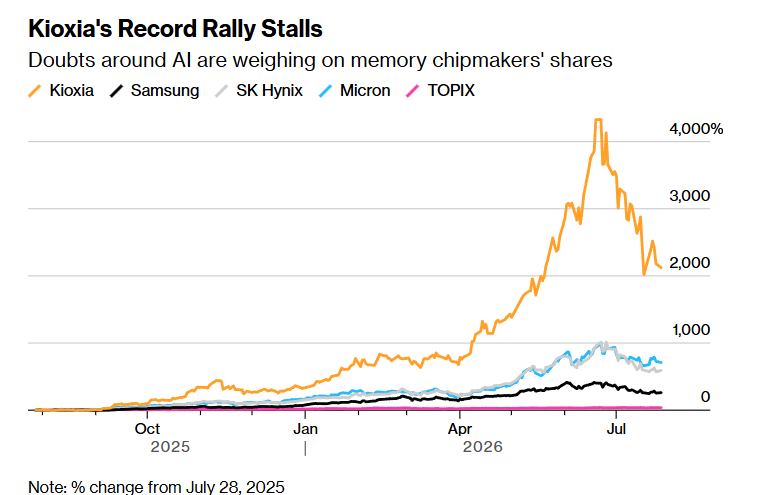
Atsushi Asai, a professor at the Waseda University School of Business, pointed out, “Some people see the current AI boom as a bubble, and there are also concerns that the rise of AI in China may quickly commercialize AI business models.” But he stressed that for Kioxia, the advent of the AI era means that ensuring scale is still critical. “The ability to interpret the market, make smart investment decisions, and act quickly will be critical.”
In the field of flash memory for high-end data centers, Kioxia is facing double pressure from customers and shareholders, not only to expand production capacity, but also to withstand the technological offensive of Korean storage giants SK Hynix and Samsung Electronics. Meanwhile, in the consumer market, small low-cost competitors such as Changjiang Storage are actively increasing production.
Nobuyuki Takezawa, a retail investor and consultant who attended Kioxia's June Annual General Meeting of Shareholders, said, “I think Kioxia can invest more. But given the pain they've suffered in the past due to their mistakes, who can blame them?” He admits that he only started investing in Kioxia at the beginning of this year, but his book income has reached tens of millions of yen.
From “living frugally” to soaring market capitalization
The core of the question is whether Kioxia can maintain its development momentum in an industry where pricing authority stems from huge capital commitments and technological innovation. After years of financial pressure and austerity policies, if competitors invest aggressive capital in the AI boom, Kioxia may face the risk of being left behind due to being too conservative. The dilemma reflects a broader reality in the tech supply chain: the cost of keeping pace in the AI arms race continues to rise even as doubts about long-term demand persist. In response to a request for comment, a Kioxia spokesperson said that the company will continue to make “appropriate” capital investments based on customer needs and market trends.
Many people attribute Kioxia's current success to the late former CEO Narumo Yasuo. The engineer-turned-leader led the spin-off of Kioxia from Toshiba and later quit in 2020 due to illness. Chengmao has long been frustrated by Toshiba's refusal to fund critical memory operations and using its division to cover losses in the nuclear power business. To maintain the department's autonomy, he opposed takeover offers from competitors such as Western Digital and Hon Hai, and instead supported Bain Capital's $18 billion acquisition in 2018.
Under the leadership of a consortium led by Bain, the new company changed its name to “Kioxia” (taken from the Japanese word “memory” and Greek “value”) and promoted the expansion of the Yokkaichi and Kitakami factories. According to former colleagues and analysts, Chengmao maintained a “siege mentality” even when laying the foundation for growth. To remind the team of the volatile market and the importance of financial discipline, he kept a Yokkaichi office elevator that had been closed to save electricity during the downturn and permanently suspended it.
Unable to match the multi-billion dollar equipment budget from more well-funded competitors, Kioxia's engineers relied on ingenious design alternatives to extract high performance from low-cost devices. This culture of “frugal innovation” has become the core of the company's survival manual.
According to people familiar with the matter, even Bain's initial expectations for this deal were relatively moderate, partly because they saw it as a way to counter rivals such as KKR and Carlyle Group in future Japanese acquisitions. A Bain spokesperson said that the fund acknowledged the long-term potential of the memory business from the beginning, but declined to comment further on Kioxia's return on investment. The fund was withdrawn in June of this year.
When Kioxia finally went public in December 2024, its valuation was only $5.6 billion, less than one-third of the original purchase price.
The turning point came in 2025, when giants such as Meta, Amazon, and Google scrambled to secure storage supplies to meet the growing demand for AI. SK Hynix, Samsung, and Micron are focusing their attention on the race for high-bandwidth memory (a type of DRAM), which has led to a shortage of storage to cache large amounts of data. Kioxia's energy-efficient NAND technology provided a timely solution.
Ironically, it was the previous “bitter days” that gave Kioxia an advantage. Forced to concentrate limited resources, Kioxia is deeply involved in energy efficiency and storage density, which just meets the data center's requirements for technology providers under space and power consumption limitations. This gave Kioxia huge pricing power. In January of this year, Kioxia extended the agreement to allow SanDisk to use patented technology at its Yokkaichi plant until 2034. According to the new agreement, SanDisk agreed to pay 1,165 million US dollars over the next four years. This is the first time that SanDisk has paid a premium for this in decades of cooperation between the two sides.
Despite the windfall, Kioxia's management team still has lingering feelings about past market crashes. CEO Koji Ota warned in early July that misjudging AI demand could easily lead to “oversupply and price collapse” in the market. However, in today's highly competitive chip industry, this caution also poses risks. Backwardness means that competitors can provide higher capacity storage at a lower cost, thereby squeezing Kioxia's profit margins and ability to reinvest.
AI Dongfeng can't hide the hidden worries of the “arms race”
In the consumer sector, Kioxia's long-term partnership with Apple is facing challenges from Yangtze River Storage. Apple tried to buy from this Chinese manufacturer, but the Trump administration blocked it. Meanwhile, according to Counterpoint data, Changjiang Storage's share in the overall NAND market has been gradually increasing since last year.
Poor production capacity or technology improvements may also prompt customers to look for alternatives. According to people familiar with the matter, Nvidia co-founder Wong In-hoon recently issued a subtle warning during a meeting with investors in Tokyo: if memory shortages continue, Nvidia may adjust its architecture to reduce its reliance on scarce components.
To ensure it isn't “bypassed,” Kioxia is shipping samples of fast flash memory designed to be closer to the Nvidia GPU in the AI server to improve efficiency. But even with innovation, Kioxia is still at a disadvantage in the capital expenditure race. Yasuhiro Kobayashi, Deputy Chief Researcher at ITOCHU Research Institute, said that Samsung and SK Hynix benefit from family control and the speed and aggressive financial support of the relationship between major shareholders and the government. Their investment scale continues to lead Kioxia, and the latter executives often avoid big bets.
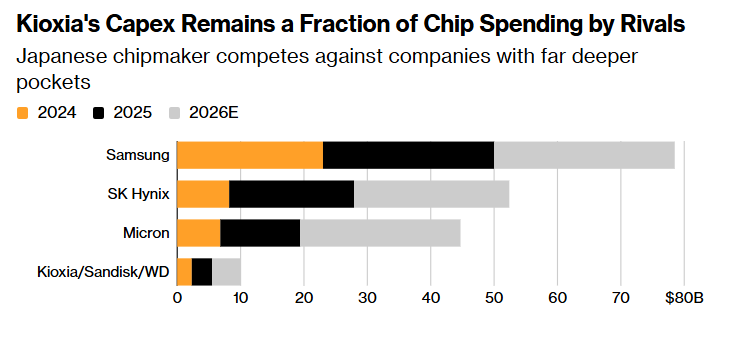
Another concern is that as of June, SK Hynix, a member of the Bain Foundation, still holds 14% of Kioxia's shares, and this potential conflict of interest has been listed as a risk factor in Kioxia's annual report.
The window to catch up with market share won't be too long. Earlier this month, Samsung began mass production of data center storage hard drives for Nvidia's upcoming Vera Rubin platform. Industry analysts said Kioxia should quickly mass-produce its advanced products and secure long-term agreements with customers such as Nvidia. Kazuyoshi Saito, senior analyst at Iwai Cosmo Securities, said, “It's important to stay ahead of the competition and make your technology the factual standard.”
At the board level, there are signs that this ambition is being revived. Koji Ota stated at the shareholders' meeting: “We invented NAND storage, but unfortunately, we are no longer number one. I don't know how long it will take, but I want to see us back on top.”