
Fitch sounds AI credit alert! When CDS surpasses EPS as a weather vane, credit discipline, cash flow and real returns reshape the global AI bull market
The Zhitong Finance App learned that Fitch (Fitch), one of the top three international credit rating agencies, recently issued a research report warning that the unprecedented artificial intelligence investment boom and the risk of a major correction are becoming major global credit market risks, and this credit risk in turn will also exacerbate financial market risks in a broad sense, such as the global equity and bond market. Credit market risks will also further exacerbate investors' concerns, that is, the sharp rise in global technology stock valuations and unprecedented artificial intelligence spending may be far ahead of future investment returns in the AI industry chain, which are still uncertain.
The Fitch analyst team said in its third-quarter “Global Risk Outlook” that the current credit environment is still mainly dominated by two short-term risks: growing vulnerability to major market pullbacks related to artificial intelligence, and continuing uncertainty about war premiums related to the geopolitical conflict between the US and Iran.
The rating agency echoes recent warnings from global regulators that the AI boom is increasingly closely linked to economic growth and global financial/capital markets, particularly in the US, which increases the risk of a bear market caused by any large-scale sell-off. Fitch said, “The scale of investment in artificial intelligence is so huge that the global economy and overall capital market are very exposed to such pullbacks.”
According to the Fitch Research Report, the AI investment boom has escalated from a technology stock valuation issue to a systemic risk in the global credit system and macroeconomy — the S&P 500 index is approaching the Internet bubble period. The issuance of US corporate bonds increased 26% in the first half of 2026. Six large North American technology companies issued a total of $182 billion in investment-grade bonds. The capital expenditure of the four major cloud computing giants is expected to surge by more than 75% to $700 billion this year. Overall, the financial market's assessment of hyperscale computing power companies also further extended from profit growth to free cash flow, financing costs, debt sustainability, and return on capital.
Fitch said that these investments will significantly drive US GDP and wealth effects in the short term, but if the future revenue, regulation, competition and return of AI are still uncertain, once the market recovers drastically and continuously, it may spread to the global economy and credit markets through falling stock prices, rising financing costs, shrinking capital expenditure, and weakening consumption. At the same time, the US-Iran conflict, rising energy prices, and stronger El Niño are likely to increase inflation and fiscal pressure, making highly indebted and low-rated countries particularly vulnerable.
For the global stock market and the AI superbull market, the impact of credit market risk is more like a change in the valuation system than an immediate end to the AI industry trend. The Philadelphia Semiconductor Index has fallen about 25% from its June 22 high and has entered a technical bear market; on July 28, SMH (US semiconductor ETF) fell about 3.6%, and South Korea's Samsung Electronics and SK Hynix plummeted 13.4% and 14.7% respectively. Coupled with the Nvidia CDS base point surge on Monday, indicating that credit market concerns have spread to the global supply chain through deleveraging, momentum reversal, and risk budget contraction. Meanwhile, the Dow, healthcare, essential consumption, and some industrial stocks remained strong, indicating that capital is shifting from “any AI computing power can rise” to assets with sufficient free cash flow, low net debt, customer diversification, contract revenue visibility, and real AI monetization capabilities.
From the AI investment frenzy to Hormuz and El Niño, credit market pricing has entered a stress-testing phase
Fitch's latest warning is the most straightforward one issued by a major global rating agency so far this year. Meanwhile, artificial intelligence-related semiconductor stocks in the Asian and US markets plummeted again on Wednesday due to market concerns about who is paying for this spending boom and signs of increasing competition between China's high-end AI chips and memory chips. The Korean stock market triggered a meltdown for two consecutive trading days. On Wednesday, Korea's benchmark stock index, the KOSPI Index, once plummeted by more than 12%, triggering the market fusing mechanism for two consecutive trading days. At one point, it fell below 5,300 points, which meant a cumulative decline of more than 43% from the recent all-time high.
Fitch's research report emphasizes that the cyclically adjusted price-earnings ratio of the S&P 500 index has risen to the level of the internet bubble in the late 1990s; at the same time, US corporate bond issuance surged a record 26% in the first half of 2026, driven mainly by artificial intelligence-related financing.
According to Fitch, Amazon, Google's parent company Alphabet, Nvidia, Facebook parent company Meta, Oracle, and SpaceX have issued a total of US$182 billion in investment-grade bonds; at the same time, the cumulative capital expenditure of Alphabet, Amazon, Meta and Microsoft is expected to increase by more than 75% this year to reach $700 billion.
The Fitch analyst team predicts that booming investment in information technology directly contributed 1.4 percent to the US GDP growth rate in the first quarter; at the same time, rising stock prices also supported most US household spending through wealth effects.
However, uncertainty surrounding future AI-related revenue generation, regulation, competition, and labor market turbulence may trigger a significant and long-lasting correction in global financial markets and have a broad impact on the macroeconomy.
Fitch said, “The extent to which the capital market and the economy are intertwined with artificial intelligence has created fragility in the credit market. This vulnerability may spread to the stock and bond markets.”
Geopolitical risks remain another major concern, especially in the context of renewed fighting between the US and Iran in recent weeks and the complete closure of the Strait of Hormuz once again.
Fitch predicts that global economic growth will slow to 2.4% in 2026, and predicts that the US inflation rate will reach 3.7% by the end of the year due to the blockade of the Strait of Hormuz and the sharp rise in energy prices caused by the Red Sea transportation also facing major risks.
Fitch also listed intense El Niño weather as an emerging credit market risk, as it could cause droughts, floods, and severe storms.
The rating agency warned that such extreme weather events could further exacerbate global inflationary pressure caused by the conflict between the US and Iran.
Countries with high debt and “junk” ratings will be particularly vulnerable, as soaring food prices may complicate the central bank system's monetary policy, significantly increase the cost of subsidies, and further increase the pressure on public finances, Fitch added.
Fitch said that in Latin America, fertilizer and diesel commodities account for 50% to 70% of agricultural input costs, and about 30% of fertilizer supply comes from the Middle East; rising costs and falling harvests may in turn greatly squeeze agricultural companies' profit margins and impact traditional transportation industries critical to economic growth, such as large global ports, railways, and toll roads.
When CDS replaces EPS as an AI investment trend vane, cash flow, credit rating, financing costs, and real returns take over pricing power
Fitch's warning means that AI is no longer just a problem of overvaluing technology stocks, but has evolved into a systemic risk factor linked to capital markets, corporate credit, and US macroeconomic growth. In the first half of 2026, US corporate bond issuance increased by 26%; Amazon, Alphabet, Nvidia, Meta, Oracle, and SpaceX issued a total of US$182 billion investment-grade bonds, and Alphabet, Amazon, Meta and Microsoft are expected to surge more than 75% to US$700 billion for the year.
According to the Fitch Research Report, investment in AI and information technology directly contributed 1.4 percent of the US GDP growth rate in the first quarter, and the rise in technology stocks also supported consumption through wealth effects, so once the expected return on AI falls, the impact will also spread along the “credit market collapse — stock price collapse — wealth effect weakens — tightening financing — slowing capital expenditure — economic growth cooling” chain, rather than being limited to the AI and semiconductor sector.
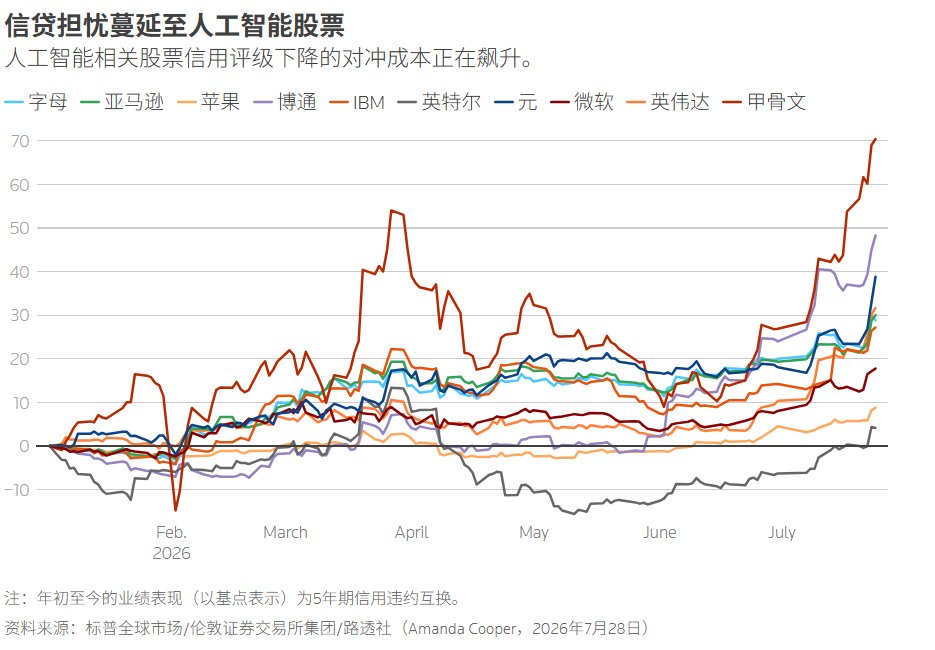
“For hyperscale computing power companies, now we need to look at CDS, not EPS.” Manish Kabra, head of US equity strategy at Societe Generale Bank, said in a research report. CDS is a so-called “credit default swap,” and investors in the bond market use it to price a company's debt repayment risk. The rise in CDS indicates that the bond market feels that the company's credit expectations have deteriorated drastically.
The so-called “look at CDS, not just EPS” does not mean that current profits are no longer meaningful. Instead, EPS can only measure how much money a company has earned today, while CDS reflects creditors' pricing of future cash flow, guarantee liability, balance sheet expansion, and tail risk in advance. Nvidia itself still has strong profitability and cash generation capabilities, but according to the Wall Street Journal, it is currently discussing providing approximately US$250 billion in financing guarantees for OpenAI's 10 gigawatt data center project in Ohio, and may additionally finance up to US$350 billion in chip purchases. If chip suppliers must use investment, loans, or guarantees to help customers buy their own products, orders no longer fully equate to terminal requirements, but begin to include “supplier credit creation requirements”: once AI revenue, utilization, or financing conditions fall short of expectations, risk may shift from customers such as OpenAI to chip vendors, cloud vendors, data center developers, and their creditors.
Oracle, on the other hand, shows a more direct path of transmission of credit risk to the cost of capital. S&P Global Ratings, one of the top three credit rating agencies, recently downgraded its long-term credit rating to BBB-, which is only one level higher than the speculative level. The reasons include the continued rise in AI infrastructure capital expenditure and the possibility that the adjusted leverage ratio will remain more than 4 times over the next few years. Higher bond spreads and CDS will raise the weighted average capital cost of data center projects, lower the net present value of projects, and force companies to choose between reducing construction, increasing the price of cloud services, issuing more shares, or accepting higher leverage; this will ultimately reverse compress the visibility of long-term orders for GPUs, HBMs, servers, optical modules, semiconductor equipment, and even data center power infrastructure.
Meta's latest data center financing costs are higher than similar previous year's projects. Recently, the investment-grade bond market has also clearly struggled to absorb a total of 75 billion US dollars of new bonds from Nvidia, SpaceX, and Amazon, which together indicates that the bond market is shifting from “unlimited supply of low-cost capital” to requiring higher risk compensation.
As a result, what the AI superbull market is really facing is not the disappearance of technological demand, but rather that financing costs are beginning to discipline the technical narrative. Currently, the absolute probability that large technology companies will actually default is still not high, and CDS market transactions may also be relatively sparse, and a small number of transactions will amplify price fluctuations; however, the importance of CDS quickly reaching a high level is that creditors no longer accept that all AI capital expenses can generate sufficient returns.
The winners of the next phase of the AI investment theme will be companies that can rely on self-financing from operating cash flow, an optimistic credit rating and financing environment, that can grow AI revenue faster than capital expenditure and depreciation, that do not rely too much on off-balance sheet guarantees, and have stable power and customer contracts; companies that rely on revolving financing, a single customer, negative free cash flow, and continuous refinancing to maintain expansion may become the high-risk link in the AI bull market's shift from “super beta” to “fundamental alpha.”