
Fundamental evidence in the semiconductor crash! UMC.US (UMC.US) performance exploded and capital expenses increased AI orders spilled from GPU to mature manufacturing
The Zhitong Finance App learned that the performance report released by Taiwan's chip manufacturing giant UMC.US (UMC.US) on Wednesday showed that its board of directors has approved a production expansion plan, which includes increasing clean room production capacity in Singapore's large-scale fab factory and building a new fab factory in Taiwan's flagship Tainan Industrial Park to make every effort to meet the growing semiconductor production capacity demand driven by artificial intelligence power demand. UMC's latest performance and future prospects can be called a major benefit at the fundamental level for the AI computing power industry chain, which has been hit hard recently. It significantly weakens the pessimistic assumption that “demand for AI computing power infrastructure has peaked”, because UMC's strong performance shows that orders are spreading from the most advanced AI computing chips to mature process node peripheral chips such as power chains.
However, according to some analysts who are pessimistic about the semiconductor market, UMC's performance cannot immediately dispel market concerns about high leverage, overcrowded positions, overvaluation, revolving financing, return on capital expenditure, and the rise of Chinese competitors.
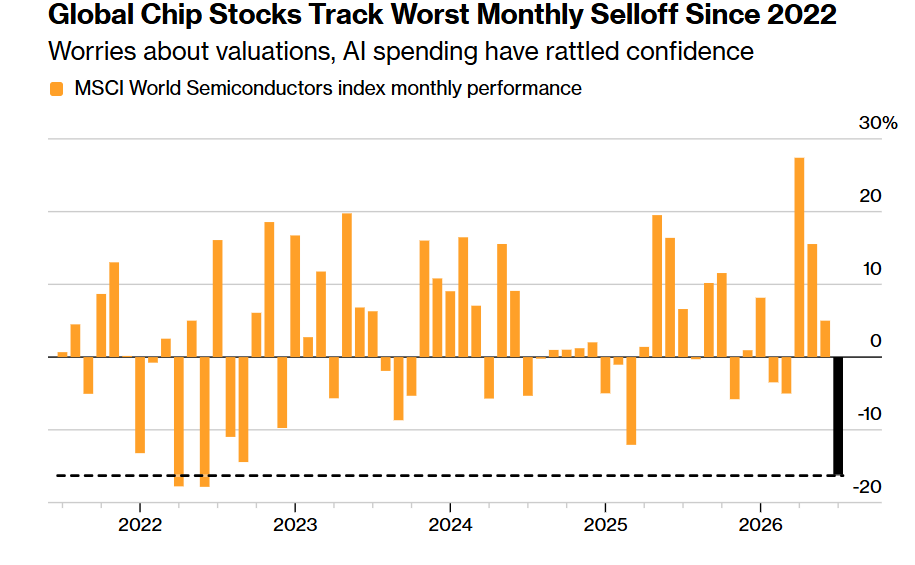
The Philadelphia Semiconductor Index has fallen about 25% from its June 22 high and has entered a technical bear market; on July 28, SMH (US semiconductor ETF) fell about 3.6%, while South Korea's Samsung Electronics and SK Hynix plummeted 13.4% and 14.7% respectively. Artificial intelligence-related semiconductor stocks in the Asian and US markets plummeted again on Wednesday. The Korean stock market triggered a meltdown for two consecutive trading days. On Wednesday, Korea's benchmark stock index, the KOSPI Index, once plummeted by more than 12%, triggering the market fusing mechanism for two consecutive trading days. At one point, it fell below 5,300 points, which meant a cumulative decline of more than 43% from its recent all-time high.
In the performance statement, UMC CEO Wang Shi said, “The clean room capacity and production capacity expansion plan will be implemented in stages, so that UMC can flexibly deploy production capacity to meet customers' AI computing power infrastructure needs while focusing on capital expenditure discipline. As a result, the 2026 capital expenditure budget will be significantly raised to $2 billion.” Additionally, UMC's board of directors has approved capital expenditure budgets of approximately $5 billion for 2026 and 2027.
Wang Shi said that the capacity expansion plan reflects the company's expectations for industry growth over the next five years. He pointed out that growth will be mainly driven by emerging applications such as high-speed optical connectivity and power products in artificial intelligence data centers, continuous vehicle electrification, intelligence, and humanoid robots.
Wang Shi said during the performance conference call, “This industry growth trend, along with our entry into advanced packaging fields such as logic and memory stacking and silicon photonics, will accelerate the growth of UMC's accessible market.” The company expects AI-related revenue to reach approximately US$300 million this year and surpass the US$1 billion mark within three years.
Unlike TSM.US (TSM.US), the world's largest wafer foundry and chip manufacturing giant, UMC mainly focuses on more mature chip process nodes (mature process technology from 14nm to 28nm and higher values); TSMC is massively expanding 3nm advanced process capacity and investing heavily in the most advanced 2 nm or even 1 nm advanced process technology to support the needs of artificial intelligence computing power resources at the sky level.
There is an essential difference in the division of labor between the two major Taiwanese chip manufacturing giants, UMC and TSMC. TSMC directly manufactures AI accelerators (that is, nearly all AI chips in the world), CPUs, and other core computing chips in the world and TSMC's leading manufacturing processes, such as 2 nm, 3 nm, and TSMC's leading manufacturing capacity, and provides high-end advanced packaging production capacity such as CoWOS; UMC's revenue below 14 nm in the second quarter was still zero, and core production capacity was concentrated at 22/28 nm and more mature nodes and characteristic process processes.
UMC is not the main manufacturer of Nvidia's flagship AI GPU films, but rather focuses on peripheral key aspects such as power management ICs, BCD chips, microcontrollers, sensors, network and RF connectivity chips, HDD and flash/DRAM controller chips, silicon photonic chips, interconnectors, and 2.5D/3D advanced packaging backends in AI server clusters and edge AI systems that are critical to AI training/inference requirements.
From the perspective of investment in the AI computing power industry chain, UMC represents not “advanced manufacturing processes to replace TSMC,” but rather a new round of reassessment of the production capacity value of mature processes as AI computing power spreads from core processors to data center power, control, high-performance storage, and optical communication/optical interconnection.
AI demand spillover, mature manufacturing process: UMC raised capital expenses, expanded production at dual bases to seize the increase in AI computing power demand
In terms of the newly announced quarterly results, thanks to strong AI demand, UMC's second-quarter revenue was approximately NT$68.73 billion (US$2.12 billion), up 17% year on year; net profit recorded a sharp increase of 374.7%, reaching NT$42.26 billion.
The continued blowout of AI inference computing power demand has led to a sharp expansion in UMC's valuation and fundamental expectations. UMC's stock price has risen 120% since this year, significantly outperforming the general market benchmark of the Taiwan stock market — that is, the 38.24% increase in Taiwan's weighted index. The Taiwanese stock market closed down 9.69% before Wednesday's earnings report. UMC.US stock ADR (UMC.US) also fell back due to the recent sharp decline in the global AI computing power industry chain and semiconductor sector. It fell by more than 35% in July, but the increase was still as high as 125% during the year.
UMC's core operating quality improved markedly in the second quarter: revenue of NT$68.733 billion, up 17% year on year; gross profit of NT$22.323 billion, up 32.3% year on year; operating profit of NT$14.950 billion, up 38.2% year on year; operating profit margin rose from about 18.4% to 21.8% from the same period last year, while gross margin rose from 28.7% to 32.5%.
The shipment volume of UMC wafers reached 1.129 million 12-inch wafers, an increase of about 16.8% over the previous year, and the capacity utilization rate increased from 76% to 85%. The increase was mainly due to actual shipment, improvement in operating rate and product portfolio, rather than simply price fluctuations. What needs to be distinguished is that net profit surged 374.7% year on year to NT$42.260 billion, including investment income of about NT$30.45 billion, so this profit increase cannot be entirely extrapolated to continuous operating growth; more representative indicators are the 38.2% year-on-year increase in operating profit and the free cash flow of NT$23.97 billion in the second quarter.
UMC's forward-looking guidance is more of an industry signal than historical profit figures. UMC expects high single-digit month-on-month growth in wafer shipments in the third quarter, the average sales price in US dollars remains strong, gross margin rises to the middle of 30%, and the utilization rate of production capacity is only 85% in the second quarter; capital expenditure will be raised from the original plan to US$2 billion, an increase of 25% over the actual US$1.6 billion in 2025, 90% of which will be invested in 12-inch production capacity, and will gradually expand the P4 clean room in Singapore and a new plant in Tainan, Taiwan.
At the same time, UMC management pointed out that demand for power management chips, sensors, and microcontrollers in 8-inch products has rebounded strongly. 22-nm revenue already accounts for 17.5% of quarterly revenue and has set a record. 12-inch silicon photonic chips have also been mass-produced and delivered for the first time, and silicon photonic platforms will be opened to a wider range of customers in 2027. This shows that AI demand is spreading from advanced GPU wafer manufacturing and foundry to “associated silicon-based computing power chains” such as power supplies, control, sensing, storage controllers, connectivity, and optical interconnections.
Fundamental counterproof in the chip collapse trajectory: TSMC, SK Hynix, Seagate, and UMC jointly prove that AI demand has not collapsed
Looking at the recent results and future prospects of UMC, TSMC, SK Hynix, and Seagate, the conclusion is even more clear: the physical-level demand associated with AI computing power infrastructure did not deteriorate in sync with the collapse and clearance of stock prices and extremely leveraged positions.
Wall Street financial giant Citigroup's latest research report shows that the arms race in the AI era is shifting from “who has the smartest model” to “who can continuously produce intelligence at the lowest cost and with the highest efficiency under physical constraints”: open weight models such as Kimi K3 are rapidly approaching the frontier of closed source, which means that model capabilities accelerate commercialization, but parameter scale, long context, and multi-step agent reasoning expand simultaneously, causing bottlenecks to shift from simple flops to HBM capacity and bandwidth, high-speed GPU interconnection, cluster scheduling, and power access. Nvidia research also points out that when model size, sequence length, and batch expansion, HBM often becomes the main expansion constraint; IEA predictions show that AI data center electricity consumption is growing significantly faster than overall electricity demand, while the power grid construction cycle is generally longer than the data center deployment cycle.
TSMC's second-quarter revenue increased 36% year-on-year, net profit increased 77.4%, high-performance computing accounts for 66% of revenue, 7nm and more advanced processes account for about 77% of wafer-type revenue, and is expected to reach 44.6 billion to 45.8 billion US dollars in the third quarter, while raising annual capital expenditure to 60 billion to 64 billion US dollars, and the annual dollar revenue growth rate to slightly more than 40%; SK Hynix's revenue increased 257% year on year, operating profit increased 557% year on year. HBM4 has begun mass production and shipping, and has signed long-term supply agreements with about 10 customers.
The US HDD storage supergiant Seagate's quarterly revenue rose from US$2,444 billion to US$3.629 billion, up 48.5%, non-GAAP gross margin jumped from 37.9% to 52.7%, free cash flow reached US$1.1 billion, and gave adjusted EPS guidance for the next quarter of US$4.1 billion and US$7.30. Advanced AI GPU/TPU/data center CPU logic chips, HBM/server DRAM/NAND, massive HDD storage, and the simultaneous strengthening of mature and characteristic processes constitute cross-verification of “the breadth of AI computing power requirements.”
Therefore, UMC's latest performance and future prospects can be called a major benefit at the fundamental level for the AI computing power industry chain, which has been hit hard recently. It significantly weakens the pessimistic assumption that “demand for AI computing power infrastructure has peaked”, because UMC's strong performance shows that orders are spreading from the most advanced AI computing chips to mature process node peripheral chips such as power chains.
However, the latest performance of AI computing power industry chain leaders such as UMC may not be enough to reverse the deleveraging of global AI stocks alone. Market concerns about high valuations, revolving finance, return on capital expenditure, and competition in China cannot be immediately dispelled. The most typical evidence is that even though SK Hynix announced record profits, the stock price still plummeted because it did not meet extremely high expectations, and South Korea's KOSPI once fell 12.6%; after TSMC announced results that greatly exceeded expectations, the global chip sector also continued to be under pressure. The current market transaction is not “whether there is AI demand,” but rather “what are the prospects for AI return on investment and whether the growth rate of AI computing power demand can cover AI capital expenses, credit market financing costs, depreciation, and high valuations over a long period of time.”