
US stock outlook | The three major stock index futures rose and fell, and the Fed's interest rate decision is about to be announced, Microsoft (MSFT.US) and Meta (META.US) will announce financial reports after the market
Pre-market market trends
1. Before the US stock market on July 29 (Wednesday), futures for the three major US stock indexes had mixed ups and downs. As of press release, Dow futures were down 0.38%, S&P 500 futures were up 0.19%, and NASDAQ futures were up 0.25%.

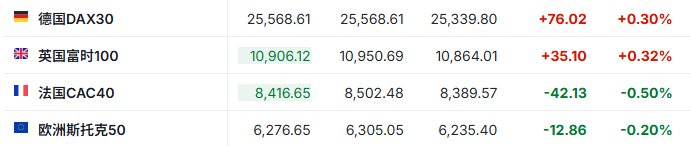
2. As of press release, the German DAX index rose 0.30%, the UK FTSE 100 index rose 0.32%, the French CAC40 index fell 0.50%, and the European Stoxx 50 index fell 0.20%.
3. As of press release, WTI crude oil rose 4.33% to $82.69 per barrel. Brent crude rose 3.91% to $85.29 per barrel.

Market news
Be wary of the Federal Reserve's “raid rate hike” tonight! A number of Wall Street institutions sounded the alarm, and traders had historic “anxiety hedging”. When Federal Reserve Chairman Kevin Walsh will announce his second interest rate decision since taking office at 2 a.m. Beijing time on Thursday, global capital markets are watching with bated breath an unprecedented suspense. Just a month ago, the market was almost certain that July would stand still; at the moment, the CME FedWatch tool shows that the probability of a 25 basis point rate hike has soared to 30% from 13% a week ago. Citi said bluntly that this was “the moment of greatest disagreement since September 2024.” What is even more worrying is that after reaching 909,714 open positions on Friday, the number of open federal funds rate futures surged further to 967,136 on Monday, setting a new historical record. “In the past, when it was time before the meeting, the market's expectations for policy results were usually highly consistent,” but this time it's completely different. BMO Capital Markets data shows that since 2015, the average error of traders predicting the final interest rate decision the day before the Federal Reserve's decision was only 2.4 basis points — and this time, the error may be calculated in “codes.”
The AI wave is distorting economic signals, and central bank decisions face the risk of “misjudgment.” Bank for International Settlements economists warn that the rise of artificial intelligence is distorting the economic signals that central banks rely on to formulate monetary policies. Its impact is strong enough to “reshape global prospects in real time,” driving growth amid trade tension and geopolitical crises, but at the same time increasing the risk of policy mistakes. In the short term, AI has the effect of boosting inflationary pressure. US spending on data centers and information technology manufacturing facilities has risen to 0.8% of GDP, and the wealth effect brought about by the rise in the stock market has further stimulated consumer spending. These “significant and visible” effects are fermenting. However, AI may also have deflationary effects. If it significantly increases productivity, or if concerns about job loss curb spending and weaken workers' bargaining power, price pressure tends to ease. However, these more sustainable productivity improvements are “uncertain and difficult to measure” and are expected to appear more gradually. Increased uncertainty directly increases the risk of “misalignment” of monetary policy. If the central bank overestimates productivity gains or underestimates the potential intensity of demand, it may keep interest rates too low, making it difficult to effectively curb inflation. Federal Reserve Chairman Walsh believes that AI is driving the US into a productivity recovery period, thus allowing borrowing costs to be reduced without stimulating inflation. However, inflation still far exceeds the Federal Reserve's target. Some officials warned that data center investment and AI-related demand are driving up prices in the short term, and that Walsh is under pressure to show determination to control inflation. The ECB's chief economist also pointed out that the ultimate impact of AI depends on whether technology replaces labor or helps increase production, whether energy supply can match electricity demand, and whether AI activities will continue to be concentrated in a few countries. Assessing its overall impact on inflation will be a major challenge facing the central bank in the next few years.
Opposition parties bombard “the country has become a casino”! Kospi plummeted 40%, and South Korea's finance minister held an emergency meeting tonight to bail out the market. South Korea will hold an emergency meeting on Wednesday evening to discuss market conditions after the stock market crash erased investors worth tens of billions of dollars in assets. According to Congressman Yoo Dong-soo (Yoo Dong-soo), the meeting will be presided over by South Korea's Minister of Finance Ko Yun-cheol. Officials from all South Korea's top financial authorities will attend. The meeting will begin at 6 p.m. local time. On Wednesday, senior government officials faced multiple rounds of questions from lawmakers in the South Korean National Assembly. Lawmakers believe that part of the sharp decline in the stock market is due to the single-share leveraged products introduced by South Korea in May. At the hearing, Koo Yun-cheol apologized and acknowledged that the regulatory authorities should have carried out a more careful review before launching these products. But he still maintains that leveraged exchange-traded funds (leveraged ETFs) are just one of a few drivers of recent market turmoil. “We have introduced a package of countermeasures, but if necessary, we will take additional steps to help the market return to normal,” Koo Yun-chul told lawmakers on Wednesday. Currently, the Korea Composite Stock Price Index (Kospi) has fallen by about 40% from its June high.
The military conflict between the US and Iran has once again escalated, and a joint attack on Iraq has pushed up oil prices. International oil prices rose sharply on Wednesday. This round of increase was mainly driven by incidents such as the joint military attack carried out by the US and Saudi Arabia against Iraq and Iran's ballistic missile launch against the US military stationed in the Middle East. The US Central Command confirmed that it had successfully intercepted ballistic missiles launched by Iran against the US military in the Middle East, and characterized the attack as a “raid attempt.” Iran's Revolutionary Guard Corps later said that it had fired multiple missiles at the US air base and Central Command Command Center in Jordan in response to America's previous attacks on Iraqi armed groups supported by Iran. Meanwhile, Saudi Arabia announced that its armed forces had coordinated with the US Central Command to carry out “targeted attacks” against armed groups supported by Iran in Iraq, accusing these groups of launching drone attacks on Saudi oil facilities. ING analysts pointed out that the latest developments have significantly weakened market expectations for a rapid easing of the situation in the Persian Gulf. On the supply side, American Petroleum Institute data shows that in the week ending July 24, U.S. crude oil inventories fell by about 3.3 million barrels, further supporting oil prices. Furthermore, some sources revealed that OPEC+ may suspend production increases for three months from October, after the organization had completed the return of voluntary production cuts according to the plan. The market is awaiting official inventory data released by the US Energy Information Administration late Wednesday to further determine the supply and demand pattern.
According to the news, the Houthis in Yemen are considering levying fees on ships passing through the Red Sea. According to sources, the Houthis in Yemen are considering levying fees on merchant ships passing through the southern waters of the Red Sea. The Houthis announced a maritime embargo against Saudi Arabia on July 20, opening up a new front against the US and its allies, and expanding the scope of attacks on oil tankers carrying global energy and other supplies to waters outside the Gulf. Sources said that the Houthis are studying the levy of fees on most ships passing through the Strait of Mande, and the implementation time of the relevant measures has not yet been determined. Currently, the Houthi media office has yet to respond. Sources said the move was aimed at normalizing the practice of levying fees on international watercourses and increasing pressure on the United States. On the other hand, a senior Iranian official said that Tehran has officially rejected Oman's plan for joint management of the Strait of Hormuz region, believing that the plan is unlikely to succeed. Iran refused to allow other countries to participate in the management of the strait, insisting that only Iran and Oman can decide on relevant arrangements based on their respective shares of the waters. Iran insists that all inbound and partly outbound waterways through the Strait of Hormuz must be under Iran's control.
Smartphone memory prices soared more than 80% in Q2, DRAM surpassed SoC and became the most expensive component of flagship models, and BOM costs were under pressure. According to Counterpoint Research data, smartphone memory prices increased by more than 80% month-on-month in the second quarter of 2026, which had a continuing structural impact on BOM costs for terminal devices. The BOM cost of flagship models increased nearly 50% year over year, and DRAM has surpassed SoC to become the most expensive single component in flagship smartphones. The introduction of 2nm flagship SoCs in the future will further drive up the BOM cost of flagship models and put greater cost pressure on OEMs. Even if OEMs raise the retail price of terminals, the overall gross margin is expected to be slightly lower than the level of flagship products of the same generation in 2025, making it difficult for the cost increase to be fully covered by pricing adjustments.
Individual stock news
Alphabet (GOOGL.US) lost ahead, can Microsoft (MSFT.US) and Meta (META.US) escape the AI capital spending “curse” tonight? Microsoft and Meta Platforms Inc. are about to release earnings reports, and the market is becoming increasingly impatient with these two tech giants' large investments in the field of artificial intelligence (AI) and the resulting continued shrinkage of cash reserves. Both companies are scheduled to announce their results after the US stock market on Wednesday EST. Although outsiders expect both to maintain rapid growth, this is not the focus of Wall Street's attention. Last week, Alphabet Inc. surpassed expectations on multiple indicators, but its stock price recorded the biggest one-day decline in more than a year. The reason was that Google's parent company experienced negative cash flow for the first time since its listing, and its capital expenditure is rising sharply. Microsoft and Meta, along with Alphabet and Amazon (AMZN.US), are in the same camp with the largest investment in AI. However, the market believes that Microsoft and Meta are not as good as Alphabet in terms of industry leadership, so scrutiny of their financial reports is likely to be more stringent. Since this year, Microsoft's stock price has fallen by a cumulative total of 19%. It is currently one of the worst 20 constituent stocks in the Nasdaq 100 Index, which has a high weight in technology stocks, and the index has risen 10% so far in 2026. Meta shares fell 10% during the same period, while Amazon (which is scheduled to release earnings on Thursday EST) remained essentially flat.
SK Hynix (SKHY.US) refutes concerns about a slowdown in AI investment: it will remain steady after next year. SK Hynix said in the second quarter earnings call: “We have noticed that investment in AI infrastructure may slow down as some large technology companies are re-examining data center leasing businesses and the rise of efficient AI models. We believe these steps are not a process of cutting AI investments, but rather a process of increasing utilization and speeding up the monetization of large-scale AI infrastructure.” SK Hynix said that the popularity of efficient AI models is unlikely to lead to a decline in demand for infrastructure and memory. As models and systems become more efficient, more users can access various services on the same infrastructure, thereby expanding the accessibility and coverage of AI services. Given that even recently launched high-efficiency AI models have explosive user demand, efficiency improvements are boosting the popularity of services and increasing overall usage rates. SK Hynix said that during medium- to long-term demand negotiations with major customers, the company also confirmed the sustainability of AI investments. It is believed that investment in AI infrastructure will remain steady after next year.
GFS.US (GFS.US) received $300 million support from the US Department of Commerce to accelerate silicon photonic technology research and development to serve AI infrastructure. GF announced on July 29 that it has signed an agreement of intent with the US Department of Commerce to accelerate the development of next-generation silicon photonics technology. Under the agreement, the US Department of Commerce is expected to provide $300 million to GF to advance research and development of advanced optical materials, wafer technology, and advanced packaging to support next-generation optical interconnection technology required for AI and high-performance computing data centers. As part of the agreement, the US Department of Commerce will also acquire about 1% of GF's shares, enabling the American public to share the company's future growth benefits. GF said the company will accelerate large-scale manufacturing of silicon photonics technology based on existing facilities in Malta, New York, and Burlington, Vermont.
The “AI energy monster” Bloom Energy (BE.US)'s revenue broke 1 billion US dollars for the first time in a single quarter, drastically raising the annual guidance. The CEO will talk on the phone: when the chip is out of power, it is inventory. With the boom in artificial intelligence infrastructure construction around the world, as an “water seller,” the “AI energy monster” Bloom Energy handed over the first report card in history that exceeded expectations with “revenue exceeding 1 billion US dollars in a single quarter”, and drastically raised its 2026 performance guidelines across the board. According to the data, Bloom Energy's total revenue for the second quarter reached a record $1,065 million, up 166% year over year, significantly exceeding Wall Street's previous forecast of $826 million; non-GAAP diluted earnings per share (EPS) was $0.78, far exceeding analysts' expectations of $0.41. Based on strong order conversion, the company drastically raised its 2026 annual revenue guide from 3.4 billion to 3.8 billion US dollars to 3.9 billion to 4.2 billion US dollars; the full-year adjusted operating profit guide was also doubled from 425 million to 450 million US dollars at the beginning of the year to 800 million to 900 million US dollars. CEO Sridhar's most impactful statement during the conference call was to announce the company's positioning in the AI data center market: “Today, all major US hyperscale cloud vendors, and more than a dozen emerging US cloud vendors, AI labs, and managed data center operators have verified and approved our power solutions for their AI factories.” Sridhar also described current pain points in impactful language: “Bloom is increasingly seen as a solution to eliminate AI power availability friction points. Chips without electricity are just inventory, not intelligence (Chips without power are inventory, not intelligence).”
UMC.US (UMC.US) achieved a phased breakthrough in the silicon photonics business with revenue of US$2.18 billion in the second quarter. According to the financial report for the second quarter of 2026 disclosed by UMC, the company achieved GAAP earnings of 0.54 US dollars per share for the second quarter; achieved revenue of 2.18 billion US dollars, equivalent to 68.73 billion Taiwan dollars, an increase of 8.5% over the previous year. The revenue scale was 80 million US dollars higher than market expectations, and net profit attributable to shareholders of the parent company reached 42.26 billion NTD, equivalent to 1.34 billion US dollars. Jason Wang, CEO of Lianhua Electronics, pointed out that benefiting from strong demand in the communications and consumer markets, wafer shipments increased 10.6% month-on-month and capacity utilization increased to 85% in the current period. 22/28nm business revenue reached a record high, with 22nanometer-related revenue accounting for 17.5% of total quarterly sales. Landmark progress has been made at the level of technology research and development. The company has delivered 12-inch photonic integrated circuits in batches to customers, verified high-volume 12-inch wafer silicon photonics manufacturing capabilities, and laid the foundation for the launch of a silicon photonic business platform for general customers in 2027. The company simultaneously issued operating guidelines for the third quarter of 2026. It is expected that wafer shipments will achieve high single-digit growth, and the average sales price in US dollars will remain strong; gross margin is expected to fall in the middle of the 30% range, and the capacity utilization rate will further rise to more than 90%. In terms of capital expenditure planning, the company determined a capital expenditure scale of 2 billion US dollars for the full year 2026.
Procter & Gamble (PG.US) profit declined in the fourth quarter, and the outlook for the full year was cautious. P&G's profit declined in the latest quarter, mainly driven by rising costs and weak sales, putting pressure on profits. The consumer goods giant, which produces Crest toothpaste and Pantene shampoo, also issued more conservative performance guidelines for the current fiscal year, predicting profits and sales falling short of Wall Street expectations. According to the data, net profit for the fourth quarter was 3.04 billion US dollars, or 1.26 US dollars per share, lower than the same period last year of 3.62 billion US dollars, or 1.48 US dollars per share. The decline in profits was mainly due to rising sales, general and administrative expenses, and the impact outweighed the positive effects of a slight increase in sales. Adjusted earnings per share were $1.43, higher than analysts' expectations of $1.41. Sales increased 2% year over year to $21.2 billion, slightly lower than analysts' expectations of $21.38 billion. Looking ahead to the new fiscal year, the company expects adjusted earnings per share to grow between 0% and 3%, about $7 in median terms, compared to analysts' expectations of $7.02. The company expects full-year earnings per share to face headwinds of around 56 cents, mainly due to multiple factors such as rising raw materials, energy and transportation costs, increased net interest expenses, and adverse exchange rate fluctuations. Procter & Gamble expects annual sales growth of between 1% and 3%, or approximately US$88.77 billion in median terms. Analysts, on the other hand, expect full-year sales of $89.4 billion.
Key economic data and event forecasts
22:30 Beijing time: Changes in US EIA crude oil inventories for the week ending July 24.
The next day at 01:30 Beijing time: The Bank of Canada announced the minutes of the monetary policy meeting.
At 02:00 Beijing time the next day: The Federal Reserve's FOMC announced the interest rate decision.
The next day at 02:30 Beijing time: The Chairman of the Federal Reserve held a press conference on monetary policy.
Performance Forecast
Thursday morning: Microsoft, Meta, Arm (ARM.US), Qualcomm (QCOM.US), Fanlin Group (LRCX.US), Starbucks (SBUX.US)
Thursday pre-market: Shell (SHEL.US), Lloyd's (LYG.US), Mastercard (MA.US), Bristol-Myers Squibb (BMY.US), Good Future (TAL.US)