
“Shrinking supply+low inventory” drives up oil prices, and “three barrels of oil” may usher in investment opportunities
From air strikes to a cease-fire, crude oil prices experienced a wave of rebound and rapid correction. Trump's “every word and action” touched the nerves of the market. The market jokingly claimed that the rise and fall of crude oil all depended on Trump.
The Zhitong Finance App learned that since the beginning of July, the US-Iran conflict has once again escalated. The US military has launched air raids on Iran for 13 consecutive days, driving crude oil prices to continue to rise sharply. Brent crude oil once surpassed 100 US dollars/barrel, and Goldman Sachs Group even claimed that it would reach 120 US dollars/barrel in the fourth quarter of this year. However, on July 25, or due to concerns about ammunition reserves, the US stopped military attacks, and oil prices continued to fall in response, but the increase in July was still over 15%.
The sharp rise in crude oil prices also led to a rise in the prices of major chemical products. In July, products such as methanol, styrene, and ethylene glycol all rose by more than 10%; in the stock market, the petrochemical sector showed impressive performance. Among them, CNPC increased by more than 20% and Sinopec by more than 15%. On July 27, due to the armistice, petrochemical products all plummeted, leading to a sharp decline in stocks related to the stock sector.
The question now is that the continuation of the impact of the current US-Iran truce, according to Trump's style, is still unknown, and the intensification of the conflict between the two countries is difficult to ease through negotiations again. Furthermore, the Houthis announced a blockade of the Red Hemand Strait against Saudi ships, intensifying the regional conflict. Goldman Sachs Group research reports that if the interruption of shipping in the Strait of Hormuz continues, the price of Brent crude oil may rise to more than 120 US dollars per barrel in the fourth quarter of this year.
If the “armistice” were only short-lived, the price of crude oil would continue to rise if the conflict occurred again, and the petrochemical-related sector would continue to enjoy.
“Strait of Mande+Strait of Hormuz” double crisis, “contraction of supply+low inventory” drives up prices
Looking back at this year's US-Iran conflict, from the US-Israel air strike on Iran in February, the April cease-fire agreement, the June negotiations, and another attack in July, it is clearly driven by events. The escalation price of the conflict has increased, and the cease-fire and mitigation have experienced regional shocks. However, the current US military's unilateral cease-fire did not have mitigating characteristics, and Iran said it has not requested the resumption of negotiations with the US, which means that the conflict may still escalate.
In fact, new variables have emerged affecting crude oil prices. Apart from the US-Iran conflict, the conflict between the Houthis and Saudi Arabia has also become a key variable. The Houthis imposed a maritime blockade on Saudi Arabia and threatened to block the Strait of Hormuz. The Strait of Hormuz stopped, and the Mander Strait became an important alternative route. Yanbu Port undertook an export task of close to 4 million b/d. Threatened by the Houthis, Saudi Arabia could only choose to take a detour. This will lead to a decrease in transportation efficiency and a sharp rise in costs.
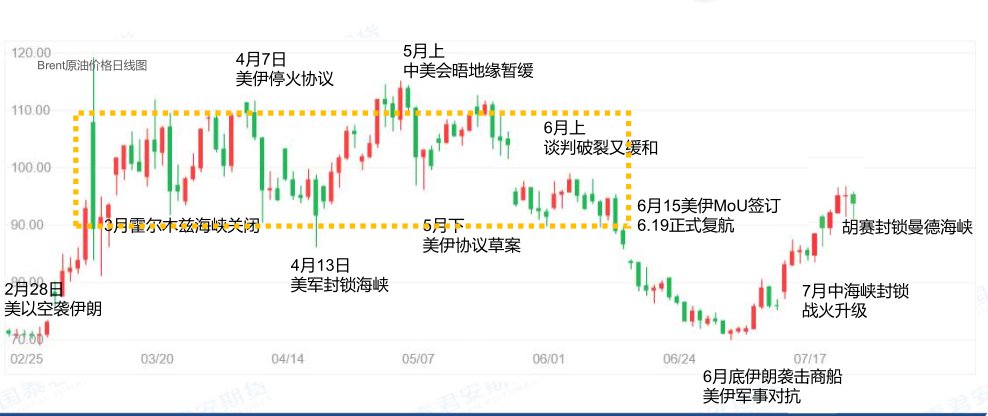
The “Strait of Mande+Strait of Hormuz” double crisis may cause another large-scale contraction on the supply side. Looking at the two rounds of supply shocks, the first round was only in the Strait of Hormuz. During the mitigation period, the concentrated release of strategic reserves from various countries was mitigated, while existing inventories were exchanged for adjustment time, so oil prices fluctuated at high levels for a long time. However, the second round was different. This time it was a double strait blockade, production capacity could not be released, and global inventory bottomed out.
According to the data, for the week of July 24, 2026, global crude oil in-transit and floating inventory was 1,342 billion barrels, a decrease of 48.55 million barrels from last week, of which in-transit inventory was 1,238 billion barrels, a decrease of 53 million barrels from last week, and oil reserves continued to decline. Take the United States, the largest reserve country, as an example. Crude oil reserves have dropped to 307.7 million barrels, a new low since 1983. Therefore, compared to the previous round, this round of supply shocks had a greater impact.
On the production capacity side, the scale of production shutdowns in the core Middle East region declined in June, but it is expected to rise sharply, especially Saudi Arabia, a major oil producer; Russia, as an oil supply replacement country, continued to attack Russian refineries in the past two months due to the Russian-Ukrainian conflict. A total of 19 refineries were damaged, covering 4.9 million barrels/day processing capacity, accounting for 70% of Russia's total refining energy. A ban on exports of refined oil products was introduced to ensure domestic supply, and supply contracted further.
It is worth noting that after many actions by the US in violation of the agreement, Iran's core advantage over the US is greater economic patience, and is fully aware that controlling the Strait of Hormuz is the most effective countermeasure against the US, and there is almost no compromise in this regard. Based on the above, there is still a possibility that crude oil prices will rise further, and according to Goldman Sachs, if it reaches 120 US dollars/barrel in the fourth quarter, the petrochemical sector will also impact higher premiums.
“Three barrels of oil+spill faucet” was the first to benefit, focusing on the continuation of the US-Iran conflict
Crude oil prices are expected to continue to rise, and domestic “three barrels of oil” are the first to benefit.
CNPC is the industry leader. In Q1 2026, the company's crude oil production remained stable at 338.3 million barrels; Sinopec (00386) produced 131 million barrels of oil equivalent; Sinopec (00386) produced 131 million barrels of oil equivalent; CNOOC (00883) achieved a net output of 205 million barrels of oil equivalent, of which China produced 140 million barrels of oil equivalent. All three barrels of oil production and sales remained stable.
Looking at the performance side, CNOOC is relatively small in volume and has high performance flexibility. CNPC and Sinopec have declined in revenue units for three consecutive years. However, CNPC's profit margin was high. In 2026, CNPC shareholders' net profit was 48.332 billion yuan, with a net interest rate of 6.56%. Sinopec was 17.06 billion yuan, and the net interest rate was only 2.4%. CNOOC's performance fluctuated, with Q1 revenue up 8.63%, shareholders' net profit of 39.144 billion yuan, up 7.06%, and net interest rate as high as 33.7%, far higher than the other two companies.
Everbright Securities released a research report stating that if the conflict between the US and Iran continues, the crude oil market regulation mechanism may fail, causing the market to face greater fluctuations. The “three barrels of oil” own resources are the driving force for China to guarantee its own energy security, and it is expected that it will fully benefit from rising oil prices. Furthermore, the dividend ratio of three barrels of oil has remained stable for a long time. As a long-term high-dividend company, it is scarce, and the value of high dividend allocation is prominent.
However, it should be noted that due to the conflict, supply contracted at the same time, leading to a simultaneous contraction in demand. Instead, small companies have suffered greatly. China Man Petroleum is one of them. Zhongman Petroleum is the first private enterprise with an independent oil field in China. Its revenue from drilling engineering services and crude oil and derivatives accounts for more than 90%, producing 235,600 tons of crude oil in Q1. Sales of crude oil and derivatives fell 19.48%, not benefiting from price increases. Total revenue fell 18.22%, shareholders' net profit fell 86.22%, and is expected to decline 64.68%-70.46% in the first half of the year.
Furthermore, the increase in crude oil prices has led to an overall rise in the chemical product line, thereby driving the performance growth of related targets. China's Xuyang (01907) is a global coking integration leader. As of 2025, it has operated 19 coke production lines, with an operating capacity of 23.7 million tons/year, 56 chemical production lines, and an operating production capacity of 6.2 million tons/year. Coke prices have been rising steadily for three consecutive quarters. Chemical products benefit from high oil price elasticity, and business growth in 2026 is highly certain. Furthermore, the company actively lays out the new energy business to form an industrial pattern driven by the three pillars.
Overall, the US-Iran conflict has once again escalated, the Trump administration's credibility in Iran has collapsed, and the probability of easing through negotiations is low, but there is uncertainty about the timing of the current cease-fire. This has increased fluctuations in oil prices, causing crude oil prices to continue to fall back. However, a new key variable has emerged in this conflict. The “Strait of Mander + Strait of Hormuz” crisis will cause crude oil supply to shrink again on a large scale, driving up prices.
If the conflict continues to escalate, the petrochemical sector once again ushered in investment opportunities. From a valuation perspective, the PB values of the Hong Kong stock Sinopec and CNOOC were 0.55 times and 1.1 times, respectively. Sinopec's valuation was relatively lower, while the PB value of China's Xuyang, an indirect beneficiary, was 0.58 times higher. Its product categories are rich, prices and demand are more flexible, and performance expectations are higher. Investors can focus on the continuation of the US-Iran conflict.