Arm (ARM.US) Q1 performance exceeded expectations but was sold off! The explosion in AI demand is difficult to beat the slowdown in the mobile phone business, and Q2 revenue guidance falls short of the most optimistic expectations
The Zhitong Finance App learned that although Arm (ARM.US) announced better-than-expected results for the first fiscal quarter of fiscal year 2027, the stock declined after the market on Wednesday because the company indicated that weak growth in the smartphone industry had overshadowed the rich opportunities brought by its expansion into the data center technology sector, and that the second-quarter revenue guidance provided fell short of the market's most optimistic expectations. After a large-scale sell-off in global semiconductor stocks, chip companies, including Arm, are being scrutinized more strictly. Even when companies release positive financial reports with overall performance, it is becoming increasingly difficult to meet investors' expectations.
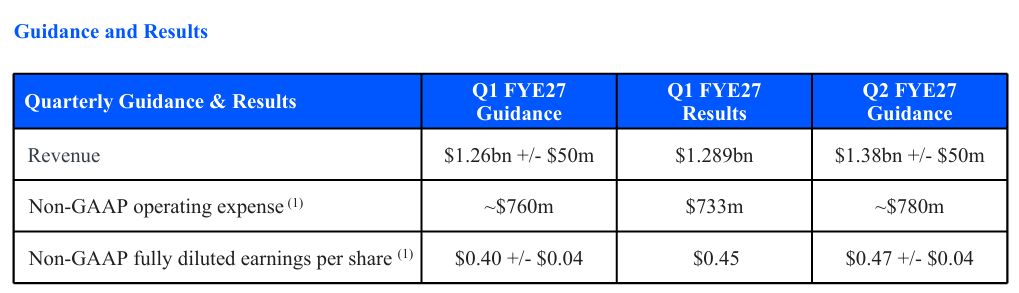
According to financial reports, Arm's revenue for the first fiscal quarter of fiscal year 2027 increased 22% year over year to US$1,289 million, better than analysts' average forecast of US$1.26 billion; adjusted net profit was US$480 million, up 28% year over year; and adjusted earnings per share increased 29% year over year to US$0.45, better than analysts' average expectation of $0.40.
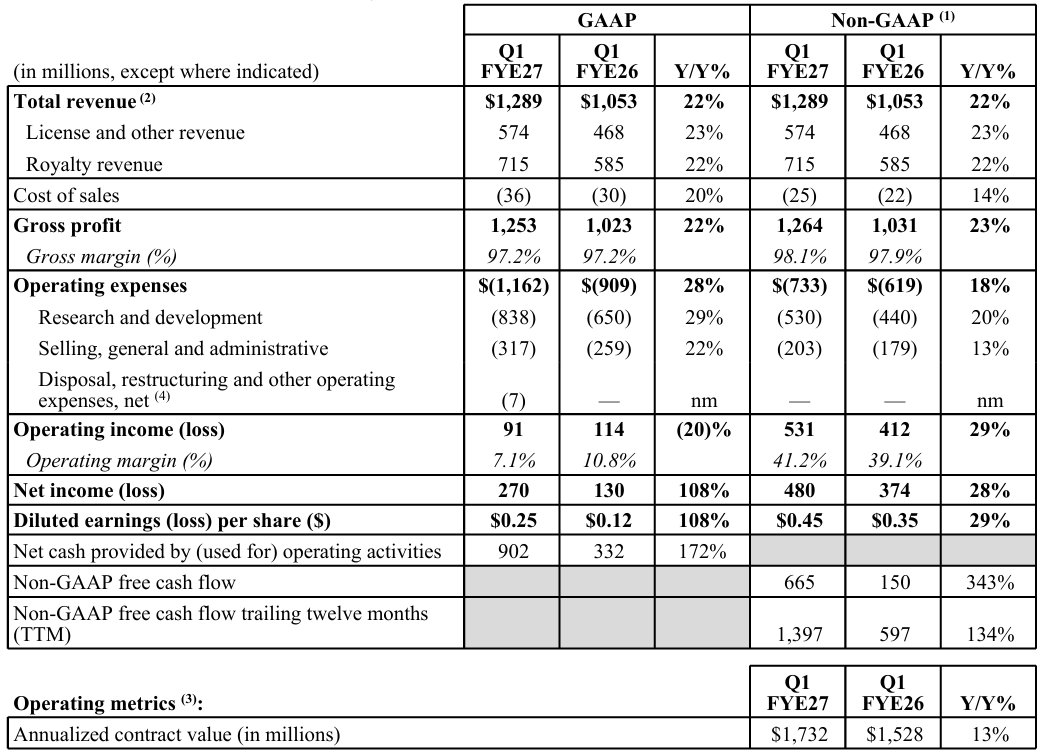
By business, Arm's licensing revenue for the first fiscal quarter increased 23% year over year to $574 million. The revenue from this business comes from customers who use its chip design architecture and other technical solutions and bring their products to market. This business is seen as an important measure of the company's future business growth.
Royalty revenue, on the other hand, increased 22% year over year to US$715 million, higher than the average market estimate of US$700 million, mainly driven by data center royalties increasing by more than doubling year over year. However, royalties paid by mobile phone manufacturers account for a large percentage of the company's revenue. Although this market is still growing for Arm, the rate of growth is slowing down. Arm charges royalties from manufacturers based on every smartphone equipped with its technology, and the stability of this revenue stream is declining. Due to a sharp rise in the price of memory chips, mobile phone manufacturers are cutting production.
Previously, Arm expected royalty revenue to grow by about 20%, but now the company expects the current quarter's royalty revenue growth to be in the “low to mid-single-digit percentage range.” Arm Chief Financial Officer Jason Childe said in an analyst conference call after the earnings report: “We do think royalty revenue will drop. There is weakness in the smartphone sector.” Arm emphasized that its expansion into the data center chip sector is offsetting the impact of the slowdown in the smartphone market, but this outlook is still fueling investors' pessimism about the stock. During the conference call, Arm shares fell about 7% in after-hours trading and fell more than 6% as of press time.
But at the same time, the data center business is opening up an important new revenue stream. Arm CEO Rene Haas said that royalty revenue from data center products has more than doubled compared to the same period last year, and market demand for next-generation chip product lines has also exceeded expectations. “Our current business is very strong and healthy, and the new business is a very attractive addition,” he said.
Earlier this year, Arm announced plans to start selling self-designed chips, a move that broke with the company's long-standing business model of only licensing technology to other companies. The company is developing a central processing unit (CPU) designed to help run artificial intelligence data centers. When Arm launched this product in March of this year, the company had already received an order of about 1 billion US dollars. Haas said that now he is confident of getting enough supply to surpass this scale, while order reserves have been expanded to more than 2 billion US dollars.
Arm also said that the trend of migrating artificial intelligence infrastructure to Arm architecture continued to accelerate during the quarter, and the adoption rate of major cloud service providers and chipmakers continued to increase, including Nvidia, Amazon Cloud Services, Google, Microsoft, and Qualcomm. Arm said its Neoverse data center processor shipments have now surpassed 1.5 billion cores.
Looking ahead, Arm expects revenue for the second fiscal quarter to reach approximately $1.38 billion. While analysts' average expectations were $1.35 billion, some forecasts were close to $1.5 billion. The company expected adjusted earnings per share for the fiscal second quarter of $0.47, better than analysts' average expectations of $0.45. The company's royalty revenue for the first fiscal quarter reached $715 million.