
A sharp drop of 24% in a single day and an 80% increase in net profit in half a year: dismantling the truth about the divergence between the performance and stock price of the old store Gold (06181)
Net profit increased 80% in the first half of the year, but the stock price fell 70% — performance to the left, stock prices to the right. Old-fashioned gold stores are experiencing a cruel collision between the “luxury narrative” and the “reality of cyclical products.”
After the market on July 27, Laopu Gold (06181) issued a positive profit forecast: sales performance (including tax) for the first half of the year was 22.7 billion yuan to 23.35 billion yuan, up 60%-65% year on year; adjusted net profit of 4.31 billion yuan to 4.36 billion yuan, up 83%-85% year on year.
After the successful results, the stock price of the old gold store did not rise but fell. The next day, its stock price plummeted 23.76%, and fell to HK$297 during the intraday period, hitting a new low of nearly a year and a half. On July 29, the company's stock price fell by nearly 5% to HK$287.6. Since the record high in July 2025 (HK$1083.83), the cumulative decline in stock prices has exceeded 73%, and the market value has shrunk sharply.
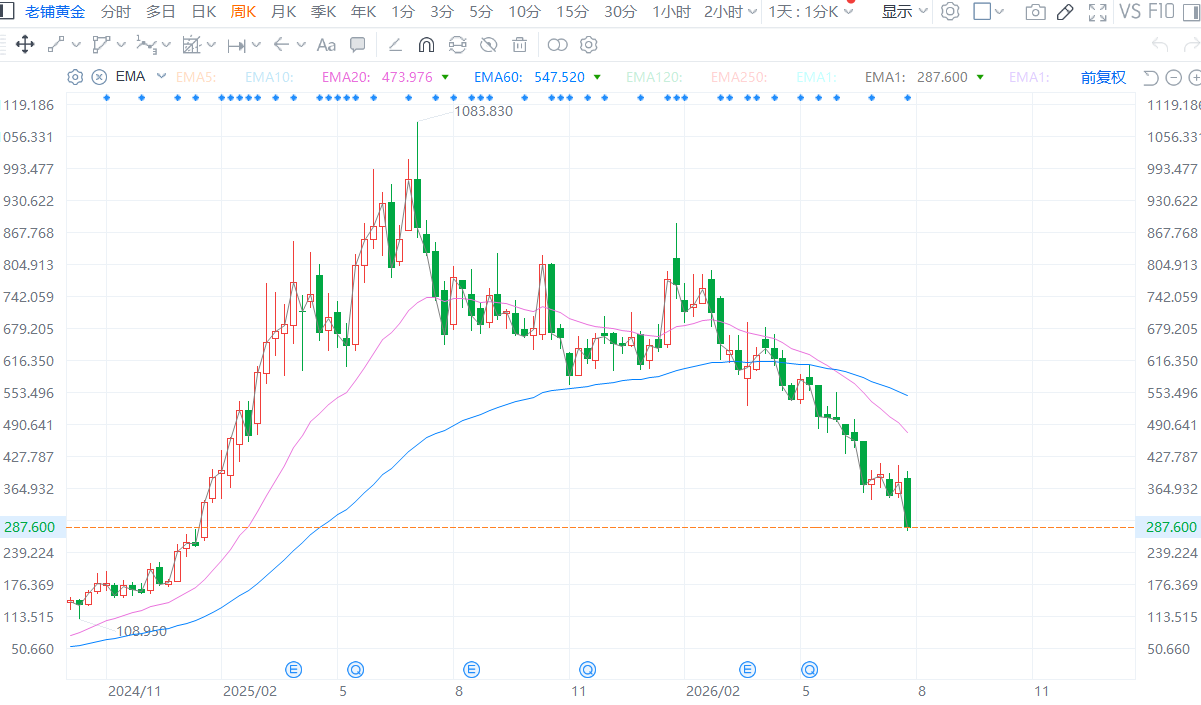
(Market source: Futu)
As a result, the sense of rift between the high performance of old gold and the sharp drop in stock prices also pushed two sharp questions to the front of the stage: namely, why is the market not buying? Will short-term twists and turns into a collapse of the growth logic?
High growth represents a quarterly imbalance, and short-term pressure will not change profit resilience
Zhitong Finance has observed that the old store Gold achieved explosive growth by leaps and bounds in 2025. In addition to establishing a solid performance base for the company, it also made the market have extremely high expectations for continued high growth in 2026.
According to financial data, in 2025, the company achieved operating income of 27.303 billion yuan, a sharp increase of 221% over the previous year; net profit to mother was 4.868 billion yuan, a sharp increase of 230.5% over the previous year. Relying on the bullish gold market and the dividends of the rise of local luxury gold, it completed a double leap in scale and profit.
On top of this high base, the company still handed over an impressive year-on-year report card in the first half of 2026. According to the performance forecast, in the first half of 2026, the company's tax-inclusive sales were 227-23.35 billion yuan, up 60%-65% year on year; adjusted net profit was 43.1 to 4.36 billion yuan, with a year-on-year increase of 83% to 85%. The profit growth rate continued to outperform the revenue growth rate, and the overall profit side improved quality and efficiency.
However, the core logic of the market decline lies not in the overall performance of the first half of the year, but in the extremely unbalanced quarterly structure. Combined with the split of the company's performance guidelines for the first quarter, the pressure in the second quarter brought about by the inflection point of the industry and pre-consumption effects was completely exposed.
According to reports, in the first quarter of 2026, Laopu Gold is expected to have sales performance of about 19 billion to 20 billion yuan, revenue of about 16.5 billion yuan to 17.5 billion yuan, and net profit of about 3.6 billion to 3.8 billion yuan. According to central calculation, the 2026Q1 net interest rate is 21.8%, continuing the boom trend of 2025.
This booming Q1 report card is mainly driven by a combination of three forces: first, the price increase effect. At the end of February, the old gold store launched its first price adjustment in the year, with an increase of 20%-30%. Second, peak season blessings. The Spring Festival has always been an absolute peak season for gold consumption. Combined with marketing nodes such as “March 8 Renewal Week”, the sales volume of the old Tmall flagship store exceeded 300 million yuan in just 1 second, and single store sales exceeded 1 billion yuan throughout the day. Third, the price of gold peaked. On January 29, the international gold price hit a historical peak of 5598.75 US dollars/ounce, and the “buy up, not buy down” consumer mentality was completely activated.
The second quarter of 2026, on the other hand, was the “other side” of the boom. The gold performance of old stores during this period showed a clear cliff-style decline. Based on Q1 data estimates, the Q2 revenue without tax was only 2.3 billion yuan to 3.95 billion yuan, a sharp drop of 76.1%-86.9% month-on-month; net profit was only 510 million to 760 million yuan, a sharp drop of more than 80% month-on-month, and a sharp drop of 34%-56% year-on-year.
Looking at the market environment and fundamentals, there are two main core factors that contributed to the phased pressure on old gold stores in the second quarter. First, pre-consumption in the first quarter was completely diverted from passenger traffic and orders in the second quarter; second, international gold prices declined rapidly in the second quarter, and the “buy up, not buy down” mentality of gold consumption was highlighted. Demand for investment gold jewelry weakened rapidly, and there was strong wait-and-see sentiment among terminal consumers.
Earning three-quarters of last year's money in the first quarter, only a fraction was earned in the second quarter. With such poor performance, it is obviously not difficult to understand that the market chose to “vote with your feet.”
However, it should be noted that in the face of short-term performance pain, the core profitability and long-term operating barriers of old gold have not been damaged, and the two major positive logics continue to be in effect.
On the one hand, gross margin continues to remain high. Despite a sharp decline in revenue in the second quarter, benefiting from the marginal decline in the cost of gold prices in the previous period and the firm brand premium capacity of the company's high-end one-price products, gross margin remained high in the second quarter. Only the expense ratio fluctuated slightly due to negative operating leverage. The central net interest rate for the Q2 single quarter remained at a high level of 20.3%, leading the profit quality industry.
On the other hand, the triple moat of brands, channels, and products continues to deepen, consolidating the foundation for long-term growth. On the channel side, the company continues to focus on the refined layout of the top luxury business district. In June 2026, new stores were opened in Vientiane, Shenzhen and David City, Zhengzhou. In July, the Shanghai Xintiandi store was expanded and upgraded, and plans to complete the optimization of 5 stores in Shanghai during the year to continue to seize core high-end traffic entrances. On the product side, the company's flexible iterative strategy hedged cycle risks, lowered the pricing of new products such as the No. 3 sapphire cross pendant, and broadened the customer base. In July, the Shanghai Xintiandi store reproduced the popular offline shopping scene, and its product strength and brand appeal were verified by the market.
Various data revealed that although gold price disturbances have caused quarterly pain to old gold stores, brand barriers are still the ballast stone for its long-term value.
The industry has entered an “extreme K-type differentiation”, and poor cycles coexist with high-end scarcity
In 2026, the domestic gold and jewelry industry showed a clear pattern of structural rift. Farewell to the era of general rise and fall, and officially entered the extreme K-type differentiation stage.
The underlying logic of the industry has fundamentally changed — the traditional Volkswagen gold circuit is mainly based on weight pricing and value preservation attributes. Industry competition has fallen into serious internal turmoil, and fluctuations in gold prices have had a strong impact on terminal demand. In the downward cycle of gold prices, the demand for value preservation from ordinary consumers subsided, sales of mid-tier gold jewelry were under heavy pressure, the overall growth rate of the industry slowed down, and homogenized competition intensified.
However, the core driving force of the local luxury, hard and luxury gold circuit, where the old gold store is located, has long been separated from the logic of gold price preservation and has moved to the emotional value and brand value of cultural collection, social etiquette, and identity symbols. For high-net-worth customers, the core value of old gold stores is not the price of gold raw materials, but rather the exclusive ancient craftsmanship, oriental aesthetic design, and endorsement of top luxury brands. Fluctuations in gold prices are only a secondary influencing variable.
Under the trend of industry differentiation, the strategic actions of leading brands further confirm the value of the track. Traditional jewellery leaders such as Chow Tai Fook and Chow Sang Sang Sang have stepped up the high-end ancient and craft gold track, increasing the layout of high-premium products and verifying the growth and scarcity of the high-end gold track.
Overall, the industry is pressured by short-term disruptions in the gold price cycle, but the medium- to long-term low-end internal volume and high-end scarcity pattern will not be reversed. Leading companies with brand barriers, product premiums, and high-end channels will continue to reap the dividends of increased industry concentration.
As a result, the stock price of old gold stores has plummeted in this round. It is essentially the result of a triple resonance of reversal of cyclical expectations, digestion of valuation bubbles, and a thunderstorm of quarterly performance.
Looking back at the stock price trend in the first half of 2026, in the first half of the year, the company continued the double dividend of the gold price bullish market and brand growth in 2025. The stock price fluctuated high. The market gave a high valuation premium to the luxury goods circuit. The price-earnings ratio during the peak period exceeded 50 times, and the valuation fully overshadowed future growth expectations.
Beginning in the second quarter, the inflection point in the market became apparent: international gold prices fell rapidly from historical highs, market expectations about the gold sector cycle turned pessimistic. Combined with expectations of a decline in second-quarter performance, the stock price began a deep correction. The maximum retracement from higher points exceeded 70%, and the valuation bubble quickly cleared up.
After Yingxi's semi-annual report came to fruition, stock prices declined at an accelerated pace. The core was that the market used long-term growth and pricing to be negative in the short-term cycle, institutions concentrated on revising profit expectations and valuation centers, and the industry valuation system ushered in restructuring, and differences between investment banks were significantly divided:
Optimists (CICC, Guojin Securities, etc.) believe that the decline in Q2 has obvious seasonal characteristics. With the peak seasons of Tanabata, National Day, and year-end gift giving in the second half of the year, consumption is expected to return. After gold prices stabilized in July, the SKP Tanabata event in Beijing and Xintiandi stores in Shanghai have resumed a rush to buy. Among them, CICC predicts that Laoshuang Gold expects a dividend rate of about 9% in 2026, which is at a high level. Guojin Securities, on the other hand, expects net profit of 7.5 billion yuan in 2026, maintaining a “buy” rating.
Pessimists (Macquarie, China Merchants Securities, etc.) believe that the spot gold price has fallen by more than 20% from its high level to about 4,100 US dollars. Previously, the rush effect caused by the price increase had clearly weakened, and sales of old gold stores are expected to drop 29% year on year in the second half of the year. High base effects are compounded by weakening demand, and high growth may be difficult to sustain.
Compared to the current valuation level, the gold valuation of old stores has already reached the bottom of history. In less than a year, its price-earnings ratio has shrunk from more than 50 times to about 9-10 times at present, which is basically the same as traditional gold companies such as Zhou Dafu and Lao Fengxiang.
In summary, it is easy to see that as the gold and jewelry industry enters the ultimate K-type differentiation stage, old gold stores are experiencing the pain of restructuring valuations from “gold price accessories” to independent luxury goods. Short-term stock prices will still be tied to gold price trends and terminal sales data, and fluctuations are more flexible; however, looking at the extended cycle, the value of the company's scarce local luxury brands has not declined. After this round of valuation restructuring, the left-side allocation value gradually became prominent.