
World Gold Council: China's jewellery consumption may receive seasonal support in the second half of the year
The Zhitong Finance App learned that the World Gold Council said that China's gold jewellery consumption may receive seasonal support in the second half of the year, and it is expected that demand for lightweight and high-end products will boost jewellery consumption spending. Demand for gold investment will remain strong, and the fundamental drivers should remain the same: geopolitical risks continue to be high; domestic bond yields remain low; the new gold value-added tax policy continues to support investment demand; if the People's Bank of China continues to buy gold, it is also expected to maintain investors' confidence in gold.
According to the China Gold Demand Trend Report released by the World Gold Council, in the second quarter, the total demand for gold in the Chinese market (including gold jewellery, gold bars, gold ETFs and industrial gold) reached 155 tons, down 41% year on year, the weakest second quarter performance since 2022. Weakening demand for jewellery (down 28% year over year) and outflow of gold ETFs (-22 tons) were the main factors contributing to the year-on-year decline in gold demand. Notably, despite declining tonnage demand, consumer spending on jewellery remained high.
In the first half of the year, demand for gold in the Chinese market reached 518 tons, a slight decrease of 7% year on year, but still significantly higher than the ten-year average of 476 tons. Despite a strong 31% year-on-year increase in demand for gold bars and coins, jewellery purchases fell 30% year over year, while gold ETF inflows slowed. Together, the two led to a slight decline in overall demand over the same period last year. Investment demand (gold bars, coins and gold ETFs) accounts for 66% of China's total demand for gold. The scale is impressive, reflecting the strong demand for risk hedging, wealth preservation, and revenue capture in the market. Despite a sharp drop in the tonnage of gold jewellery demand, consumer spending on jewellery products continued to rise, driven by a sharp rise in gold prices.
Total demand for gold in the Chinese market remained steady in the first half of 2026
Retail gold demand in various sectors of the Chinese market (in terms of tonnage and amount)
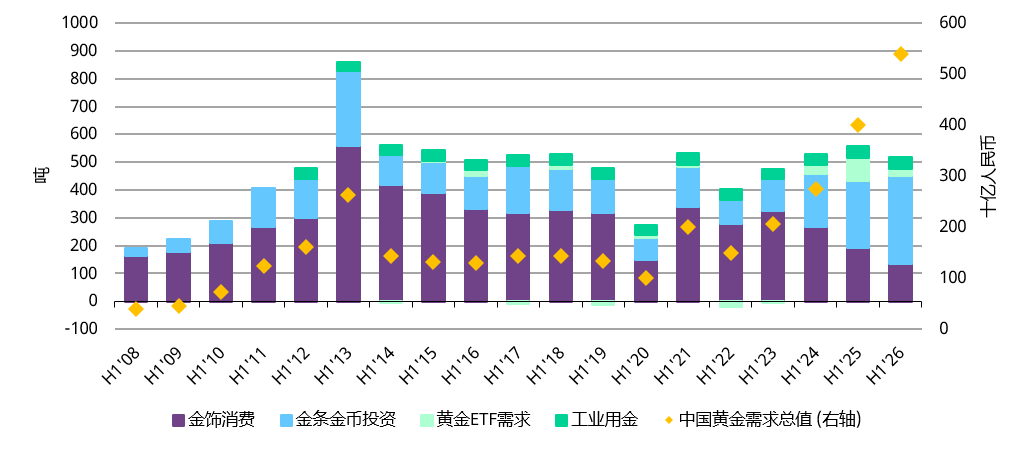
Gold jewellery: Demand for jewellery experienced its weakest performance in the second quarter since 2005, causing total demand in the first half of the year to be far below the long-term average; however, consumer spending on jewellery was still considerable.
Gold bars & coins: Gold bar and coin investment remained steady in the second quarter. Although it fell slightly from the historical high in the first quarter, it was still far above the average for the same period of 10 years, thus driving performance in the first half of the year to a record high.
Gold ETFs: Despite significant net outflows in the second quarter, benefiting from a strong first quarter, demand for gold ETFs in China remained steady in the first half of the year.
Central bank purchases: The People's Bank of China has increased its gold holdings for seven consecutive quarters. Despite fluctuations in gold prices, the volume of gold purchases in the second quarter hit a new high since the end of 2023, driving official gold reserves to 2,346 tons, accounting for 8% of total foreign exchange reserves.
In the second quarter, China's jewellery demand weakened further, at only 50 tons, down 28% year on year, the weakest second-quarter performance since 2005.
Compared with the first quarter, jewellery demand plummeted 41% month-on-month. This was partly affected by seasonal factors, as the second quarter is usually a low season for traditional jewellery consumption. Jewellery consumption remained weak throughout the first half of the year: demand in this sector fell 30% year-on-year in the first six months of this year. It reached 136 tons, which is 52% lower than the ten-year average in the first half of the year.
High gold prices and increased volatility further curtailed jewellery purchases. Many consumers delay purchasing decisions or choose to trade in. This trend gradually heats up, and new consumption declines. Meanwhile, quasi-investment demand continues to shift to gold bars, coins, and other products, as additional VAT burdens reduce the appeal of jewellery to investment-oriented buyers.
These challenges have accelerated industry consolidation. Major jewellery brands continued to reduce their retail stores against the backdrop of weak demand. The wave of integration also extended to the upstream sector, leading to a reduction in the number of manufacturers, factories and showrooms.
However, in terms of value, consumer spending in the second quarter was still relatively resilient, reaching 49.6 billion yuan, down only 7% from the previous year, and 10% higher than the ten-year average of 44.9 billion yuan.
Demand for gold jewellery tonnage weakens, but RMB spending rises
China's quarterly demand for gold jewellery tonnage and RMB consumption in the first half
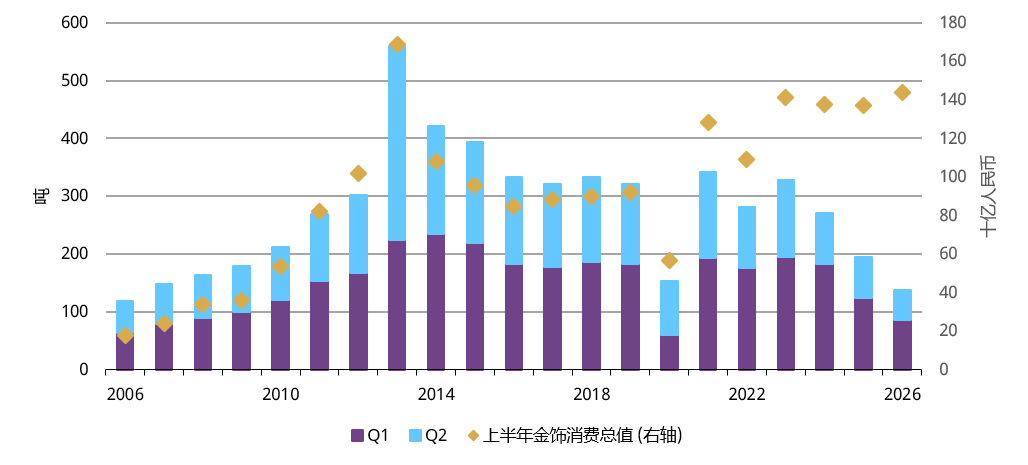
This trend continued throughout the first half of the year: although consumers switched to lightweight products due to cost considerations, spending on jewellery did not decrease — total jewellery consumption in the Chinese market reached RMB 141.9 billion in the first half of the year, up 2% year over year, the second-strongest level in the first half of the year on record.
Overall, the trend of market polarization has further intensified. Lightweight hard and pure gold products and high-end ancient gold series continued to perform excellently. The industry continues to introduce lightweight designs incorporating affordable diamonds, colored gemstones, and enamel elements to provide consumers with choices that are both cost-effective and emotionally valuable. For retailers, these products are still an important source of revenue and revenue. Competition in the high-end ancient French gold sector has also intensified, and many new brands are rapidly emerging to target affluent consumer groups.
Looking to the future
The World Gold Council predicts that demand for jewellery is expected to receive seasonal support in the second half of the year, including factors such as demand for wedding jewellery and holiday spending.
However, the pace of demand recovery will still largely depend on gold price trends and consumer confidence. High gold prices may continue to put pressure on tonnage demand, but demand for lightweight, innovative and high value-added products is still relatively stable.
Meanwhile, according to exchanges between the World Gold Council and major industry players, this round of gold jewellery store contraction is unlikely to end in the short term.