Technology stops, defense rises! There was a big shift in capital during the US stock earnings season. Which companies that underestimate consumer necessities are worth paying attention to?
The Zhitong Finance App learned that as the second-quarter earnings season for US stocks enters an intensive disclosure window, investors are looking at the consumer necessities sector against the backdrop of an uncertain economic environment, focusing on changes in pricing strategies, consumer demand, and profit margin trends of related companies to screen high-quality targets with safety margins.
Seekingalpha said that many blue-chip stocks are viewed as defensive investments, and companies with attractive valuations are likely to attract more attention. The agency selected a number of underestimated consumer necessities to focus on during the second quarter earnings season, covering various segments such as packaged food, food distribution, supermarket retail, tobacco, beverages, household and personal care.
Among them, Conegra (CAG.US), Jinbao (CPB.US), General Mills (GIS.US), and United Natural Foods (UNFI.US) received the highest A+ rating, which is currently the target of the most significant valuation discount within the sector;
This was followed by high-quality companies that received Class A ratings, including Albertsons (ACI.US), Darling International (DAR.US), Kraft Heinz (KHC.US), Altria (MO.US), Pilgrim's Pride (PPC.US), and Moku Liquors (TAP.US);
In addition, individual stocks such as Cal-Maine Foods (CALM.US), CLX.US (CLX.US), and COTY.US (COTY.US) received A-ratings, and there is also considerable room for valuation repair.
The market style is already “voting with your feet” to exchange money
As the earnings season continues to advance, there has been a significant shift in market style. Previously, overvalued technology sectors such as chips, which were boosted by the AI boom, continued to be pressured, stock prices pulled back sharply, and risk aversion in the market heated up. Large amounts of capital were withdrawn from highly volatile growth tracks, and defensive sectors with strong performance certainty and reasonable valuations were placed instead.
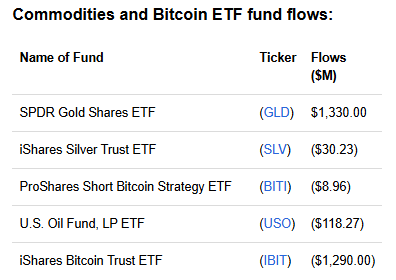
The latest weekly US stock ETF fund flow data can clearly confirm the safe-haven rotation logic of market capital. As of the week ending July 24, of the 11 major industry sectors in the S&P 500 index, 7 sectors achieved net capital inflows. The defensive sector took the lead in capital inflows. Growth was high in volatility, and the financial sector experienced capital outflows.
According to data from etfdb.com, the total net inflow of 11 S&P 500 industry tracking ETFs last week was about US$349.11 million. The defensive sector is far ahead in its ability to attract funds. The medical sector ETF (XLV) topped the list with a net inflow of US$360.84 million, followed by the consumer necessities sector ETF (XLP), with a net inflow of US$3136.4 million, and the industrial sector ETF (XLI) with a net inflow of US$310.86 million.
In contrast, the financial sector ETF (XLF) had a net weekly net outflow of US$403.82 million, the largest outflow sector for the whole week; the optional consumer sector ETF (XLY) and the communications services sector ETF (XLC) had net outflows of US$343.6 million and US$295.48 million respectively.
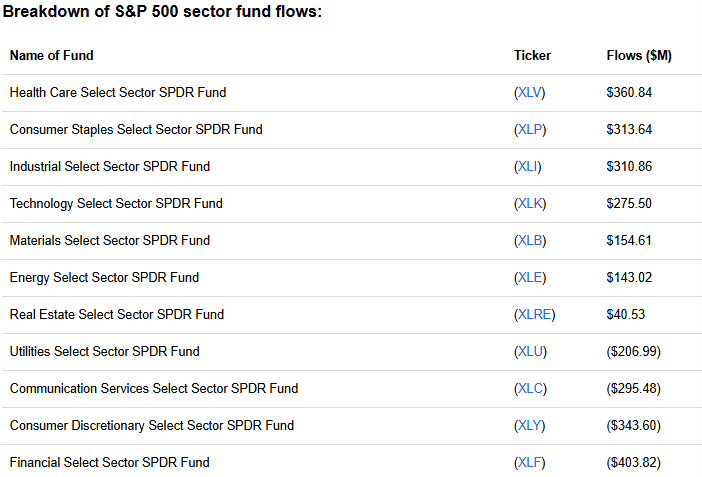
At the same time, trends in the precious metals category diverged. The net weekly inflow of gold ETF (GLD) was 1.33 billion US dollars, and the price rose 1.12% at the same time; however, silver ETF (SLV) had a slight net outflow of 30.23 million US dollars.
Crypto assets became the hardest hit area of the week's capital outflows. Bitcoin ETF (IBIT) had a net weekly net outflow of 1.29 billion US dollars. Bitcoin prices fell 3.26% during the same period, and the sell-off sentiment of risky assets in the market was prominent. The Bitcoin Futures ETF (BITI), which was shorted by 1x, had an outflow of $8.96 million.