
GDP plummeted by 4.8%! The US-Iran conflict cut off oil exports, and Saudi Arabia experienced the biggest economic contraction since the COVID-19 pandemic
The Zhitong Finance App notes that the Saudi Arabian economy experienced the sharpest quarterly contraction since the outbreak of the COVID-19 pandemic due to the challenge posed by the US-Israel war against Iran to the critical oil industry. Preliminary data released on Thursday showed that in the three months to June, the country's GDP fell 4.8% year over year. In comparison, the growth rate for the first quarter was 3%.
The economic contraction was mainly driven by a 24.7% decline in the oil sector, which grew by 2.9% in the first quarter. Non-oil activity, the focus of the Saudi authorities' reshaping of the economic landscape, grew 0.6% in the current quarter compared to 2.9% in the previous quarter.
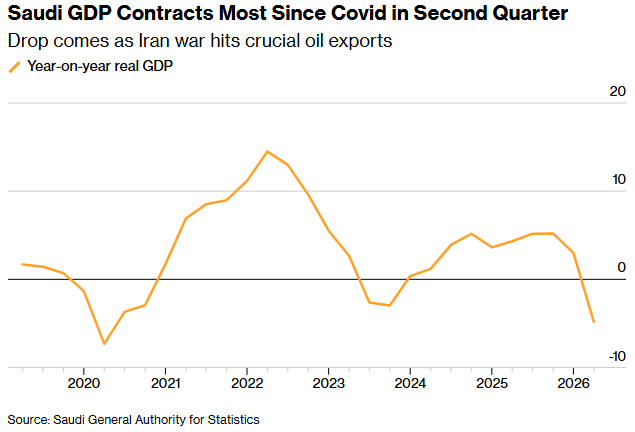
Saudi Arabia's GDP fell sharply in the second quarter
These data highlight the pressure that the war between the US and Iran has put on the Middle East's largest economy for several months, and there is still no sign of a clear peace agreement in the short term. At various stages of the conflict, Iran attacked US allies along the Persian Gulf coast, including Saudi Arabia's energy facilities.
The crisis paralyzed the Strait of Hormuz for several weeks. As a major transportation route in the Gulf region, the strait once carried one-fifth of the world's oil transportation. With the US and Iran reaching a preliminary peace agreement, Saudi exports through this route resumed in June, but after the cease-fire agreement broke down this month, it faced a new threat from Iran.
As the world's largest oil exporter, Saudi Arabia has taken countermeasures to divert crude oil delivery to the Red Sea port of Yanbu (Yanbu) via pipeline, thus providing another export route to the global market. However, the new threat to Saudi ports and shipping from the Iran-backed Houthis from neighboring Yemen has now also increased the risk to this route.
Saudi oil production is still below pre-war levels, but the country has benefited to some extent from a sharp rise in crude oil prices, which reached $92.7 per barrel on Thursday.
The International Monetary Fund (IMF) said Saudi Arabia is “showing agility and resilience,” which reflects the country's “strong macroeconomic fundamentals and diversified oil and logistics infrastructure.”
The IMF stated in a statement on Wednesday that the economy is expected to recover steadily as maritime traffic gradually returns to normal in the Strait of Hormuz. The agency expects Saudi economic growth to slow to 1.7% in 2026, then accelerate to 5.5% the following year.
The International Monetary Fund also said that in the medium term, economic growth will be supported by “strong consumption and investment (including government-led projects and major international activities) and continued structural reforms under the 'Vision 2030'.”