
US stock outlook | The three major stock index futures rose sharply, and 30-year US bond yields soared to 19-year highs Apple (AAPL.US) and Amazon (AMZN.US) released financial reports after the market
Pre-market market trends
1. Before the US stock market on July 30 (Thursday), futures for the three major US stock indices rose sharply. As of press release, Dow futures were up 0.57%, S&P 500 futures were up 0.74%, and NASDAQ futures were up 1.50%.

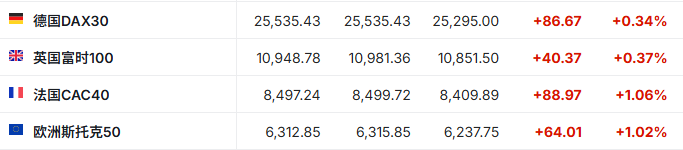
2. As of press release, the German DAX index rose 0.34%, the British FTSE 100 index rose 0.37%, the French CAC40 index rose 1.06%, and the European Stoxx 50 index rose 1.02%.
3. As of press release, WTI crude oil fell 1.31% to $83.35 per barrel. Brent crude oil fell 1.18% to $87.05 per barrel.

Market news
The bond market “votes with your feet”: Walsh hawkish rhetoric is hard to stand still, and the yield on 30-year US bonds soared to a 19-year high. The bond market sent a clear signal: Despite the tough rhetoric of Federal Reserve Chairman Kevin Walsh on curbing inflation, he doesn't seem to be in a hurry to use the central bank's policy tools to deliver on his promises. After the Federal Reserve kept interest rates unchanged for the seventh month in a row, investors sold off 30-year US Treasury bonds in a big way, driving their yield to soar by 14 basis points to nearly 5.23%, a record high in 19 years. This shift in the market reflects growing concerns among investors that it will be difficult for Walsh to contain inflation which has been above the Federal Reserve's target level for five consecutive years. In this context, bondholders, on the one hand, lowered the yield on shorter-end treasury bonds — which showed that they quickly lowered their bets on the Fed's immediate interest rate hike; on the other hand, they demanded that long-term treasury bonds provide higher risk compensation to hedge against inflationary uncertainty in the next few years. The decline in two-year yields went hand in hand with the rise in 30-year yields, making the yield curve steeper after the current Federal Reserve decision, at least the highest since the mid-90s of the last century.
The Bank of England kept interest rates on the sidelines, and energy risk became the key to subsequent policies. The Bank of England kept the benchmark interest rate unchanged at 3.75%, in line with general market expectations. Despite the escalation of the conflict in the Middle East, which may push up energy prices and increase inflationary pressure, the Bank of England chose to stay on hold. In recent months, UK inflation has continued to fall short of market expectations, and economic activity has remained relatively resilient. However, Bank of England officials are increasingly worried that continued disturbances in energy supply will drag down economic growth and push the domestic economy to face wider upward pressure on prices. The Bank of England's 9-member monetary policy committee made this decision after the Federal Reserve announced its interest rate decision. Previously, the Federal Reserve also kept interest rates unchanged, but 3 of the 12 voting members advocated an immediate rate increase. The ECB also kept interest rates unchanged earlier this month, while hinting at a possible rate hike in September.
Anthropic and open source models collided OpenAI executives with a “reassurance pill”: July's annualized revenue surpassed the sum of the second quarter. Against the backdrop of continued intensification of competition in the industry, OpenAI management unleashed business confidence for all employees. According to reports, during an internal meeting with employees on Wednesday, Chief Financial Officer Sarah Flair and Board Chairman Brett Taylor praised OpenAI's revenue growth and discussed competition with Anthropic. Flair said that OpenAI's annualized recurring revenue (ARR) in July already exceeded total revenue for the entire second quarter. Flyer and Taylor said that the increase in performance was mainly due to the release of the GPT-5.6 series model, the launch of the new enterprise ChatGPT Work, and the continued increase in the usage rate of the AI programming tool Codex. According to media reports in March, OpenAI's annualized revenue recently surpassed 25 billion US dollars.
Pakistan: US-Iran negotiations are still ongoing, aimed at normalizing the situation. At the regular weekly press conference in Islamabad, Pakistan's Foreign Ministry spokesman Tahir al-Adabi said that negotiations between the US and Iran to restore stability — particularly in the Strait of Hormuz — are “ongoing”. He said that the two sides should find a solution through dialogue and diplomacy, and Pakistan has always been committed to resolving the issue through diplomatic means. At the time of publication of the above statement, the conflict in the Middle East region escalated as the US retaliated against Iran's attack on the US military with a new round of attacks. According to a post posted by the US Central Command on Wednesday on the X platform, the US side hit dozens of targets during the two-hour operation aimed at weakening Iran's ability to threaten the US military, Arab allies, and commercial shipping in the region.
The report said that the Korea Exchange is considering a temporary ban on short selling. The source responded that it is currently only in the process of discussion. According to media reports, the Korea Exchange has begun to examine the possibility of implementing a “temporary ban on short selling” and “reducing the limit on price increases and falls” as one of the high-intensity measures to deal with the sharp decline in the stock market. According to previous news, the Korea Exchange conducted internal discussions on the afternoon of the 29th on the feasibility of temporarily banning short selling transactions and the time required to implement the system. Infomax, a subsidiary of Yonhap News Agency, quoted a source familiar with the relevant situation as saying, “Currently, we have only confirmed that this is technically possible,” but the person also emphasized: “This is only a discussion in the process of confirming available means to mitigate stock market volatility; it is not based on implementation.”
The European Union launched an AI gigafactory program, leveraging an investment of more than 30 billion euros. The EU launched a tender today and plans to establish up to 7 artificial intelligence gigafactories in Europe. This is the EU's latest round of important steps to promote European technological autonomy and achieve the ambition of an “artificial intelligence continent.” The plan is led by industry and has received financial support of up to 10 billion euros from the EU and member states, and is expected to leverage at least 20 billion euros of private investment across the EU. The plan will expand AI computing capabilities in Europe and provide infrastructure for startups, growing businesses, SMEs, industry, academic institutions, and the public sector to train, reason, and fine-tune advanced AI models. The AI Gigafactory will integrate advanced AI processors, software and cloud technology stacks, high-speed connectivity networks, and energy-efficient data centers. The plan will be combined with Europe's existing network of 19 AI factories to further strengthen Europe's leadership position, resilience and strategic autonomy in the field of technology.
Individual stock news
AI gambling ushered in testing time! Amazon (AMZN.US) Q2 earnings report core highlights: AWS is the biggest variable, and cash flow affects market sentiment. Amazon will release its second-quarter earnings report after the US stock market closes on July 30 (Thursday). Investors focus on three core signals: whether the cloud computing service business AWS is growing at an accelerated pace, whether retail profit margins remain stable, and whether huge spending in artificial intelligence (AI) related fields is expected to further drive future growth. Analysts generally expect Amazon's Q2 revenue to reach 19.2 billion US dollars, up 17% year on year, slightly lower than the median value of the company's previous guidance range of 1940 billion to 1990 billion US dollars, but it is still expected to hit the fastest growth rate in five years; operating profit is expected to exceed 23 billion US dollars, and earnings per share are expected to be 1.81 US dollars, up from 1.64 US dollars in the previous quarter and 1.32 US dollars in the same period last year. The much-publicized revenue growth rate of the AWS cloud business is expected to exceed 30% for the first time since 2022, and AI-related cloud services will continue to be the main driving force for growth. The main topics of this Amazon earnings call will include the 2026 capital expenditure guidance update, expected return on investment due to huge AI investments, operating margin outlook, recent developments in Trainium and chip production capacity, and an in-depth analysis of Prime Day trends.
The “light capital AI” route faces a major test of performance! Apple (AAPL.US) is on the list tonight, and the options market is cautiously bullish. Early on Friday morning, Beijing time, Apple will release financial results for the third fiscal quarter of the 2026 fiscal year. This is not only a key window for the market to test its performance resilience and AI strategy, but it will also be the last earnings conference call before Tim Cook (Tim Cook) hands over the position of CEO (CEO) to hardware director John Ternus (John Ternus) on September 1. Facing the peak of stock prices approaching historic highs and market capitalization approaching 5 trillion US dollars, the derivatives market is sending a strong signal of high risk hedging and profit locking in. Although the market generally expects Apple to hand over a solid report card again, the options market's pricing reflects unprecedented prudence. Currently, Apple's stock price is close to 338 US dollars, and the average premium for the 340 US dollar cross-option is about 12.05 US dollars. The short-term trading range is expected to be 328.45 US dollars to 352.55 US dollars, implying that the stock price fluctuates about 3.5% to 3.8% after the financial report. According to Cboe LiveVol data, this implied fluctuation is far higher than the historical average fluctuation of over 1% over the past year. According to SpotGamma data, options market pricing fluctuated around 4% after financial reporting. The market's expectations for Apple this quarter are already quite adequate. Wall Street Consensus estimates that Apple's Q3 revenue is about US$108.96 billion, up 15.87% year on year, close to the company's previous revenue guidance limit of 14% to 17%; earnings per share are expected to be 1.89 US dollars, up 20.38% year on year. Apple has surpassed analysts' revenue expectations for 13 consecutive quarters.
The cost of the AI project got out of control, Amazon engineers were in a hurry to fortify it, and tech giants couldn't escape the pain of implementing the technology. According to reports, some Amazon AI projects have experienced serious cost overruns. Employees call them “disastrously high” expenses. The root cause is improper deployment methods and lack of cost control measures. Senior engineers revealed at an internal meeting on Tuesday that the operation of migrating traditional programming tasks to AI models has caused significant “unplanned” expenses, and the team is working to establish automated protection mechanisms to curb subsequent cost expansion. A senior employee admits that it is currently difficult to accurately estimate the true cost of any AI-related project, reflecting the financial uncertainty of the actual implementation of this technology. The company, with a market capitalization of about 2.5 trillion US dollars, is promoting large-scale layoffs with the aim of reducing operating costs while freeing up space for capital expenses of about 200 billion US dollars this year, the vast majority of which will be invested in AI and data center construction. The incident revealed that even the world's leading technology companies face common cost management challenges in the AI integration process, and the market will later focus on whether Amazon can balance investment in expansion with financial discipline.
Demand for AI storage is still booming! Samsung (SSNLF.US) handed over explosive financial reports: Q2 chip profits increased 250 times, and revenue and profit reached record highs. On Thursday, South Korean memory chip giant Samsung Electronics handed over a quarterly report that went down in history — operating profit surged 1814% year on year to 89.5 trillion won (about 62 billion US dollars), up 56.4% month-on-month, and revenue of 171.5 trillion won increased 130% year over year, up 28% month on month; both set a record high in history. The single-quarter profit for the second quarter of 2026 already exceeds Samsung's net profit in 2024 (33.6 trillion won) and 2025 (45.2 trillion won) combined. Net profit reached 71.62 trillion won (about 49.6 billion US dollars), a sharp increase of 1299.9% over the previous year. Earnings per share were 10,849 won. The day before, SK Hynix (SKHY.US) also announced the strongest performance in history, with operating profit soaring 557% to 60.5 trillion won. In the second quarter of 2026, the two South Korean storage giants achieved a combined operating profit of about 150 trillion won (about 104 billion US dollars) — equivalent to a daily net profit of more than 1.1 billion US dollars.
Insiders are intensively reducing their holdings! The CEO of Micron (MU.US) sold 37.3 million US dollars of shares in a single week, and executives “cashed out” in compliance with regulations, which may amplify short-term sentiment shocks. Micron Technology CEO Sanjay Mehrotra sold about $37.3 million worth of company shares last week, according to regulatory documents disclosed on Tuesday. Mehrotra sold more than 40,000 shares on July 24, according to a pre-drawn trading plan. Against the backdrop of a general sell-off of popular memory chip stocks, the chipmaker's stock price peaked on June 25 and has since fallen by about 34%. On Tuesday, the stock fell for the third consecutive trading day, hitting a new low in two months. In the past six months, Mehrotra has not reported any record of increase in stock holdings on the open market. The biggest deal he disclosed occurred in late June, when he sold 28,506 shares through multiple transactions, and then reduced his holdings further in July. In addition to Micron, many leading semiconductor companies, including Nvidia, their core executives and directors have also recently frequently reduced their holdings by tens of millions or even hundreds of millions of dollars.
Disney (DIS.US) “Track Change” AI App! OpenAI Codex breaks into the hinterland of business operations and shifts the main AI investment line from computing power to application monetization. Some media quoted information revealed by people familiar with the matter as reporting that Walt Disney, one of the Hollywood giants, has stopped using GitHub Copilot, an AI application superplatform owned by Microsoft (MSFT.US), instead using Codex and other artificial intelligence programming tools developed by OpenAI, a global AI application leader. The media quoted a screenshot of internal information from people familiar with the matter as saying that the adjustment is scheduled to be implemented in August, and that Claude Enterprise and Cursor AI application tools will continue to be retained, and will only affect artificial intelligence applications and programming in the US region. The media added that according to information conveyed to employees by a Disney internal technical department head, the move would not affect the international team.
Key economic data and event forecasts
20:30 Beijing time: The monthly rate of personal expenditure in the US in June, the annual rate of the US PCE price index for June, the preliminary value of the annualized quarterly rate of US real GDP for the second quarter, and the number of jobless claims in the US for the week ending July 25.
Performance Forecast
Friday morning: Apple, Amazon, Coinbase (COIN.US), Rivian (RIVN.US)
Friday pre-market: ExxonMobil (XOM.US), Chevron (CVX.US), Abbv (ABBV.US)