
Inflation concerns weigh on US debt: BlackRock's “widow maker” ETF hits a new low in 22 years, market decline hedging costs soar
The Zhitong Finance App learned that as concerns about inflationary stickiness continued to impact fixed income portfolios, the sharp decline in long-term US Treasury bonds caused one of BlackRock's popular exchange-traded funds to fall to its lowest level in more than 20 years. BlackRock's iShares 20-year Treasury bond ETF (TLT) fell to its lowest point since 2004 on Friday, even lower than the low during the global financial crisis. The ETF is down more than 50% from its all-time high in 2020, more than any previous time.
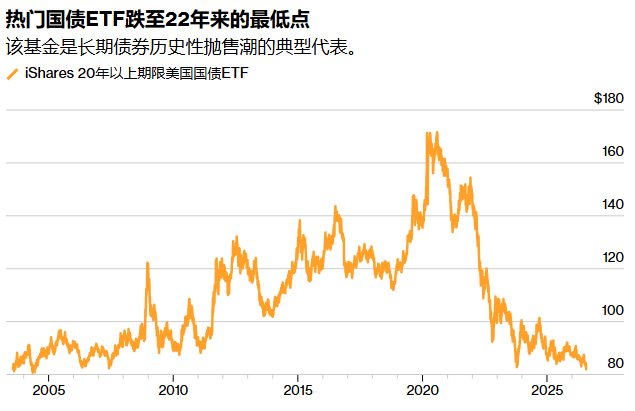
This fund — dubbed the “widow maker” by some in the industry — has always been a popular tool for investors to sell bottom bonds, but as yields continue to rise and the value of the fund falls, many dips buyers have suffered heavy losses. TLT's total assets once soared to over 60 billion US dollars in 2024, but since the long-awaited rebound did not occur, it has now fallen back to 41 billion US dollars.
On Friday, the 30-year US Treasury yield rose to 5.28%, the highest level since 2007. Previously, the Federal Reserve kept interest rates unchanged on Wednesday, triggering a wave of sell-offs. Investors feared that Federal Reserve Chairman Kevin Walsh would not be able to control inflation, which had been above the target level of the Federal Reserve for five consecutive years.
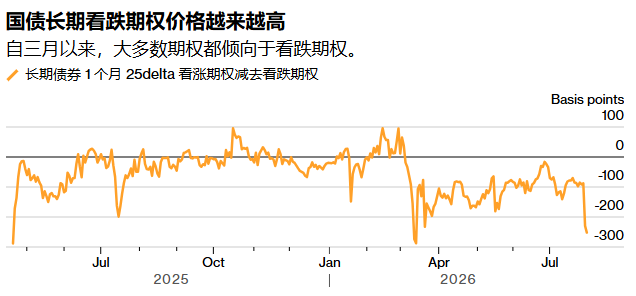
Meanwhile, as the impact of this week's Federal Reserve policy meeting continues to affect the interest rate market, bond traders paid the highest premium since March to prevent long-term bond yields from rising further. Fears that the Federal Reserve may not be able to act quickly to curb inflation have led to the 30-year US Treasury yield rising to the highest level since 2007 in recent days, and the cost of hedging larger losses has also increased: the premium of put options over call options (measured by the 1-month 25 delta skewed implied volatility index) has reached its highest level in about five months.
Investors are hedging the risk of 10-year and 30-year treasury bonds through a series of options structures around US Treasury bonds due in September. This position allocation shows that they are worried that interest rate volatility will increase if concerns about inflation continue. Despite recent increases in yield, the ICE BofA MOVE index, which is an indicator of the volatility of the US Treasury bond market, remains relatively sluggish.
On Friday, the price trend of US Treasury bonds weakened again, and long-term treasury yields continued to rise, echoing increases in crude oil and European bonds. The flow of funds on Friday showed that investors expected the 10-year Treasury yield to rise to around 4.8%, about 10 basis points higher than the current level.

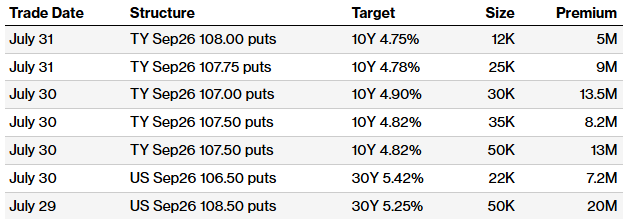
Investors are increasingly worried that Federal Reserve Chairman Kevin Walsh will not be able to control inflation, which has been above the central bank's target level for five consecutive years. On Wednesday, a large buyer of long-term US Treasury put options paid a premium of around $20 million to hedge the risk that the 30-year Treasury yield could rise to about 5.3%. This week, the Federal Reserve kept interest rates unchanged for the seventh month in a row. The option was bought for between 23 and 37 basis points, but the price has soared to 75 basis points on Friday.
Since the Federal Reserve meeting, options capital inflows have been large. The target yield is as high as 4.9% on 10-year Treasury bonds and 5.42% on 30-year Treasury bonds, which is slightly lower than the 2007 high.