
AI Unicorn IPO Feast Press the pause button! OpenAI's listing was allegedly delayed until 2027, and SpaceX plummeted as the most glaring warning
The Zhitong Finance App learned that the “biggest IPO in history” carnival lasted less than two weeks. SpaceX plummeted from a peak of $225 to $108, triggering a deep tsunami of confidence across the AI capital market. According to several people familiar with the matter, ChatGPT developer OpenAI has taken a sharp step back from its initial ambition of “going public as soon as possible this fall,” and currently clearly favors delaying the IPO schedule until 2027. Behind this delay is a head-on collision between CEO Sam Ultraman's insistence on the trillion-dollar valuation bottom line and the harsh reality of the market.
SpaceX's “Lessons from the Past”: $225 Binge vs. $108 Sobriety
On June 12, SpaceX landed on the NASDAQ with an issue price of 135 US dollars. On the first day of listing, the market capitalization surpassed 1.77 trillion US dollars, and the scale of capital raised set the record for the largest IPO in the history of US stocks. Retail subscribers exceeded 100 billion US dollars, and the market once saw it as a perfect model for the dual narrative of AI and space economy.
However, the carnival only lasted less than two weeks. On June 23, SpaceX plummeted by about 16% in a single day. On July 15, the stock price fell below the issue price of 135 US dollars for the first time. By the close of July 28, SpaceX's stock price was reported at $116.41, a cumulative drop of 48.4% from the all-time high of $225.64, close to a “fall”; it fell further to $108 at the close on July 31 (Friday), and the cumulative evaporation of more than 1.2 trillion US dollars from the higher market capitalization was over 1.2 trillion US dollars.
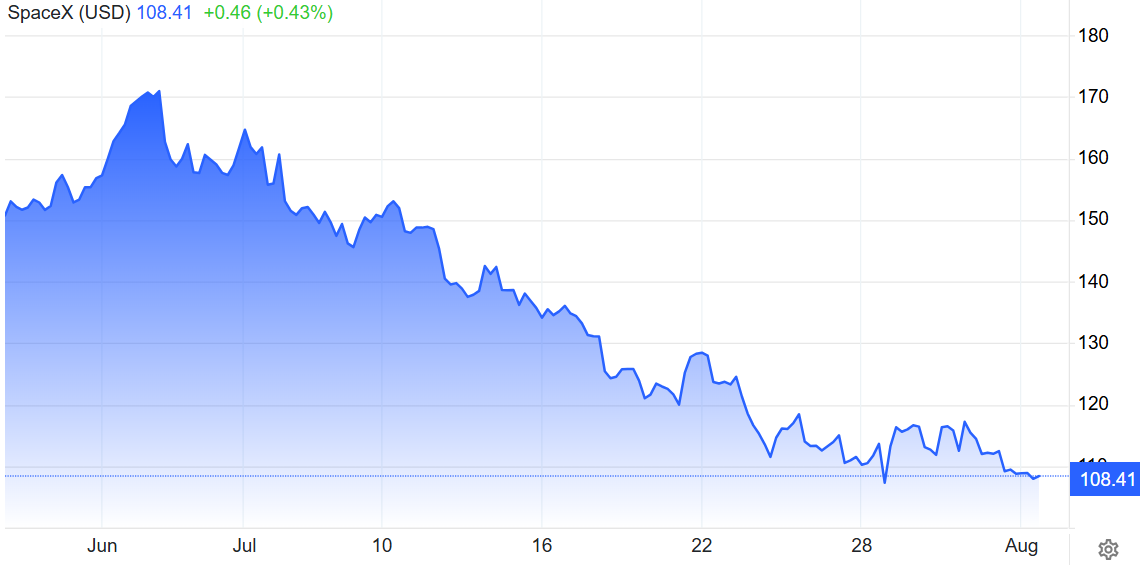
This sharp drop was a direct psychological deterrent to OpenAI's IPO plans. Bankers providing IPO proposals for OpenAI clearly warned that recent sharp fluctuations in technology stocks and a sharp drop in stock prices after SpaceX's listing could seriously weaken retail investors' enthusiasm for OpenAI's issuance of shares. A source familiar with the matter revealed that OpenAI's advisors spoke bluntly with the company in the past week that retail investors may lack enthusiasm for its stock.
Fidelity Securities wrote in a recent report that OpenAI's anchored valuation is “closer to $700 billion to $800 billion rather than $1 trillion.”
The trillion-dollar obsession: Ultraman's “red line” and the consultant's dilemma
OpenAI's valuation dilemma is a core contradiction in delaying decision-making. In March 2026, OpenAI completed financing of 122 billion US dollars, and the post-investment valuation reached 852 billion US dollars. It is already the unlisted technology company with the highest valuation in the world. However, this achievement fell far short of Ultraman's psychological expectations. Ultraman has been urging a team of advisors, including bankers and lawyers, to try to push the company's IPO valuation to $1 trillion, according to people familiar with the matter.
The consulting team proposed two solutions to Ultraman: one was to delay the IPO until 2027, wait for the market environment to improve, while bringing the company's financial performance closer to the trillion dollar valuation target; the other was to go public before the end of 2026, but accept a lower valuation. According to a person who has been in contact with Ultraman, when advisers proposed this option, Ultraman said any plan to cut the valuation below trillion dollars “won't work.”
At the same time, OpenAI's financial situation is also testing investors' patience. The company's net loss reached 38.5 billion US dollars last year, mainly due to huge expenses on computing power infrastructure construction, R&D investment, and corporate restructuring. According to The Information, in the first quarter of 2026, OpenAI burned 3.7 billion US dollars in cash, more than half of the $5.7 billion revenue for the same period. The company expects to spend $600 billion in computing and hardware by 2030.
Anthropic's “rush”, a silent provocation valued at 965 billion
While OpenAI is hesitating, its biggest competitor, Anthropic, is rushing to the open market at full speed. At the end of May this year, Anthropic completed Series H financing of 65 billion US dollars, and the post-investment valuation climbed to 965 billion US dollars, surpassing OpenAI's valuation of 852 billion US dollars. On June 1, Anthropic took the lead in secretly submitting an IPO application to the SEC. On July 15, media reported that Anthropic is advancing its IPO plan at full speed. The underwriting bank has begun arranging meetings between management and potential investors, and the listing is expected to be completed in October this year as soon as possible. Anthropic has selected Morgan Stanley, Goldman Sachs, and J.P. Morgan Chase as lead underwriters.
According to people familiar with the matter, in recent months, some of OpenAI's big investors have privately expressed concern that the company is spending cash too fast compared to its growth, while others have hedged their bets on OpenAI by investing in Anthropic. Anthropic is speeding up plans for a fall IPO and has begun meeting with potential investors to highlight its lead over the ChatGPT manufacturer. OpenAI, which initially hoped to go public before Anthropic, may now have to wait until next year.
Market background: The AI sector is collectively cooling down, and the IPO window is narrowing
OpenAI's delay is not an exception. The analysis indicates that the IPOs of large model companies, which were originally scheduled to launch in the second half of 2026, may be postponed to the first half of 2027 due to declining market risk appetite and uncertainty in the liquidity environment. The change in the IPO schedule means that the company's high-profile listing plan will be significantly delayed from what the market had previously anticipated this fall.
OpenAI secretly submitted S-1 documents to the SEC on June 8. The company said in a statement at the time: “We haven't decided when to go public, and it may take time because some things may be easier to move forward as a private company. Submitting the IPO documents allows us to have a faster option to enter the open market when listing is more in the company's interest.”
The most intuitive interpretation of the 2027 timeline is: OpenAI is capable of waiting. By delaying, the company can continue to expand usage, improve pricing, and seek a more stable business mix between consumer products, enterprise tools, and infrastructure partners before entering the open market subject to quarterly discipline. According to the latest report, OpenAI's annualized recurring revenue in July has surpassed the total for the entire second quarter.