
IPO News | Lijing Technology once again listed the Hong Kong Stock Exchange as the world's second largest consumer electronics camera module provider
The Zhitong Finance App learned that according to the Hong Kong Stock Exchange's disclosure on July 31, Lijing Innovation Technology Co., Ltd. (Lijing Technology for short) has once again submitted a listing application to the main board of the Hong Kong Stock Exchange. CITIC Securities and CICC are co-sponsors. The company submitted its listing to the Hong Kong Stock Exchange on November 28, 2025.
Company profile
According to the prospectus, the company is a leading global provider of precision optical solutions, focusing on the high-end optical module and system integration market for global consumer electronics, automotive electronics, smart office applications, and other emerging fields such as intelligent robots, XR smart terminals, and smart glasses. According to Frost & Sullivan, in terms of 2025 revenue, the company ranked second among global manufacturers in the field of consumer electronics camera modules and number one among Chinese manufacturers.
According to Frost & Sullivan, in terms of 2025 revenue, the company ranked second among global manufacturers in the field of consumer electronics camera modules and number one among Chinese manufacturers. Among them, in terms of revenue in 2025, the company ranked second among global manufacturers in the field of high-end smartphone camera modules, first among Chinese manufacturers, and number one among global manufacturers in the field of laptop and tablet camera modules.
Financial data
revenue
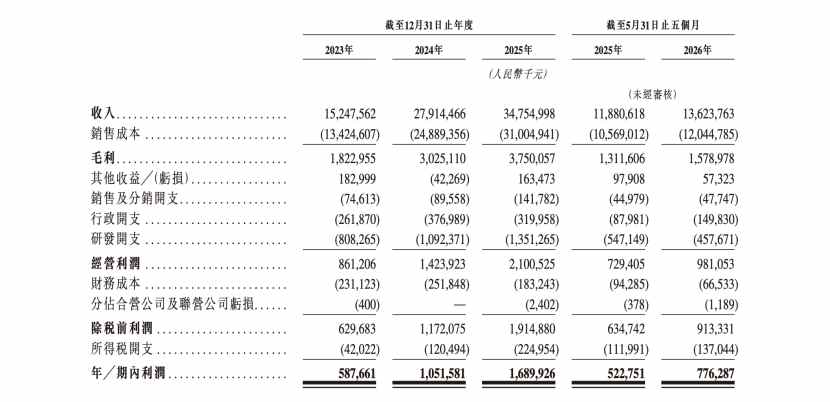
Mainly from sales of consumer electronics products, including camera modules for smartphones, laptops and tablets, the total amount was RMB11.92 billion, $23.85 billion, $31.28 billion, $10.59 billion and $12.42 billion respectively in 2023, 2024 and 2025, and the five months ended May 31, 2026, accounting for 78.2%, 85.5%, 90.0%, 89.2% and 91.2% of total revenue for each year/period, respectively.
Gross profit and gross profit margin
In 2023, 2024, and 2025, the company's gross profit was approximately RMB 1,823 billion, RMB 3,025 billion, and RMB 3.75 billion respectively; the recorded gross margins were approximately 12.0%, 10.8%, and 10.8%, respectively.
Profit for the year/period
In 2023, 2024, and 2025, the company's annual profit was approximately 588 million yuan, 1,052 million yuan and 1,690 million yuan respectively, with compound annual growth rates of 69.6%; net profit margins were 3.9%, 3.8% and 4.9%, respectively. For the five months ended May 31, 2026, profit for the period was 776 million yuan, up 48.5% year on year, and the net profit margin further improved to 5.7%.
Industry Overview
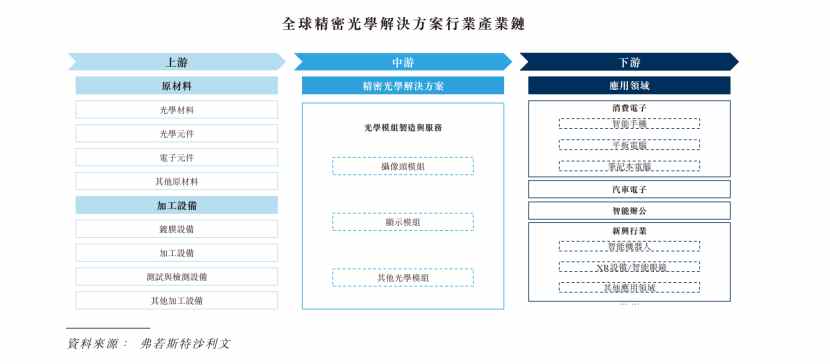
Precision optical solutions refer to comprehensive solutions based on optical modules provided based on high-precision optical design, manufacturing and inspection technology. They cover various types of products such as camera modules and display modules, and are widely used in sensing, imaging, distance measurement and display scenarios. Precision optical solutions are a key support for the development of consumer electronics, automotive electronics, smart offices and emerging fields, such as intelligent robots, XR smart terminals, smart glasses, naked eye 3D products, holographic projection and immersive displays. They are of great significance in improving system performance, ensuring operational stability, and promoting technological innovation.
The rapid development of AI technology places higher demands on optical modules. Optical modules require higher pixels, stronger sensing capabilities, and lower power consumption to meet the needs of intelligent devices for accurate sensing, immediate analysis, and adaptation to complex environments. Therefore, optical modules are evolving from traditional sensing and imaging functions to the fusion of intelligent sensing and computational optics, providing key support for the continuous upgrading of AI hardware. At the same time, the introduction of AI has significantly raised the level of intelligence in image processing and interaction, accelerated the spread of cross-scene applications, and promoted the upgrading of demand and industry expansion for precision optical solutions. AI also streamlines optical manufacturing by improving process automation and quality control, so that high-precision components required for AI hardware can be iterated at a faster speed and more stable production.
Consumer electronics precision optical solutions are the core support for smart consumer electronics devices to achieve high-quality images, perceptual interaction, and differentiated experiences. Affected by factors such as the global economic slowdown and weak demand for consumer electronics terminals, the global consumer electronics precision optical solutions market shrank from about US$79.6 billion in 2021 to approximately US$72.7 billion in 2023. With the rapid implementation of next-generation optical technologies such as AI imaging algorithms and multi-camera fusion, the market picked up and reached about US$86.9 billion in 2025, with a compound annual growth rate of 2.2% between 2021 and 2025. Driven by the upgrading of consumer electronics smart device imaging experiences and the expansion of innovative optical applications, the global consumer electronics precision optical solutions market is expected to reach US$124.9 billion by 2030, with a CAGR of 9.9% between 2026 and 2030.
Among them, AI has become the core driving force for the growth of the global consumer electronics precision optical solutions market. Along with the rapid increase in shipments of smart terminals such as AI smartphones, AI tablets, and AI laptops, optical modules have been given more computational photography, intelligent sensing, and immersive interaction functions, driving the simultaneous increase in the market value and technical complexity of optical demand. The global market for precision optical solutions for AI consumer electronics is expected to reach approximately US$94.2 billion by 2030, with a CAGR of 27.3% between 2026 and 2030.
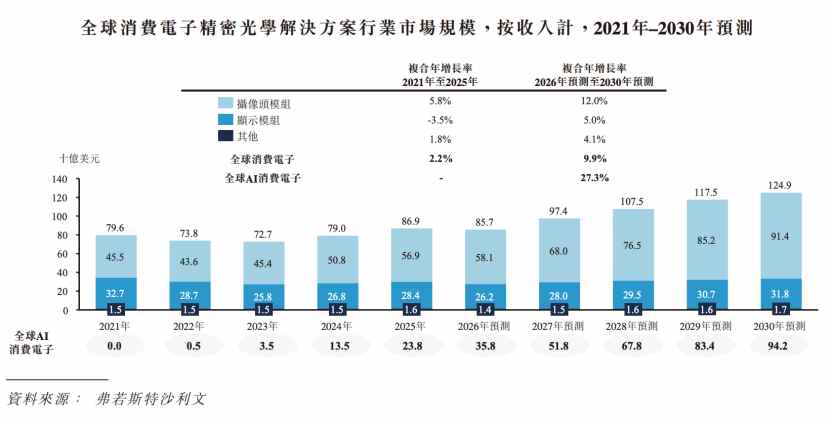
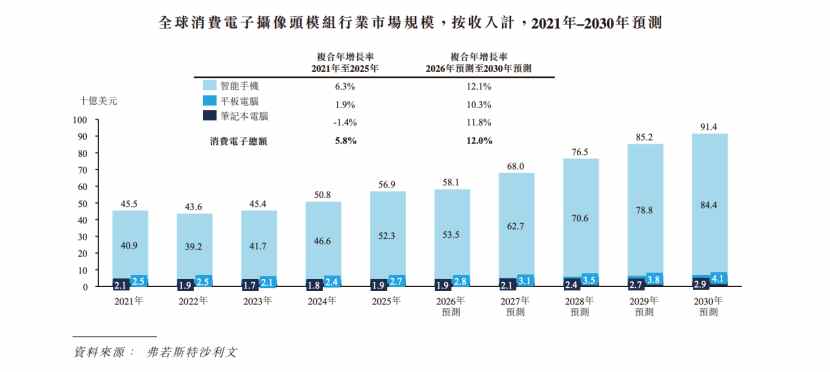
As a key component in precision optical solutions, consumer electronics camera modules are widely used in consumer electronics products such as smartphones, tablets, and laptops. In 2021, the global consumer electronics camera module market was about US$45.5 billion. Due to fluctuations in demand for consumer electronics terminals, the market size fell back to US$43.6 billion in 2022. Since 2023, with multi-camera trends, image algorithm upgrades, and AI visual functions becoming increasingly standard, the market size has continued to grow, reaching US$56.9 billion in 2025, with a compound annual growth rate of 5.8%. The global consumer electronics camera module market is expected to reach US$91.4 billion by 2030, with a CAGR of 12.0% between 2026 and 2030.
Smartphones are still the largest application market for camera modules, accounting for more than 90% in 2025, followed by tablets and laptops, accounting for 4.8% and 3.4% respectively. Looking ahead, the tablet and laptop markets will place higher demands on 3D imaging, face recognition, and video conferencing experiences, driving the penetration of high-resolution and multi-function camera modules. The overall market size is growing rapidly, with compound annual growth rates of 10.3% and 11.8% respectively.
Board Information
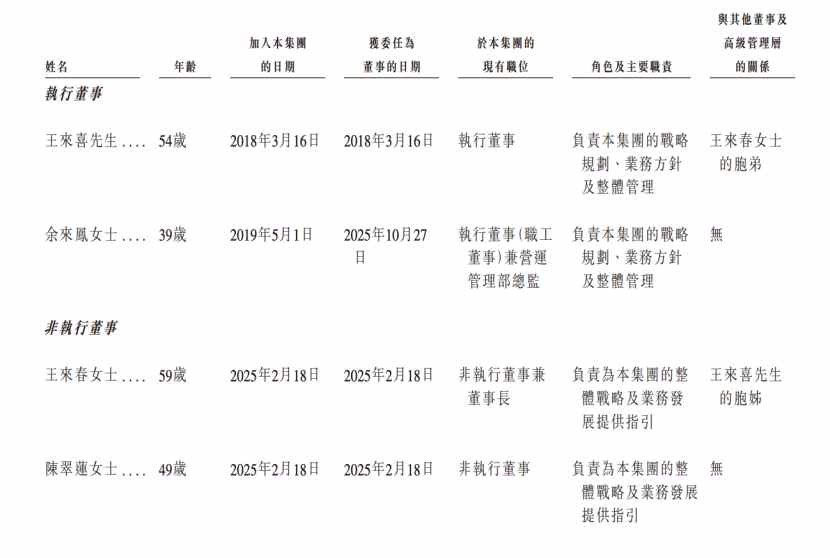
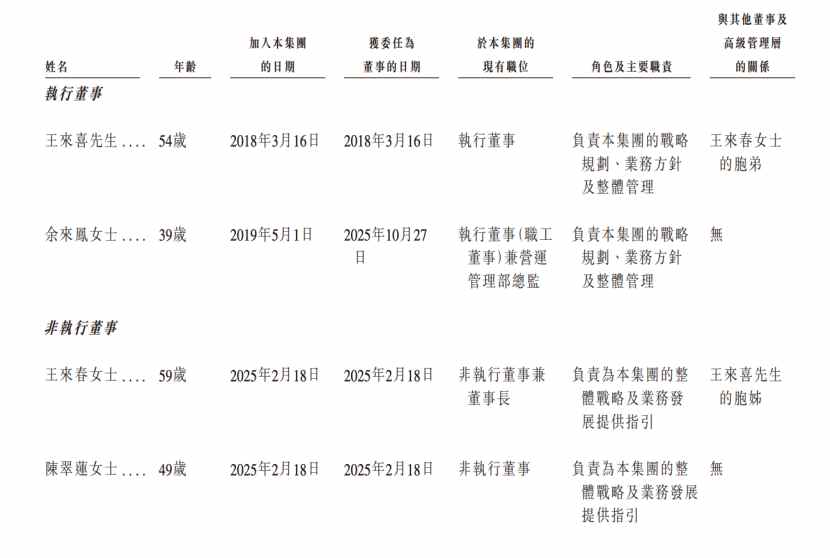
The Board consists of nine directors, including 2 executive directors, 4 non-executive directors and 3 independent non-executive directors.
Shareholding structure
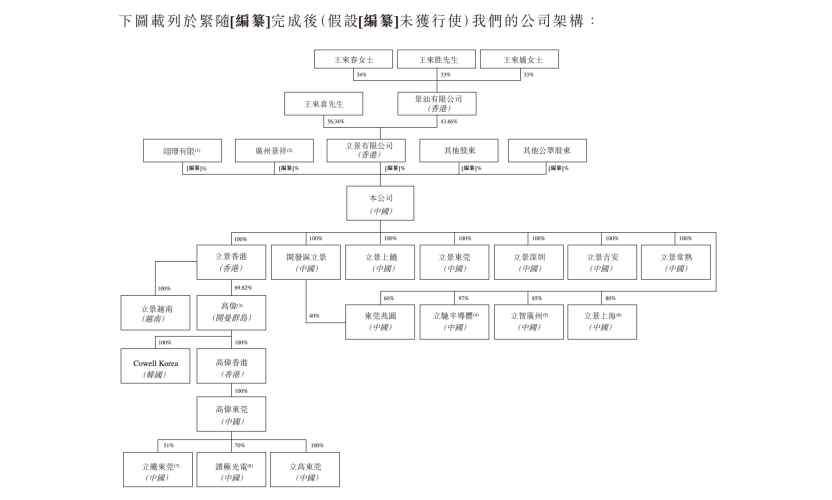
As of the last practical date, the company was owned by Lijing Co., Ltd. and Lijing Co., Ltd. was a company with about 56.34% owned by Mr. Wang Laixi and Jingshan Co., Ltd. (34% owned by Ms. Wang Laichun (sister of Mr. Wang Laixi), 33% by Mr. Wang Laisheng (brother of Mr. Wang Laixi), and 33% owned by Ms. Wang Laixi (sister of Mr. Wang Laixi)).
Intermediary team
Co-sponsors CITIC Securities (Hong Kong) Limited, China International Finance Hong Kong Securities Limited
Legal Advisors: Ouhua Law Firm, Zhong Lun Law Firm, Mingyong United Law Firm
Jingtian Gongcheng Law Firm, a law firm close to the co-sponsor's legal adviser
Auditors and reporting accountants KPMG
Industry Consultant Frost & Sullivan (Beijing) Consulting Co., Ltd. Shanghai Branch