
AWS is speeding up again, and Amazon (AMZN.US) AI investment has entered a return verification period
After the US stock market on July 31, Beijing time, Amazon released financial results for the second quarter of 2026. The most important sign of this financial report is not only that both revenue and profit have exceeded expectations, but that AWS has re-entered the acceleration channel, and the AI and self-developed chip businesses have begun to respond to market questions about huge capital expenses with quantifiable revenue.
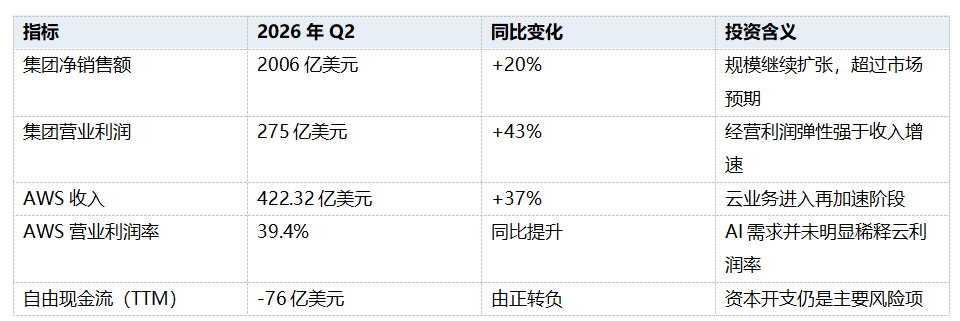
According to Amazon's official earnings report, the company's net sales for the second quarter reached 2006 billion US dollars, up 20% year on year; operating profit was 27.5 billion US dollars, up 43% year on year. Net profit reached $62.6 billion, or $5.75 per diluted share, but this included $53.4 billion in non-operating pre-tax earnings from Anthropic Investments. Therefore, judging the quality of Amazon's performance in this round, we should pay more attention to the four main lines of operating profit, AWS growth rate, advertising growth, and cash flow pressure.
1. Financial Highlights: Growth no longer depends only on retail; AWS has become a core variable
Looking at the business structure, Amazon showed a combination of “stable retail, strong advertising, and cloud acceleration” in the second quarter. North American business revenue was US$116.2 billion, up 16% year on year, and operating profit was US$9.1 billion; international business revenue was US$42.2 billion, up 15% year on year, and operating profit was US$1.7 billion. The retail business did not drag down the Group's profits. Prime Day was brought forward to the second quarter, improved delivery efficiency, and growth in fresh and daily necessities all supported consumer-side performance.
The advertising business is also booming. According to Amazon's official disclosure, ad revenue increased 26% year over year. Driven by e-commerce traffic, Prime Video ads, and AI advertising tools, advertising has become an important force in improving the gross profit structure of retail businesses. For investors, the significance of advertising is that it makes the Amazon retail business no longer just a trading platform with low profit margins, but gradually shift to a “transaction+media+data” compound monetization model.
But what really changed the market narrative this quarter was AWS. AWS's revenue for the second quarter was US$42.232 billion, up 37% year on year, the fastest growth rate in 18 quarters; operating profit was US$16.621 billion, up 64% year on year, and operating margin reached 39.4%. This means that Amazon is not only increasing its investment in the AI cloud competition, but is also beginning to show the simultaneous characteristics of accelerated revenue and improved profit margins.
2. AI commercialization begins to be implemented: AWS, Anthropic form a closed loop with self-developed chips
In the past few quarters, the market's main question about Amazon was: Microsoft Azure and Google Cloud are more clear in AI narratives. Is AWS losing its lead? The answer given in the second-quarter earnings report is quite straightforward. Amazon disclosed that the current annualized revenue operating rate of AWS has reached 169 billion US dollars, on-hand orders have reached 496 billion US dollars, and the annual revenue operating rate of the AI business and chip business has both exceeded 25 billion US dollars, with a year-on-year increase of three digits.
This set of data changed the judgment framework for Amazon's AI investment. Previously, the market saw a rapid rise in capital expenditure, but now it is beginning to see evidence of a response on the demand side. AWS's AI business drives training, inference, data storage, vector databases, security governance, and CPU workloads; self-developed chips Trainium and Graviton assume the role of reducing customer costs and improving the efficiency of Amazon's infrastructure. Amazon revealed in its earnings report that leading AI laboratories such as Anthropic and OpenAI have made multi-gigawatt-level promises to Trainium for many years, which provides greater visibility for AWS's subsequent revenue transformation.
Judging from industry logic, Amazon's advantage is not a single-point model capability, but rather a combination of cloud infrastructure, model platforms, enterprise data, chips, and application layer services. Amazon Bedrock's customer spending in the second quarter exceeded all previous quarters combined, indicating that demand for “multi-model, governable, and deployable” AI platforms from enterprise customers is growing. After entering the age of inference, applications such as agents, code generation, and enterprise workflow automation will simultaneously consume GPU, CPU, storage, and database resources, which is the value of AWS's comprehensive infrastructure.
3. Capital expenditure is a point of disagreement: short-term cash flow is under pressure, and the long term depends on order fulfillment
Amazon's biggest controversy this quarter was still capital expenditure. The company raised its forecast for cash capital expenditure in 2026 from about 200 billion US dollars to about 220 billion US dollars. The Associated Press reports that CEO Andy Jassy said on a conference call that even if it reaches 220 billion US dollars, the company will still not be able to meet all demand in 2026, and it is expected that this state of short supply will continue in 2027, and the reserved demand for 2028 is also quite impressive.
High capital expenditure directly suppresses free cash flow. According to Amazon's official financial report, in the past 12 months ending June 30, 2026, the company's operating cash flow was US$161.4 billion, an increase of 33% over the previous year; however, free cash flow was US$7.6 billion, compared to an inflow of US$18.2 billion in the same period last year, mainly due to a year-on-year increase of 66.1 billion US dollars in property and equipment purchases, and related investments are mainly directed at AI infrastructure.
This is also a problem currently faced by tech giants: AI infrastructure costs money first, then revenue is confirmed, and there is a production capacity construction cycle and depreciation pressure in the middle. The difference is that Amazon used AWS this quarter to accelerate growth, $496 billion in on-hand orders, and an annual revenue operating rate of more than 25 billion US dollars each for the AI and chip businesses, giving a relatively clear explanation of input and output. The market is willing to pay for this logic in the short term, but we still need to see if AI revenue growth can continue to outperform capital expenditure and depreciation pressure.
4. Market reaction: Shifting from “worrying about burning money” to “verifying returns”
After the earnings report was released, Amazon's stock price strengthened markedly. MarketWatch reports that Amazon's stock price once rose by more than 13% in the intraday period after the earnings report, which is expected to be the best single-day performance in many years; Investopedia quoted market opinions as saying that the AWS growth rate exceeded expectations and signs of return on AI investment are important reasons driving up the stock price. It also mentioned that J.P. Morgan raised Amazon's target price to $365 for reasons including increased AWS momentum and improved AI return expectations.
However, the third-quarter guidance still forms a short-term “speed bump.” Amazon expects net sales for the third quarter to be US$19.7 billion to US$20.5 billion, up 9% to 12% year on year; operating profit of US$22.5 billion to US$26.5 billion. The company explained that the advance of Prime Day from the third quarter of last year to the second quarter of this year will affect the year-on-year scale. If the impact of Prime Day is excluded, the year-on-year revenue growth rate for the third quarter will be about 400 basis points higher; at the same time, the exchange rate is expected to have an adverse effect of about 80 basis points.
Therefore, investment judgments on Amazon need to be divided into two levels: in the short term, the stock price has quickly exceeded expectations in Q2, and third-quarter revenue guidance and free cash flow pressure may fluctuate; in the medium to long term, if AWS continues to accelerate and AI and self-developed chip revenue continues to expand, the market's valuation anchor for Amazon may further shift from a “retail platform+cloud profit center” to an “AI infrastructure platform+global consumer ecosystem.”
5. Investment conclusion: Amazon returns to the main AI cloud
Taken together, the core highlight of Amazon's second-quarter earnings report is that AWS is no longer just a cash cow that maintains profits, but has once again become the Group's fastest growing and most deterministic engine. The retail business stabilizes its basic market, and advertising continues to improve its profit structure, while AWS uses revenue growth, profit margins, and order backlog to prove that AI demand is entering a fulfillment period.
The risk is also clear: capital expenditure is already at an all-time high, free cash flow is negative, and depreciation pressure may gradually become apparent in the future. If AI customer demand or enterprise reasoning applications grow less than expected, the market may re-examine the rationality of high investment. However, as far as this quarter is concerned, at least, Amazon handed over an earnings report that can ease the “anxiety of AI burning money.” For long-term investors, subsequent key tracking metrics should include AWS growth rate, AI and chip business annualized revenue, changes in on-hand orders, capital expenditure pace, and free cash flow restoration progress.
6. Conference Call Minutes: Key Signals Released by Management
• AWS growth is picking up speed again. Management said that AWS grew 36.7% year-on-year in the second quarter, accelerating for the fifth consecutive quarter, the fastest growth rate in 18 quarters, and added more than 4.6 billion US dollars in quarter-on-quarter revenue.
• The AI and chip business has become a new growth point. Amazon revealed that the annual revenue operating rate of the AWS AI business and chip business both exceeded 25 billion US dollars, and both achieved three-digit year-on-year growth.
• In-hand orders provide revenue visibility. AWS's on-hand orders reached 496 billion US dollars, a three-digit increase over the previous year. Management believes this reflects the customer's long-term commitment to future computing power and cloud services.
• Capital expenditure continues to rise. The company raised its cash capital expenditure forecast to about US$220 billion in 2026, mainly investing in AWS and generative AI infrastructure, as well as robotics, semiconductors, and satellites.
• Supply is still insufficient. Andy Jassy said in a conference call that even if capital expenditure increases, the company will still not be able to meet all demand in 2026, and it is expected that a similar supply and demand pattern will continue in 2027, and strong demand has already been seen in 2028.
• The payback cycle of investment is explained with emphasis. Management emphasized that long-term assets such as data centers, land, electricity, and construction require early investment, while short-term assets such as servers and network equipment will be deployed according to customer needs, and revenue recognition lags behind capital expenses.
• The retail side remains stable. Prime members delivered at record speeds, fresh food and daily necessities grew faster than the overall business, and both North American and international businesses remained profitable.
• The advertising business continues to grow at a high rate. Ad revenue increased 26% year over year, with Prime Video ads, live sports, and AI advertising tools being key drivers.
• The guidance for the third quarter was cautious. The company expects sales of 19.7 billion to 2020 billion US dollars and operating profit of 22.5 billion to 26.5 billion US dollars in the third quarter; management indicated that the Prime Day advance and exchange rate will affect year-on-year performance.
• Core points of observation. The main line of the call is: AI investment is not a short-term expense, but rather a pre-construction around clarifying orders and long-term computing power requirements; however, the market still needs to use the next few quarters to verify cash flow recovery and capital expenditure returns.