
Building Better Commodity Spreads – Part 3: Why the Front Month Matters
Dual Edge Research publishes two powerful newsletters that work great individually — and even better together. The Bull Strangle Newsletter focuses on stocks and options, combining stock ownership with premium-selling strategies to generate consistent income and market-beating returns. The Smart Spreads Newsletter specializes in seasonal commodity futures spreads, offering a diversified approach with low correlation to equities. Together, they deliver a complete investment perspective — one focused on income, the other on diversification — all under one simple subscription.
Introduction
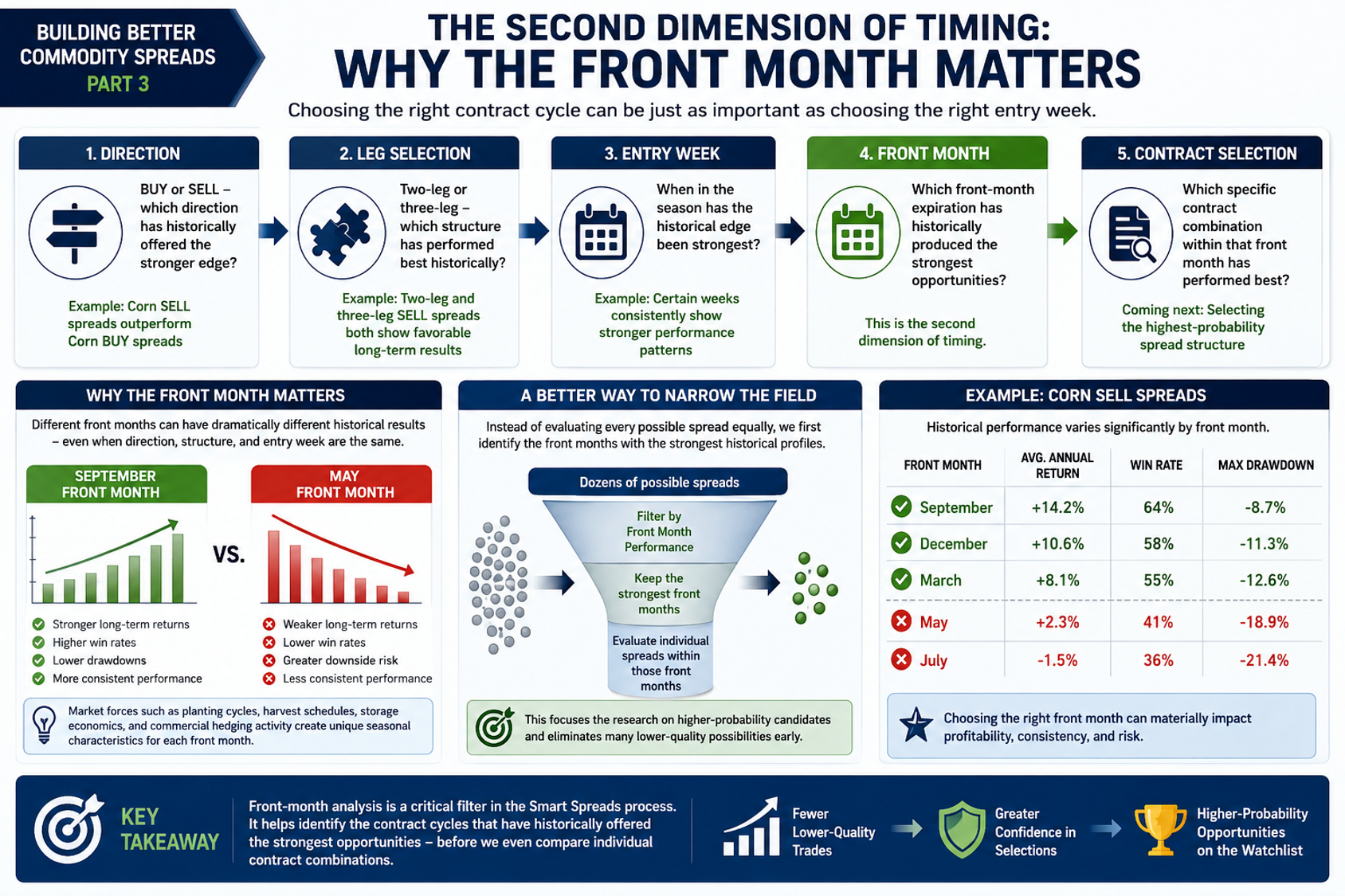
In the previous article, we explored why entering a seasonal spread can have a significant impact on its historical performance. This week, we'll examine another timing decision that is often overlooked—but has proven to be just as important in our research. The contract cycle. Most commodity spread traders begin by selecting a market and deciding whether to buy or sell the spread. Some may even refine that decision by choosing between a two-leg or three-leg structure. From there, many select the contract months that appear to fit the seasonal pattern. Our research took a different approach. Instead of immediately comparing individual calendar spreads, we asked a more fundamental question:
- Which front month has historically produced the strongest opportunities?
That simple question led to one of the most important discoveries in the Smart Spreads research process. Looking Beyond Individual Spreads Suppose we've already completed the first stages of our research. After evaluating hundreds of historical opportunities, we've determined that:
- Corn SELL spreads have historically outperformed Corn BUY spreads.
- Two-leg and three-leg SELL spreads have both demonstrated favorable long-term characteristics.
At this point, we haven't selected any contract months. Instead, we ask:
- If I'm trading Corn SELL spreads, which front-month expiration has historically produced the strongest opportunities?
Rather than comparing dozens of individual spreads immediately, we evaluate the historical performance of each front month independently. For Corn, that means asking questions such as:
- How have September front-month spreads performed?
- How have December front-month spreads performed?
- How have March front-month spreads performed?
Each front month has its own historical profile. Some have produced remarkably consistent results over many years. Others have historically generated weaker returns, lower win rates, or greater downside risk. That distinction becomes an important part of the screening process.
Why This Matters
Consider two traders entering the market during the same week. Both trade Corn. Both choose the SELL direction. Both use the same number of legs. Yet one begins with a September front month while the other selects May. Although the trades may appear similar, history often tells a very different story. Over time, different front months have developed distinct seasonal characteristics based on planting cycles, harvest schedules, storage economics, commercial hedging activity, and other recurring market forces. Those differences can materially affect historical profitability, consistency, and risk. In other words, selecting the proper front month can be just as important as selecting the proper entry week.
A Better Way to Narrow the Field
One of the challenges in commodity spread research is the sheer number of possible combinations. Even after selecting a market, direction, and number of legs, dozens of individual spreads may still qualify for consideration. Front-month analysis provides an efficient way to narrow that universe. Rather than evaluating every possible calendar spread equally, we first identify the front months that have historically demonstrated the strongest statistical characteristics. Only then do we compare the individual contract combinations within those preferred front months. This transforms the research process from searching through hundreds of possibilities to focusing on a much smaller group of historically favorable candidates.
Building Higher-Probability Trades
This illustrates an important principle behind the Smart Spreads methodology. Every stage of the research process asks a different question. Direction identifies whether buying or selling has historically offered the stronger edge Leg selection determines the structure that has historically performed best Entry-week analysis identifies when the historical edge has been strongest. Front-month analysis identifies which contract cycle has historically provided the most favorable opportunities.
Each layer removes additional lower-quality candidates. Each layer increases confidence in the remaining opportunities. Rather than relying on a single statistic or seasonal tendency, Smart Spreads combines multiple independent sources of historical evidence before a trade earns a place on the watchlist.
Looking Ahead
Selecting the right front month is only part of the contract-selection process. Once the preferred contract cycle has been identified, another important decision remains. Which specific contract combination has historically produced the strongest results? For example, if September has historically been the strongest front month for a particular market, should the spread be September-December, September-March, September-May, or another combination altogether? In the next article, we'll explore how contract selection builds on front-month analysis to identify the specific spread structures that have historically produced the highest-probability opportunities.
Additional Details
The Bull Strangle Newsletter focuses on stocks and options, combining stock ownership with disciplined option-selling techniques designed to generate consistent income while managing risk.
The Smart Spreads Newsletter focuses on seasonal commodity spreads, a historically proven approach that seeks opportunities across agricultural, energy, metal, and financial futures markets.
Each strategy is designed to stand on its own, but together they provide a diversified approach that can perform across a wide range of market environments. For traders looking to deepen their education, The Bull Strangle Strategy and Trading Commodity Spreads, both available on Amazon.
Visit BullStrangle.com to subscribe for just $1 for the first month.
For a video overview of the Bull Strangle Newsletter
For a video overview of the Smart Spreads Newsletter
Darren Carlat
Dual Edge Research
(214) 636-3133
DualEdgeResearch@gmail.com
Disclaimer
This information is for informational purposes only and should not be considered as investment advice. Past performance is not indicative of future results, and all investments carry inherent risk. Consult with a financial advisor before making any investment decisions.