
The US Treasury Department is expected to refuse to revise the US bond issuance guidelines, and the “addiction” of short-term bonds may face the risk of interest rate shocks
The Zhitong Finance App learned that the debt management team led by US Treasury Secretary Bezent has long rejected Wall Street's proposal to adjust future US Treasury bond issuance guidelines, so much so that now many Tier 1 traders no longer expect relevant policies to change in the short term. Before announcing the quarterly debt strategy statement on Wednesday, most Tier 1 traders expect that the US Treasury will restate its previous position that “at least the next few quarters” will not increase the scale of issuance of medium- to long-term treasury bonds (notes and bonds).
This forward-looking guidance dates back to the Biden administration. Bezent has previously criticized this practice, believing that its purpose is to lower long-term borrowing costs before the November 2024 election. Today, the Republican administration led by US President Trump is facing midterm elections, and any signal that suggests expanding the scale of treasury bond auctions may lead to a further rise in US bond yields, which is not in the interest of the government.
Last week, the yield on 30-year US Treasury bonds rose to its highest level since 2007. Since the financing costs of long-term bonds are already very high compared to short-term bonds, many traders doubt whether the Ministry of Finance will actually expand the scale of issuing long-term treasury bonds in the next few years.
Since taking office, Bezent has relied on short-term treasury notes (up to one year) to meet the government's growing financing needs. Due to lower interest rates on short-term treasury bills, this strategy helped control the Ministry of Finance's financing costs. But this strategy also has risks — continued reliance on short-term treasury notes means that debt service costs will be more vulnerable to short-term interest rate shocks, and investors are currently betting that the Federal Reserve may be forced to tighten monetary policy in the next few months.
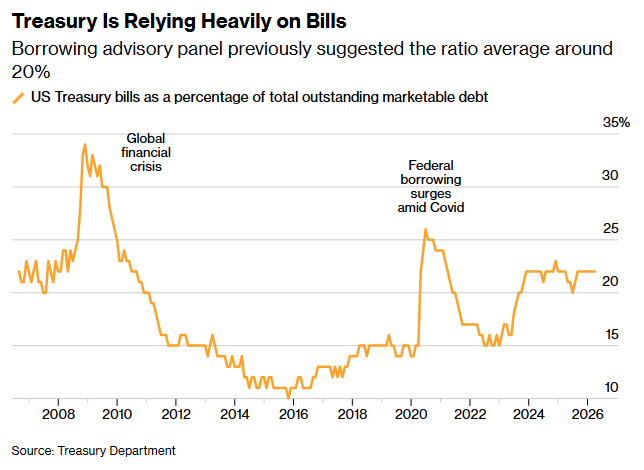
The US Treasury relies heavily on short-term treasury notes to meet financing needs
Blake Gwen, head of US interest rate strategy at RBC Capital Markets, said: “The US Treasury should reserve more room for choice by adjusting the guidelines. This approach may carry the risk of boosting returns, but sooner or later, this shift will occur. The longer we wait, the greater the market's importance and impact on the eventual cancellation of this guidance.”
The US Treasury Department will update the current quarterly financing needs forecast on Monday and then issue a so-called “quarterly refinancing announcement” on Wednesday. In May of this year, the Ministry of Finance estimated net financing requirements of US$671 billion in the three months ending September.
Bank of America calculations show that if the Treasury keeps the issuance scale of interest-bearing bonds (that is, notes and long-term bonds) unchanged until the end of fiscal year 2027, then the share of short-term treasury bills in outstanding government debt will rise to close to 25%, which will be the highest level since 2004 (excluding anomalies during the COVID-19 pandemic and global financial crisis). The Ministry of Finance's Loan Advisory Committee previously recommended that short-term treasury bills account for an average of about 20%.
As for continuing to rely on short-term treasury securities financing, the US Treasury currently has reason to believe that strong demand can absorb additional supply, at least temporarily. According to Crane Data LLC, the size of money market funds has now grown to around $8.3 trillion.
Bessent also said that stablecoin issuers may become a new source of demand for short-term treasury notes in the future. Meanwhile, the Federal Reserve is increasing its treasury bond holdings, in part by reinvesting maturing mortgage securities funds into short-term treasury notes.
Since the last quarterly refinancing announcement in May, traders have continued to delay when they expect the Treasury to begin increasing the issuance of interest-bearing bonds. Many currently expect this change to occur as early as May 2027.
As for next week's refinancing treasury bond auction, if the scale of issuance remains the same, it will include: issuing 58 billion US dollars of 3-year US Treasury bonds on August 11; issuing 42 billion US dollars of 10-year US Treasury bonds on August 12; and issuing 25 billion US dollars of 30-year US Treasury bonds on August 13.
Economists expect the US federal budget deficit to remain at around $2 trillion in the next few years, which means that the government will have to continue to increase borrowing. Over time, large amounts of maturing debt mean that the current scale of the auction will not be able to raise fresh capital for the Treasury.
J.P. Morgan analysts believe that starting from fiscal year 2027 (that is, starting October 1), the US Treasury will experience a “financing gap.” The bank expects the cumulative financing gap between 2027 and 2030 to reach 3.7 trillion US dollars.
J.P. Morgan's strategy team, led by Jay Barry, wrote in a refinancing preview report released last week: “From a prudent debt management perspective, we think the Treasury should remove the word 'at least' from the long-standing forward-looking guidance next week.” However, they added: “Political factors are at play.” They pointed out that the Trump administration is motivated to avoid rising US bond yields before the election. In addition, Bezent has also been concerned about reducing long-term returns.
Few agencies expect the US Treasury to adjust guidelines
Although most tier-1 traders expect the US Treasury to reaffirm its position that it will not increase the scale of medium- to long-term treasury bonds (notes and bonds) “at least the next few quarters,” some banks, including Deutsche Bank, Wells Fargo, and Imperial Bank of Canada Capital Markets, believe that the US Treasury may adjust issuance guidelines on Wednesday to prepare for an earlier increase in the scale of interest-bearing bond issuance. Although specific wording may take many forms, the key is to provide sufficient flexibility for the Ministry of Finance to announce adjustments as early as February next year.
However, market confidence in this change is still low. The Wells Fargo team, led by Michael Pugliser, said: “We wouldn't be surprised if the Treasury again avoids adjusting the relevant wording, especially since the November refinancing announcement will be announced the day after the general election.” However, the team also believes: “Based on fundamentals and previous recommendations from the Treasury's Borrowing Advisory Committee, this change should eventually come.”
The Treasury's Borrowing Advisory Committee consists of investors, Tier 1 traders, and other market participants. In the future, when the Ministry of Finance finally increases the issuance of interest-bearing bonds, most traders expect that the new issuance will focus mainly on short- and medium-term bonds, rather than 10-year, 20-year, and 30-year long-term bonds. The yield in the so-called “middle section” of the yield curve is currently under less pressure. Last weekend, the yield on 5-year US Treasury bonds was around 4.45%, lower than 4.73% on 10-year Treasury bonds and 5.27% on 30-year Treasury bonds.
In May of this year, the Ministry of Finance said that officials are studying the possibility of increasing the issuance of interest-bearing bonds, “focusing on structural demand trends and the potential costs and risks brought about by different issuance structures.” TD Securities strategists Gennady Goldberg and Molly Brooks wrote in the report: “This statement suggests that any future action by the Treasury Department to increase the issuance of interest-bearing bonds may lean towards the front end of the yield curve.”
Traders will also be watching to see if the Ministry of Finance will further reveal its interest in investing some of the excess cash in the repurchase market. Treasury officials have previously asked Tier 1 traders for their views on this move in routine pre-refinancing investigations.