From infrastructure gold mining to app monetization! Goldman Sachs judgment: The AI main line ushered in a major switch, and Microsoft (MSFT.US) is expected to become the core beneficiary
The Zhitong Finance App learned that the AI bull market is ushering in an important watershed. In the past two years, capital has sought AI “sellers” such as chips and network equipment vendors, but the trend is changing. Investors are no longer simply chasing larger models or data centers, but are demanding that AI can bring real, quantifiable returns. Goldman Sachs pointed out that Microsoft (MSFT.US) is expected to become the core beneficiary of this round of style changes by deeply embedding the software ecosystem in the daily work of hundreds of millions of workers.
Goldman Sachs added Microsoft to its US “Conviction List” (Conviction List) in its latest monthly report, while maintaining the stock's “buy” rating and raising the target price from $610 to $640, which is 31% higher than the current stock price level. More importantly, the “Convinced Buy List” is a combination of investment targets with the highest potential for growth and the highest confidence level selected by the bank. Being included in this list indicates that Goldman Sachs is more optimistic about Microsoft than the regular “buy” rating.
Goldman Sachs software industry analyst Gabriela Borges points out that the AI investment narrative is undergoing a subtle but significant shift: the focus of capital will gradually shift from AI model training infrastructure providers to platforms that can turn AI into sustainable corporate revenue.
Enterprise-level AI applications are becoming Microsoft's biggest opportunity
The enterprise-level AI circuit is seen as Microsoft's most important growth line right now. In the past, the market hyped up AI, and the focus was on underlying computing power infrastructure; however, as the industry advanced to a new stage, how to implement commercial AI services for a large number of enterprises became the key to victory or loss.
Microsoft's latest quarterly earnings report has shown the market clear evidence that AI investment is beginning to turn into real revenue. According to financial reports, Microsoft's Q4 revenue was US$90.1 billion, an increase of 18% over the previous year, far exceeding analysts' expectations of US$87.7 billion. Among them, revenue from Azure and other cloud services increased 43% year over year, the fastest growth rate since 2022. Microsoft also revealed that Azure's annual revenue surpassed 100 billion US dollars for the first time, becoming another “100 billion” business pillar of the company after Office and Windows.
Currently, Google's parent company Alphabet dominates the field of enterprise AI applications, and nearly 90% of the Fortune 100 companies have adopted its Gemini enterprise version. However, Microsoft revealed in its latest financial report that its 365 Copilot has surpassed 30 million paid seats, a significant increase from the level of about 20 million three months ago, indicating that the adoption rate of its flagship AI assistant on the enterprise side continues to increase.
This data is critical because Azure is no longer just a cloud server tenant. It has become the foundation of Microsoft's AI services, and Microsoft 365 Copilot provides businesses with practical ways to deploy AI in email, spreadsheets, programming, meetings, and business workflows.
This is the key that Goldman Sachs is optimistic about Microsoft's business model: training large AI models requires huge capital investment, but relying on a subscription model to sell AI-enabled productivity software can generate continuous, high-margin recurring corporate revenue.
Borges pointed out, “In the past 6 to 12 months, one of the main arguments that the market has been bearish on Microsoft is that Copilot products have not reached the ideal state.” However, she added that product quality continues to improve, and the rise in the number of users helps create a “positive feedback loop.”
Goldman Sachs expects that as Copilot continues to penetrate, AI operation efficiency continues to be optimized, and large-scale enterprise deployment becomes the norm, Microsoft's earnings per share growth rate will increase from about 12% in FY2027 to more than 20% in FY2029.
AI gold mining circuit rotation: the winner of the first wave is infrastructure, and the next wave belongs to software
In the past two years, the biggest winners in the AI market have been concentrated on the infrastructure circuit. Chip makers and hardware vendors have benefited greatly because companies need to purchase computing power to deploy AI.
But the market landscape is changing. As enterprise customers transition from AI testing to large-scale deployment, the advantages of software platforms that have already established deep relationships with customers continue to be highlighted.
Microsoft reaches hundreds of millions of commercial users through platforms such as Windows, Microsoft 365, Teams, Dynamics, GitHub, and Azure. Adding AI functionality to mature products that customers have already paid for is far easier than persuading companies to adopt a new system.
Of course, Microsoft still has multiple challenges ahead: capital expenditure on AI infrastructure remains high; competition among cloud vendors such as Google and Amazon continues to intensify; at the same time, the pace of enterprise AI implementation may be slower than the market's optimistic expectations, hampering the speed of commercialization.
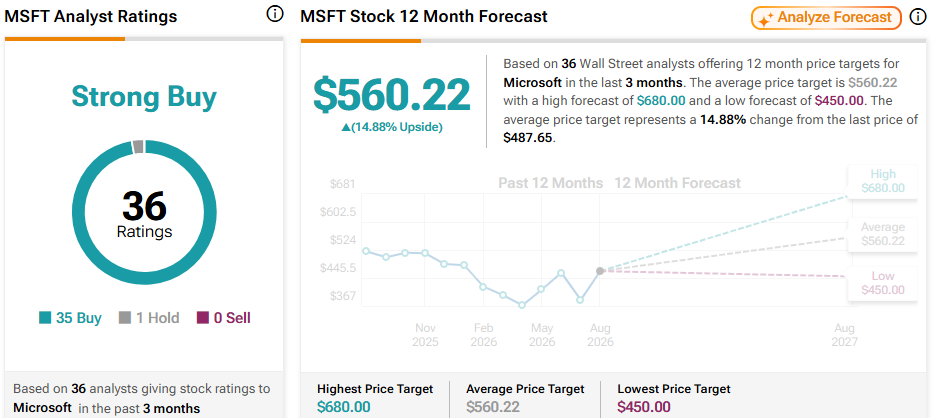
The AI boom is expected to continue Wall Street analysts are strongly bullish on Microsoft
Simply put, Goldman Sachs doesn't think the AI infrastructure boom will end there, but the biggest investment opportunity is shifting: the market will favor companies that can turn computing power investment into long-term stable corporate revenue. Data such as Microsoft's strong earnings report, Azure reaching the 100 billion annualized revenue milestone, and Copilot surpassing 30 million paid seats show that this transformation has already begun.
For long-term investors, this is the main line of investment with greater sustainability. Building AI infrastructure created the winners in the first round of the AI bull market, and helping companies apply AI on a daily basis may spawn the next batch of winners. Goldman Sachs is optimistic that Microsoft will seize the opportunity on this racetrack.
According to Tipranks data, the vast majority of Wall Street analysts are optimistic about Microsoft. The consensus rating is “Strong Buy”. The average target price is 560.22 US dollars, which corresponds to a potential increase of about 15%.