
For the third time, we have reached the high window period before breaking through. Can Good Future (TAL.US)'s good performance bring good stock prices?
With revenue up 31.9% year on year, net profit grew as high as 1204.3% year on year during the same period. Wall Street immediately gave positive feedback when Good Future (TAL.US), the 27Q1 financial report with a high increase in revenue and a sharp increase in net profit, came out.
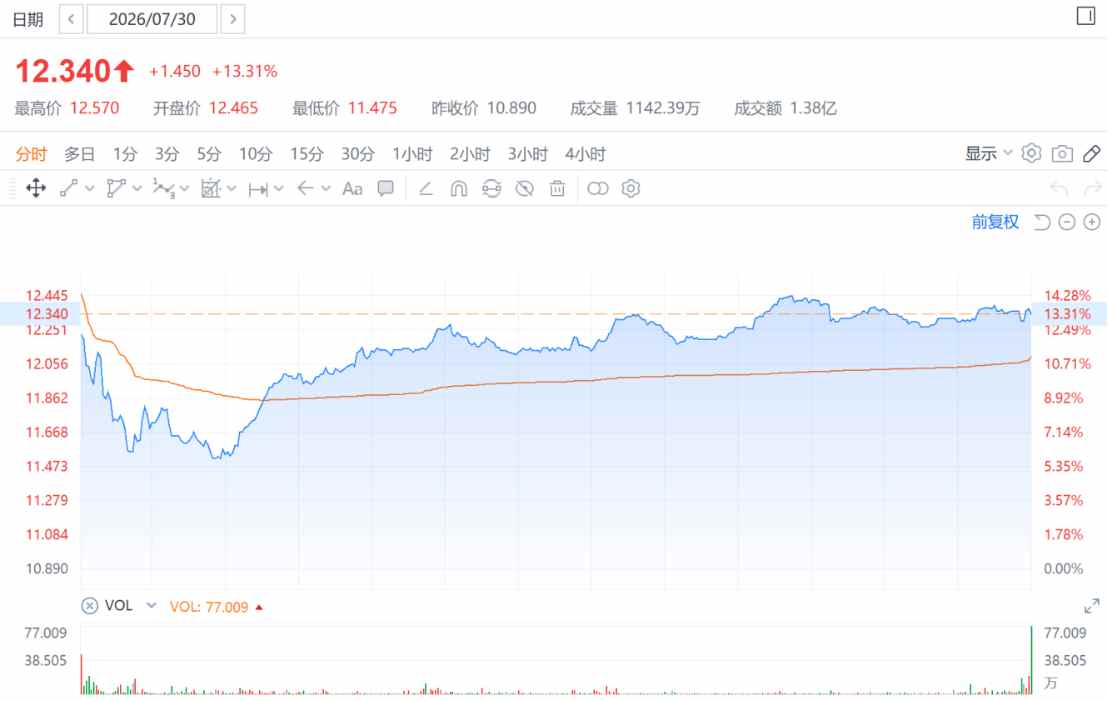
The Zhitong Finance App observed that on July 30, Hao Future's stock price jumped high and rose 12.27% when it opened. Although its stock price increase narrowed to less than 6% within the next hour, Good Future's stock price did not continue to decline. Instead, it experienced a strong rebound and continued to fluctuate upward under the support of many parties, leaving a clear long-term shadow on the K line of the day.
At a time when the US stock market urgently needs to inject certainty into the AI narrative, as a leading company with the “AI+ education” concept of Chinese securities, Good Future has laid a good foundation for its steady growth in the new fiscal year with its strong profit elasticity during the peak spring training season.
Did the stock price break through previous highs or continue to fluctuate?
Looking at the long-term timeline, since hitting a phased high of $13.37 in the intraday period on October 30 last year, Good Future's stock price has been fluctuating sideways, and has already been on a “roller coaster” for 3 rounds.
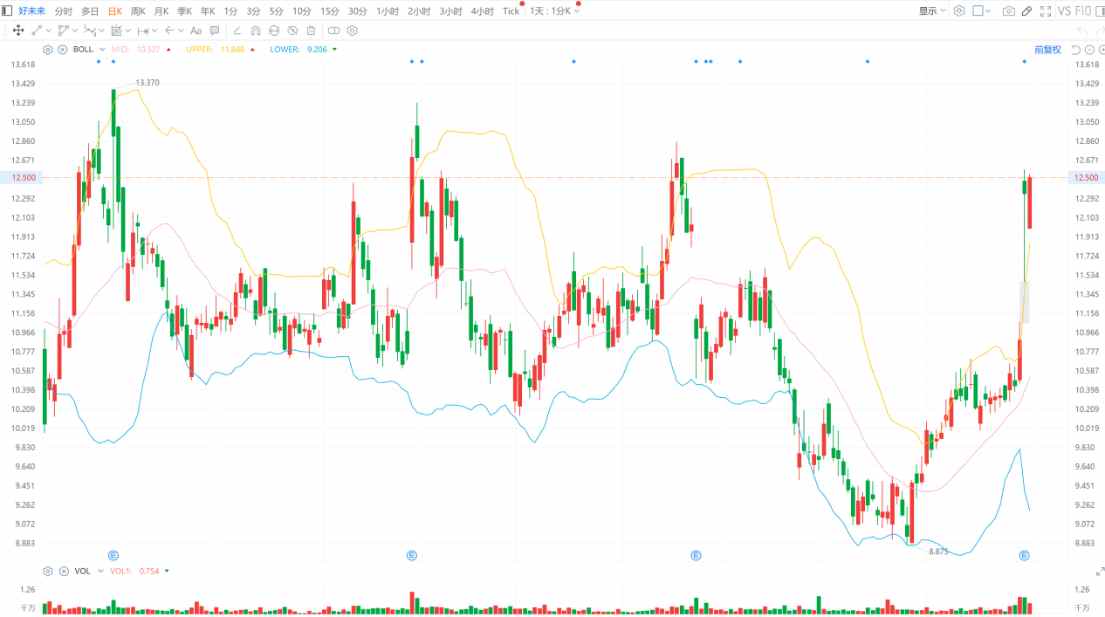
Judging from the market before the disclosure of this financial report, after the stock price continued to attack BOLL's online trajectory in mid-April this year, Good Future's stock price continued to fluctuate and fall, and on April 23, it quickly lowered the stock price to near the BOLL line below the BOLL line. After that, until June 25, Good Future stock prices continued to fluctuate between the middle and lower tracks of the BOLL line amid sluggish market sentiment.
From June 26 to July 1, Hao Future's stock price showed a wave of impacting BOLL's online trajectory, but at the time, only a “small yin and young” market pattern appeared, and no obvious increase in trading volume support was observed, nor did it form an effective physical K-line breakthrough.
Looking at volume, the daily trading volume at this stage is clearly shrinking compared to mid-April this year, showing an overall “price increase and decrease” pattern. At this point, the market showed a weak rebound signal. Due to the previous 2-month fluctuation and decline, in mid-July, the profit ratio of on-market chips was less than 40%. Therefore, in the future, the upper part of the market is reluctant to sell and the selling pressure is small, so the main capital can increase without volume. However, on the other hand, it also indicates that there is no active purchase of incremental capital, which indicates a lack of capacity to carry out off-market support.
However, when the 27Q1 financial report was officially revealed, the stock price of Good Future finally ushered in a round of sharp rise on July 30, supported by a certain sentiment, and the stock price increase logic changed from the previous overfall and rebound to deterministic growth. Unlike before, we saw a clear increase in trading volume. The stock trading volume reached 11.423,900 shares on the same day, and the low price of the day also broke through the BOLL online trajectory. Behind the sharp rise in volume and price, it indicates that the willingness of OTC coin holders to enter the market has increased significantly compared to before.
On July 31, Good Future's stock price closed up 1.30% again on the basis of stabilizing the previous day's stock price increase. However, the trading volume narrowed to less than 8 million shares on the same day, showing a high level of price growth and contraction, which also left some market investors shaken whether it could successfully break through the previous high.
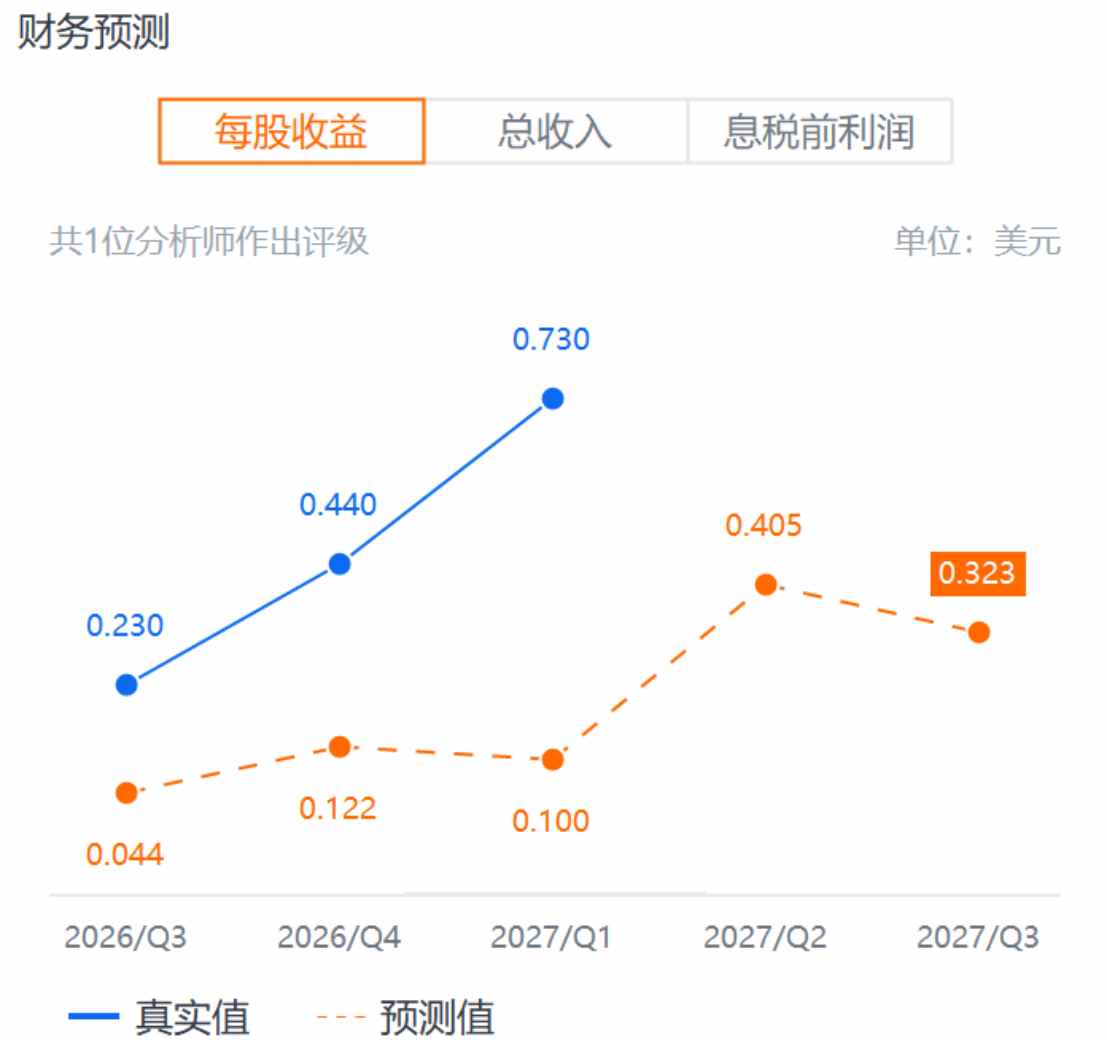
Looking at the current overall US stock market, although the AI market in US stocks at this stage is mainly focused on cloud AI vendors and AI hardware chains, in terms of investment logic, compared to the previous aggressive AI narrative, investors seem to be more concerned about the certainty of earnings brought by the company. According to the data, earnings per share for the current good future reached $0.73, far higher than the previous analysts' forecast of 0.1 US dollars.
Currently, in the AI field, there is a huge difference in the pace of profit cashing in various aspects such as computing power, large models, AI applications, and terminal hardware. Some racetrack prosperity has clearly slowed down, and some aspects are still accelerating upward. Therefore, at this stage, investors at the practical level or prefer to continuously track changes in the target net profit growth rate, and place more importance on the company's ability to redeem returns on AI investment. And good future earnings reports are in line with the current investment tone of the US stock market.
Behind the net profit growth rate of over 1,200%
Well, in the future, the stock price will open higher and rise by more than 12% on July 30, which is not unrelated to its financial performance exceeding expectations. Among them, the important indicator that guided the market to make large purchases on the same day was undoubtedly the current net profit growth rate data.
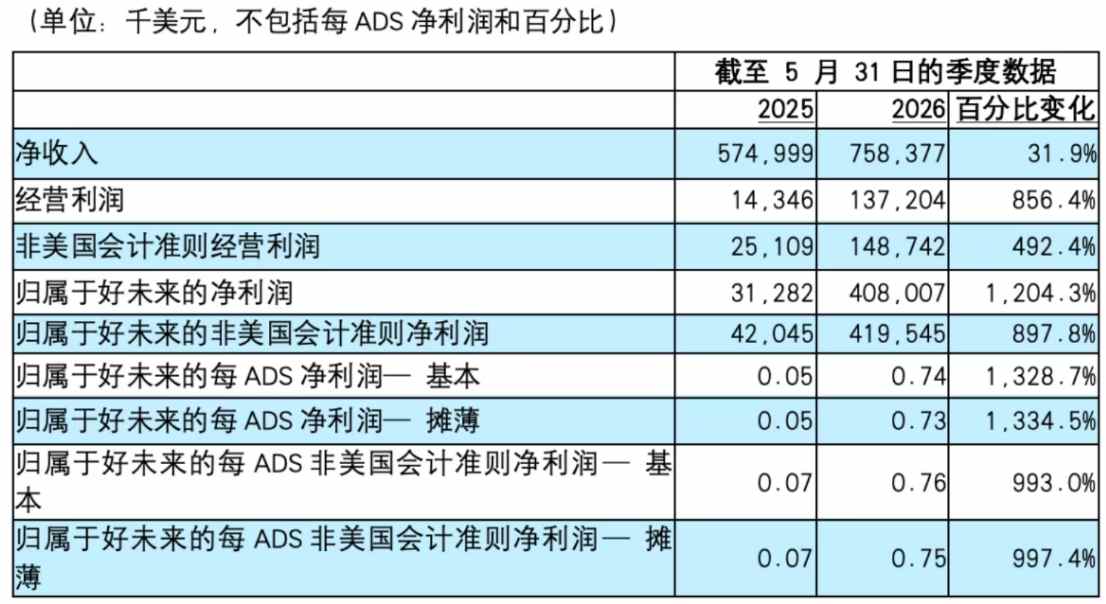
Financial reports show that Haowai's net profit for the 27Q1 quarter reached 408 million US dollars, a sharp increase of 1204.3% over the previous year; the company's current revenue also reached 758 million US dollars, an increase of 31.9% over the same period last year.
However, Good Future clearly disclosed in its financial report that net other revenue for the quarter was only 9.5 million US dollars compared to the same period last year, an increase of more than 40 times over the previous year. This change was “mainly driven by changes in the fair value of certain investments.” In other words, net profit jumped from operating profit of US$137 million to US$408 million. The median difference of about US$271 million was mainly due to changes in portfolio valuation, which was a one-time non-operating income.
Excluding the one-time factor, the company's non-GAAP net profit was US$420 million, up 897.8% year on year, which can relatively clearly reflect the profit improvement of the company's main business in the current period, and revenue side growth is a key factor in achieving improved profitability in a good future.
On the revenue side, as one of the company's core revenue sources, the current revenue of the Good Future Learning Service business (including offline small classes and online business) increased year-on-year, mainly due to the year-on-year increase in revenue from offline small classes and online literacy courses. According to the data, its Learn & Think offline learning service business is already operating in 44 cities in mainland China and some international markets, with a total of more than 600 learning centers.
Although no specific revenue was disclosed, Good Future CFO Peng Zhuangzhuang mentioned during the earnings conference call that the company continued to achieve double-digit year-on-year growth in revenue from the Learn and Think offline learning service literacy classes in the current period. The renewal rate, a key indicator, remained healthy in the first quarter, exceeding 80%, which is basically the same as the same period last year.
Furthermore, the company's financial report revealed that its current deferred revenue increased from US$882 million in the same period last year to US$1,219 million, an increase of 38.21% over the previous year.
In terms of the content solution business, the company's transformation and development's core business, company executives disclosed that this quarter, revenue from the Good Future Learning Equipment business increased year-on-year. As the Learn+Think learning device portfolio and user base continues to expand, key engagement metrics remain stable and healthy. In the 27Q1 quarter, there were more than 2 million active learning devices per week. The weekly activity rate was about 80%, and the average daily active use time of a single device was about 1 hour.
In addition to revenue side growth, the cost and expense side of continuous control is also a key element that constitutes good future current growth. Financial reports show that the company's current costs and expenses totaled US$621 million, up only 10.8% year on year, far lower than revenue growth; of these, sales and marketing expenses were US$172 million, down 4.8% year on year. At the same time as revenue soared, marketing declined, indicating a marked increase in brand potential and word-of-mouth repurchase power.
In terms of cash flow, financial reports show that in addition to the US$1,219 billion deferred revenue mentioned above, Good Future's current cash and short-term investments totaled US$2,875 million, and net cash flow from operating activities was US$478 million, which intuitively shows that its main business has strong hematopoietic capacity while also having significant resilience to risks.
In addition, the company also announced a 12-month extension of its share repurchase program to repurchase up to approximately $394 million of the company's common shares until July 28, 2027. The positive repurchase plan indicates that the company aims to continue to boost market confidence. For a good future showing strong profit elasticity in a single quarter, this may become a short-term window period for stock prices to rise against the market.