
Increased market competition compounded by weak consumer confidence! The automobile and luxury goods sector became Europe's “fuel tank” for the bright earnings season
The Zhitong Finance App learned that, dragged down by increased market competition and weak consumer confidence, the continued underperformance of European luxury brands and car manufacturers cast a shadow over Europe's overall optimistic earnings season.
According to the data, the second-quarter earnings per share (EPS) of MSCI European Optional Consumer Goods Index companies fell 4.3% year on year, compared with previous market expectations of a 7.4% increase. The benchmark index covers fashion giants, including LVMH, and auto giants such as the BMW Group. It is also currently the only industry sector reporting a decline in earnings per share. In contrast, driven by the energy and technology industry, the overall MSCI Europe Index achieved a 14% year-on-year increase in earnings per share in the second quarter, the strongest performance in three years.
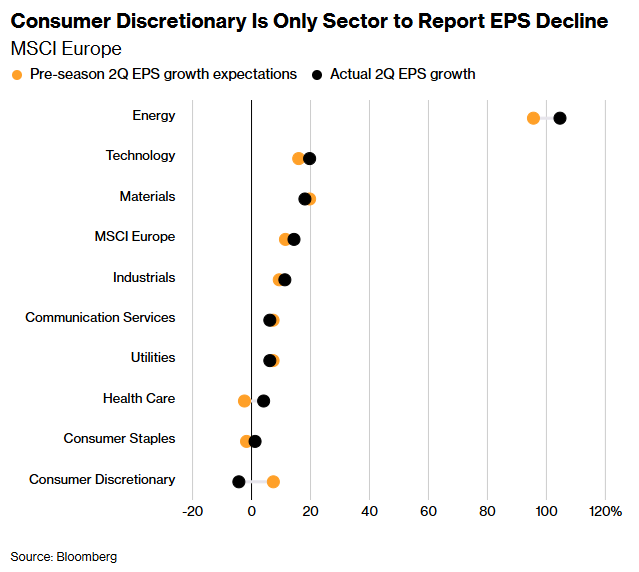
Optional consumer goods became the only European sector to report a decline in earnings per share in the second quarter
A typical example of the difficult situation facing the automotive industry is the VW Group. Due to long-term sluggish performance in the Chinese market, Volkswagen Group's second-quarter results fell short of market expectations and lowered sales prospects. Industry research analyst Michael Dean said that part of Volkswagen Group's performance falling short of expectations was due to negative pricing pressure and rising product costs. “This further highlights the urgency of the Volkswagen Group to restructure its model lineup, reduce the number of employees, and close factories.”
Another European car manufacturer, Stellantis (STLA.US), which is undergoing a business transformation, also performed less than analysts' expectations. Rising raw material costs, price pressure in the European market, and uneven recovery progress in North America, a key market, have limited the company's room to improve its performance.
For others, strong sales growth is being offset by cost pressures. Adidas's second-quarter profit fell short of market expectations because the increase in revenue that was originally expected to be brought about by the World Cup was offset by increased marketing expenses. In the luxury goods industry, even some brands that have traditionally been more resilient are under pressure on earnings release day. As sales growth was weaker than expected, Hermès stock fell to its lowest level in more than three years on the day the earnings report was announced.
Although weak consumer confidence has curtailed purchasing power and the Middle East conflict has impeded the recovery of regional shopping centers such as Dubai, other markets seem to be gradually recovering. Trench coat manufacturer Burberry and Cartier parent company Richemont both benefit from continued strong consumer demand in the US.
Although the next earnings season is expected to face similar themes — worsening consumer confidence, increased competition, and continued inflationary pressure — some sectors are facing more optimistic prospects. After a difficult performance at the beginning of this year, the Stoxx Europe 600 Optional Consumer Goods Index is expected to still achieve 15% earnings per share growth this year, so the market's focus is shifting to critical second-half performance.
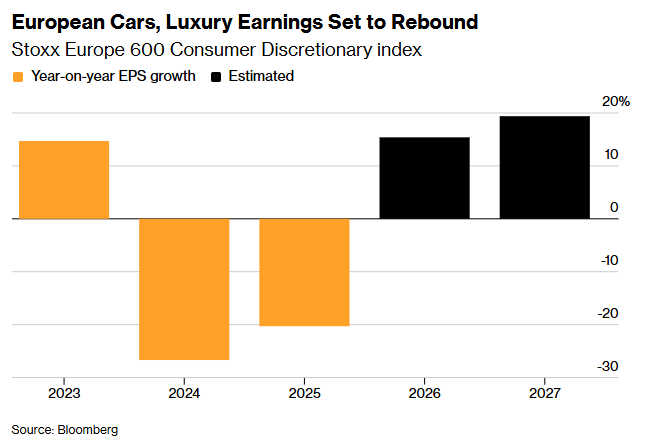
European auto and luxury goods companies' profits are expected to rebound
For the VW Group, the focus of the market is on its transformation process. Citigroup analyst Harald C. Hendrikse said, “VW Group management is dealing with tremendous external pressure from the Chinese, European and US markets, and has performed very well.” He added that investors are currently looking for signs of a significant improvement in the company's profit margins in the second half of the year.
Analyst Deborah Aitken said that LVMH's core fashion and leather goods business has resumed organic sales growth, indicating that consumer demand for high-end products is increasing; at the same time, the reshaping plan of Gucci, a subsidiary of Kering Group, is progressing according to plan.
Deutsche Bank analyst Adam Cochrane said, “Common themes still include the continued strong demand for luxury goods among high-end US consumers and the impact of weak European travel spending on local spending. The Chinese market seems to be recovering slowly, but it is gradually accumulating momentum.”
As for Adidas, Jefferies analyst James Gesinich pointed out that despite the “mistake” of second-quarter profits falling short of expectations, if the next few quarters can prove that revenue growth is bringing healthier profit leverage, then the market may soon forget this event.