
IPO outlook | The core pipeline depends entirely on mergers and acquisitions, and Shenji Pharmaceuticals' bright performance cannot hide concerns about weak R&D
Recently, Shenji Pharmaceuticals Co., Ltd. (Shenji Pharmaceuticals for short) submitted a listing application to the main board of the Hong Kong Stock Exchange, with J.P. Morgan Chase, CITIC Securities, and HSBC as co-sponsors.
Unlike most innovative 18A pharmaceutical companies that have not yet made a profit, Shenji Pharmaceutical has many mature products that have been approved for marketing, and recorded more than 1 billion yuan in revenue and 154 million yuan in net profit in 2025, and has achieved stable profits.
However, there is no shortage of concerns behind the impressive performance: the company's current product matrix and R&D pipeline mostly stem from external acquisitions and introductions, its own R&D base is relatively weak, and its long-term innovation ability has yet to be verified. With this IPO, the “gold content” of the company's own R&D strength may become the focus of market attention.
Revenue mainly depends on the three original research drugs on the market
According to the prospectus, Shenji Pharmaceutical was co-founded by Kangqiao Capital and Mubadala in June 2024, and both parties each held 47.62% of the shares. In November of the same year, Shenji Pharmaceuticals, which had only been in operation for more than five months, completed the acquisition of Ushibi's neurology and allergy business for nearly 30 years through its wholly-owned subsidiary Shenji Hong Kong, and incorporated mature products such as Kepulan, Vipert, and Centamine along with the Zhuhai production base. Ushibi Zhuhai subsequently changed its name to Shenji Zhuhai and became a wholly-owned subsidiary.
On the financial side, the core operator Shenji Zhuhai's revenue from 2023 to 2025 was 936 million yuan, 935 million yuan, and 1.152 billion yuan (RMB 1.152 million, same below), and gross profit increased from 424 million yuan to 551 million yuan. Net profit for the same period was 60.36 million yuan, 30.96 million yuan, and 154 million yuan. Profit fluctuated greatly; gross margin rose steadily from 45.3% to 47.9%.
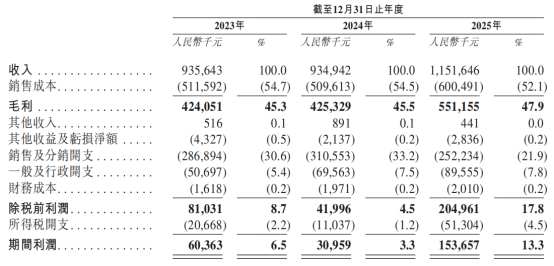
At the same time, high debt and cost pressures are prominent. To raise capital for the acquisition, Shenji Pharmaceuticals applied for a merger and acquisition loan of 2 billion yuan from Ping An Bank and pledged all shares in core subsidiaries such as Shenji Zhuhai, Shenji Shanghai Trading, and Shenji Hong Kong. By the end of 2025, the total amount of interest-bearing loans was still 1,994 million yuan, and interest expenses for the year reached 123 million yuan, accounting for more than 80% of the Group's net profit. Furthermore, although the goodwill of 983 million yuan on the book has not been depreciated, once the impairment is triggered, it will directly erode profits. As of the end of the same period, the Group's cash on book was 729 million yuan, and operating cash flow was 340 million yuan. However, the number of inventory turnover days was 148.7 days, and working capital was clearly occupied.
In terms of customer concentration, the top five customers accounted for 80.3%, 79.9% and 86.6% of revenue from 2023 to 2025, respectively, and the largest single customer accounted for 26.2%, 33.3%, and 32.8%, respectively, indicating that loss of a single customer or fluctuating orders will have a direct impact on performance.
In terms of the commercialization system, the company has built an omni-channel network covering 18,000 hospitals, 11,000 medical professionals and 100,000 pharmacies, with a sales team of 384 people, forming one of the largest neurological specialist sales teams in China. The Zhuhai base has production capacity for tablets, capsules and oral solutions. Among them, Kaipulan tablets have an annual production capacity of 190 million tablets, and the utilization rate will reach 89.2% in 2025. Shenji Pharmaceuticals is simultaneously expanding production. In August 2025, it signed a memorandum of cooperation with the Zhuhai High-tech Zone to invest no less than 100 million yuan to build a workshop, focusing on promoting the localized production of centermine drops and first-class new drug analgesics, with an estimated annual output value of nearly 1 billion yuan after delivery. Construction of the project began on June 8, 2026.
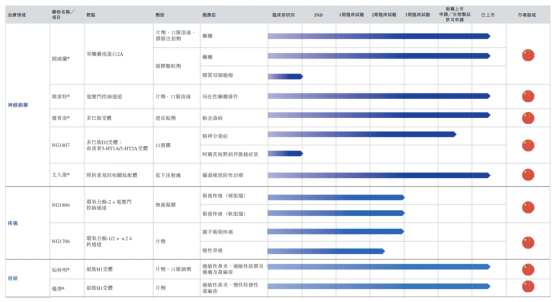
In terms of product layout, the company has launched 6 products, including well-known original research drugs such as Kaipran, Vipert, Centamine, and recently approved Ijiuwei, as well as various drug candidates under development, such as NG1706, NG1806, and NG1807, covering treatment fields such as epilepsy, Parkinson's disease, and allergic rhinitis.
However, according to the Zhitong Finance App, the company's revenue structure is highly concentrated. Of the 1,319 billion yuan pharmaceutical sales revenue in 2025, Kaipran contributed 949 million yuan (accounting for 71.9%), Vipat contributed 218 million yuan (16.5%), and Centamine contributed 131 million yuan (9.9%). The three products together accounted for 98.3%, and the rest of the product revenue was minimal.
Among them, Kaipuran is a second-generation broad-spectrum antiepileptic drug with good safety. It was approved in China in 2006, but currently many domestic companies have launched generic drugs, and there is limited room for future growth; Vipert is a third-generation anti-epileptic product with differentiated mechanisms of action, clear efficacy and good tolerability in focal seizures; and Centamine is a widely recognized second-generation antihistamine with two dosage forms, tablets and drops, covering pediatric, otolaryngology, dermatology and immunology needs.
The company admits that before the commercialization of new products, revenue is still highly dependent on a few products such as Kaepulan in the short term, and the risk of a single product structure cannot be ignored.
The long-term R&D capacity of the 10-billion migraine market is questionable
The Zhitong Finance App learned that in addition to introducing a variety of mature products, Shenji Pharmaceutical has also laid out several innovation pipelines in an attempt to open up a second curve before the growth of mature varieties slows down. In addition to the three major players, Kempat, and Centromine, the company has also introduced the original drug Aijiuwei for migraine, and varieties under development such as NG1706 (oral dual-mechanism non-opioid pain management drug), NG1806 (long-acting dual-mechanism non-opioid pain management drug after surgery), and NG1807 (innovative oral dissolving agent for schizophrenia).
Among them, Ajiuwei (furinazumab injection) is expected to become a new revenue pillar, helping the company enter the domestic 10 billion migraine prevention market. Migraine is the second largest neurological disability in the world. It affects about 1.04 billion people worldwide, and the global market size will reach 9.6 billion US dollars in 2022. It is expected to increase to 17.5 billion US dollars in 2027, with a compound annual growth rate of 9.4%.
Ai Jiuwei was approved by the BLA of the State Drug Administration in June 2026, and the company plans to submit age extension applications for young patients in the second half of 2026. This drug is the world's first and only CGRP antagonist approved by the FDA for migraine in children and adults. It was marketed in the US and Europe in 2018 and 2019, and has a mature commercial sales record.
However, prior to Ajiuwei, three similar drugs had already been approved domestically: Pfizer's remegipam, Eli Lilly's gacanizumab, and Amgen/Novartis's erinazumab. As the fourth imported CGRP targeted drug in China, Aijiuwei's first-mover advantage was not significant.
In terms of remaining assets, Uplo is the first transdermal dopamine agonist patch to treat Parkinson's disease in China. It is delivered once a day without oral administration, which helps reduce the common “end-of-dose phenomenon” of oral therapy and is expected to reshape the treatment model;
NG1706 is an innovative oral dual-mechanism non-opioid analgesic showing potential as a differentiated non-opioid replacement in postoperative pain treatment;
NG1806 is a long-term dual-mechanism non-opioid pain management drug designed to provide 72-hour pain relief. It is expected to become the first long-term dual-mechanism product of its kind in China. Clinical values include reducing opioid exposure, shortening hospitalization time, and improving recovery after surgery. Phase III trials are expected to begin within 2026;
NG1807 is a bryprazole oral solution. Its NDA has been submitted and is being reviewed. After approval, the company plans to expand to Alzheimer's disease-related excitation indications (approved in the US).
However, as an innovative pharmaceutical company, Shenji Pharma's own R&D capabilities are clearly weak. The company's total R&D expenses in 2025 were only 5.07 million yuan, accounting for 0.4% of revenue, of which outsourced service fees accounted for 84.4% and employee costs accounted for 14.9%. R&D efforts were seriously inadequate, and there are big questions about whether it can successfully advance in the research pipeline in the future.
More importantly, the cost pressure of the BD introduction model will continue to show over time. According to the licensing agreement, the company is required to pay down payments, R&D milestones, sales milestones, and tiered royalties. In the case of iJiuwei, the share ratio of subsequent sales is usually between 10% and 20% of sales, which will continue to erode product profits and further squeeze profit margins.
Overall, although Shenji Pharmaceutical has built a mature commercial product pipeline with capital operation and handed over a brilliant financial report, as an innovative pharmaceutical company, pipeline thickness and R&D capabilities are the foundation of the moat. If the company fails to truly “make up” courses on the R&D side, even if it goes public successfully, the subsequent development path may be full of challenges and uncertainties.