
Should You Buy Nvidia Stock Before Aug. 26? Here's What History Suggests.
Key Points
The major artificial intelligence (AI) hyperscalers have reported earnings, and all signs point to more capital spending.
Accelerating AI infrastructure spend bodes well for Nvidia's data center business.
Despite record results, Nvidia stock has largely traded sideways after reporting earnings over the last year.
Nvidia (NASDAQ: NVDA) is scheduled to report its second-quarter fiscal 2027 results on Aug. 26, and the timing raises what has lately become a familiar question for Nvidia investors: Is the stock worth buying ahead of the earnings announcement?
The major artificial intelligence (AI) hyperscalers -- Alphabet, Meta Platforms, Amazon, Microsoft, and Oracle -- have already delivered their latest numbers, and a clear theme has emerged: Big tech continues to allocate substantial capital expenditures (capex) to expand AI infrastructure.
Where to invest $1,000 right now? Our analyst team just revealed what they believe are the 10 best stocks to buy right now, when you join Stock Advisor. See the stocks »
This spending environment is constructive for Nvidia, which remains a primary supplier of data center GPUs while steadily deepening its position in CPUs, networking gear, and full-stack AI systems. With earnings right around the corner, the decision to buy shares now hinges on expectations, historical patterns, and a realistic view of timing.
Image source: Nvidia.
What does Wall Street expect for Nvidia's earnings?
Consensus estimates among Wall Street analysts point to revenue of roughly $91.8 billion, with a range spanning $90.3 billion to $96.7 billion. That figure is nearly double Nvidia's revenue from the second quarter one year ago. On the profitability side, analysts forecast earnings per share (EPS) of about $2.08, bookended by estimates between $2.03 and $2.20.
Wall Street's numbers are modestly above the guidance Nvidia's management provided when the company reported first-quarter results. Management previously stated that second-quarter revenue would be around $91 billion -- plus or minus 2% -- and projected gross margins near 75%.
How does Nvidia stock usually perform after earnings?
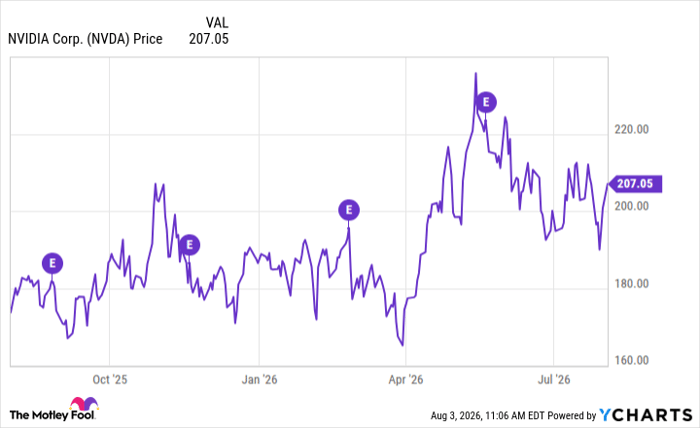
The chart offers a window into how Nvidia stock has behaved around earnings releases over the last year. Earnings reports are marked by the purple circles with "E" in the center.
Data by YCharts.
In the first instance, Nvidia stock was trading in the mid-$180s before reporting earnings. Shares subsequently slipped toward $170 in the weeks that followed before recovering.
The next release occurred after a run-up above $200. This was followed by a multi-week pullback into the $170 range. The most recent earnings event saw Nvidia stock peak above $220, followed by a prolonged sell-off that left shares currently near $207.
Across these episodes, the immediate post-earnings reaction has more often than not been neutral to negative over the immediate one to three months. That said, the longer-term trajectory has remained upward.
The key takeaway is that volatility around earnings announcements has been pronounced, with shares frequently giving back their pre-release gains.
Should you buy Nvidia stock before earnings?
History suggests that a sharp, sustained rally immediately after the upcoming earnings release is far from guaranteed. This means buying an entire Nvidia position today carries the risk of short-term underperformance if the market treats a solid print as already discounted.
Waiting until investors digest Nvidia's latest numbers will likely avoid near-term noise, yet it also risks missing a positive rerating that could accompany continued evidence of hyperscaler demand. Investors could also add shares over many years -- removing the need to forecast what might happen over the next few weeks.
Given Nvidia's dominant position in AI infrastructure ecosystems and the multiyear nature of the capex supercycle underway, I think dollar-cost averaging aligns more closely with the company's durable fundamentals than attempts to time a single earnings reaction. Nvidia stock should continue to move higher over the long term. The chart reminds investors that the trajectory between earnings dates is rarely smooth.
Adam Spatacco has positions in Alphabet, Amazon, Microsoft, and Nvidia. The Motley Fool has positions in and recommends Alphabet, Amazon, Meta Platforms, Microsoft, Nvidia, and Oracle. The Motley Fool has a disclosure policy.