
Grain Spreads: Weather over Demand
Please join me for a free grain webinar every Thursday at 3pm Central. We discuss supply, demand, weather, and the charts. Sign up Now
Commentary
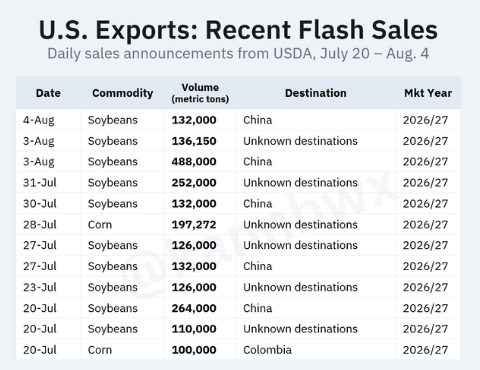
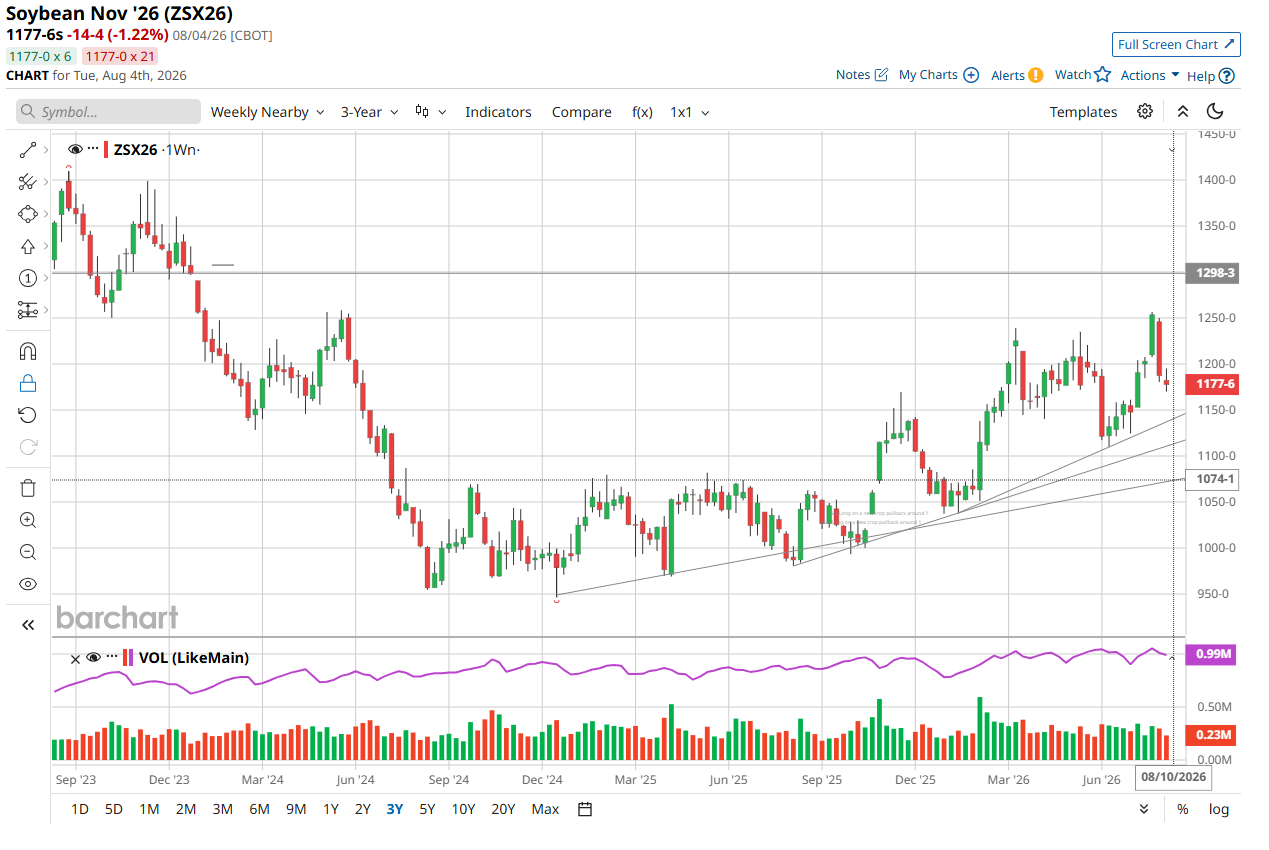
Despite China increasing soybean purchases, weather and its impact on future yields wins the day and beans and meal are pressured yet again today with November beans down double digits. It now begs the question, are the growing season highs of July 24th at 12.56 for the growing season in? If cooler and wet conditions verify in the next few weeks, it could be the case. Keep in mind we have more external factors affecting price and trader psychology this marketing year than the last two crop seasons. These include war in the Middle East and Black Sea, plus China coming to Washington in September for ongoing advances in possible trade deals with US AG products at the forefront. This is still a supply side driven market and weather rules. Crop sizes can get bigger if August weather cooperates and we may be seeing managed funds that were long over 160K bean contracts, pull the liquidation lever and exit. Watch 11.66 and then 11.52 as key levels of support for November 26 beans this week. Should those levels not hold, we could see a liquidation dump to 11.20 then 11.00. To regain upside and turn bullish the market needs to close over the gap made on 7/17 to 7/20 between 12.04 and 12.07. Should that occur, we can retest and even surpass the highs at 12.56. This in my view would be spurred by all of the forecasted rain/moisture to not verify in the upcoming 6 to 10- and 11-15-day forecasts while the summer heat sticks around. A big ask in my view but it’s possible as weather models can flip in a NY minute. Longer term I want to be buyer across the grain Board, but I feel we may head lower first amid fund liquidations into harvest. Current weather prospects have turned bearish for now, but lest see if the forecasts verify. Bean hedge idea below.
Trade Idea
Options-Lock in 11.50 beans using October 26 options. Buy the October 26 soybean 11.50 puts. Sell the 11.30/11.50 October soybean call spread. Cost to entry is even money plus trade costs and fees.
The maximum cost and risk are 1K plus commissions and fees per spread. We are using October options to lock in a floor for November beans at 11.50. This trade is designed for the bean producer to hedge a portion of his production.
If you would like to receive more information on the commodity markets, please use the link to join our email list Sign Up Now
Sean Lusk
Vice President Commercial Hedging Division
Walsh Trading
312 957 8103
888 391 7894 toll free
312 256 0109 fax
Walsh Trading
311 S Wacker Drive Suite 540
Chicago, Il 60606
Walsh Trading, Inc. is registered as a Guaranteed Introducing Broker with the Commodity Futures Trading Commission and an NFA Member.
Futures and options trading involves substantial risk and is not suitable for all investors. Therefore, individuals should carefully consider their financial condition in deciding whether to trade. Option traders should be aware that the exercise of a long option will result in a futures position. The valuation of futures and options may fluctuate, and as a result, clients may lose more than their original investment. The information contained on this site is the opinion of the writer or was obtained from sources cited within the commentary. The impact on market prices due to seasonal or market cycles and current news events may already be reflected in market prices.PAST PERFORMANCE IS NOT NECESSARILY INDICATIVE OF FUTURE RESULTS. All information, communications, publications, and reports, including this specific material, used and distributed by Walsh Trading, Inc. (“WTI”) shall be construed as a solicitation for entering into a derivatives transaction. WTI does not distribute research reports, employ research analysts, or maintain a research department as defined in CFTC Regulation 1.71.