
With tariff rebates and software sales of popular two-wheel drives, Nintendo's Q1 operating profit surged 150% to surpass expectations, but concerns about hardware costs and sales were evident
The Zhitong Finance App learned that in the first full fiscal year after the launch of Switch 2, Nintendo handed over a report card that surprised the market. On August 6, the Kyoto gaming giant released its financial report for the first quarter of fiscal year 2027 (April to June 2026), showing that net profit for the quarter reached 147.4 billion yen (approximately US$934 million), far exceeding analysts' general expectations of 77.8 billion yen; revenue was 517.8 billion yen, which also greatly exceeded market expectations of 448.8 billion yen. Operating profit soared to 142.6 billion yen from 56.9 billion yen in the same period last year; net profit increased 53.5% from the same period last year. Although net sales decreased by 9.5% year over year, they significantly exceeded market expectations.
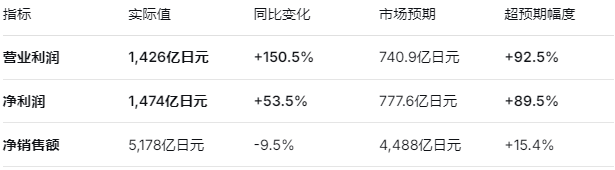
US tariff rebates and first-party game sales have become the two pillars of this quarter's performance exceeding expectations. However, the sharp drop in Switch 2 hardware sales by 34% year over year, the cost of key components continues to soar, and the reality that the price has already risen twice during the year are casting a shadow over the future of the gaming giant.
Tariff rebates “windfall” boost profits
This quarter's results surpassed expectations, thanks in large part to a “windfall.” In February 2026, the US Supreme Court ruled that tariffs previously levied under the International Emergency Economic Powers Act were illegal. Subsequently, Nintendo America filed a lawsuit in court to demand that the government fully refund customs duties, interest, and legal fees.
According to financial reports, Nintendo confirmed an IEEPA tariff refund of about 300 million US dollars during the quarter, taking into account the reduction in sales costs. These tariffs were previously borne by companies rather than passed on to consumers, but now refunds directly recoup costs, boosting profits significantly.
By the end of July, the US government had issued about $100 billion in tariff refunds to companies. Nintendo became one of the main beneficiaries, and this tax refund directly boosted the company's profits. This is similar to Sony's (SONY.US) situation — Sony announced a 37% year-on-year increase in operating revenue last week, also benefiting from around $507.7 million in tariff refunds.
However, this tax refund has also sparked legal controversy. In April of this year, American consumers filed a class action lawsuit accusing Nintendo, on the one hand, of profiting by increasing the sales price of products due to rising tariffs, and on the other hand, receiving tariff compensation from the government, which is a “repeated profit.” Nintendo, on the other hand, made it clear that it would not return refunds to consumers, calling it the normal purchase price.
First-party software supports half of the sky, but hardware sales have declined
On the software side, Nintendo demonstrated strong IP monetization capabilities. First-party games such as “Pokémon: Pokémon World” and “Friends Gathering: Dreams Come True” performed well and became the core engine driving revenue growth.
Switch 2 software sold 9.46 million copies this quarter. First-party games such as “Pokémon: Pokémon World” and “Friends Gathering: Dreams Come True” performed well, and digital revenue surged 90% year over year. The IP-related business doubled, driven by the continued success of “Super Mario Galaxy Movie”.
However, the signal on the hardware side was not positive. In the first quarter of fiscal year 2027 (April to June 2026), Switch 2 console sales fell 34.4% year on year to 3.82 million units, and sales of the original Switch also fell 31.8% year on year to 660,000 units. Although Switch 2 sold a total of 1.86 million units in its first year, sales have decelerated significantly after reaching a high level.
Nintendo expects Switch 2 sales to fall further to 16.5 million units in fiscal year 2027 (down 16.9% year over year), but software sales are expected to increase by 23.2% to 60 million copies. This “hardware decline, software upgrade” pattern reflects that the company is trying to hedge against the decline in hardware revenue through high-profit first-party game sales.
Cost crisis: parts prices skyrocketed and two price increases during the year
Although there was a sharp increase in revenue in the first year of Switch 2's launch, gross margin dropped sharply by nearly 20 percentage points to 40%, showing a clear “increase in revenue without increase in profit” characteristic.
The core of the cost pressure comes from the sharp rise in the price of memory chips and memory. Explosive demand for AI data centers is eating up global storage capacity and driving up the price of key components. Microsoft Xbox head Asha Sharma bluntly stated “We are in a hardware component crisis” in an internal memo — the price of host storage components has more than tripled since the fall of 2025, and is expected to increase more than 5 times over two years ago by the 2027 holiday season, and memory costs have followed a similar trajectory. Nintendo anticipates that the combined impact of memory chip prices and tariffs will impact its business by about 100 billion yen.
The pressure on the cost side comes from soaring memory chip prices. Demand for DRAM and NAND flash memory, driven by the AI boom, has doubled the cost of related components several times over the past year. Nintendo has previously warned that rising memory prices and US tariffs will have a cost impact of about 100 billion yen (about 640 million US dollars) this fiscal year.
To cope with cost pressure, Nintendo has raised the Switch 2 price twice in 2026. On May 25, the price in the Japanese market was raised from 49,980 yen to 59,980 yen; starting September 1, the US market will rise from 449.99 US dollars to 499.99 US dollars, and the European and Canadian markets will follow suit. Nick McKay, an analyst at Freedom Capital Markets, pointed out that the rise in parts prices and tariffs and the recent lack of major shocks are still issues that investors continue to worry about.
Market Outlook: A critical time for a shift in growth engines
Despite this quarter's performance exceeding expectations, the challenges Nintendo faced cannot be ignored. Switch 2 has entered the second year of its life cycle, and there is a clear downward trend in hardware sales; the cost of key components is still rising, and profit margins are under pressure; two price increases during the year may further curb demand.
Meanwhile, investors are expecting flagship series such as “Super Mario” and “The Legend of Zelda” to launch new “blockbusters” on new consoles, but they haven't appeared as of this quarter. Highly profitable software sales are critical to the company's profitability — under the double pressure of declining hardware sales and rising costs, whether first-party games can continue to provide strong profit support will be a key variable in determining Nintendo's performance in the next few quarters.
Despite this impressive profit, Nintendo remains cautious about the outlook for the whole year. The company maintained its full-year operating profit forecast of 370 billion yen — a figure far lower than analysts' previous estimates of around 480 billion yen. Maintaining guidance throughout the year means management believes that cost pressure will continue to be pressured in subsequent quarters. Nick McKay, an analyst at Freedom Capital Markets, pointed out that memory costs are expected to rise more than fivefold by the 2027 holiday season compared to the fall of 2025.