
The “locomotive of the European economy” is clearly showing signs of recovery! Germany's factory orders in June exceeded expectations by 3.1%, and defense and infrastructure spending became the engine
The Zhitong Finance App learned that data released by the German Federal Statistical Office on Thursday showed that the manufacturing industry in Europe's largest economy is sending a strong signal of recovery. German factory orders increased 3.1% month-on-month in June, not only significantly exceeding the median value of 0.5% predicted by economists, but also surpassing the most optimistic expectations in the Bloomberg survey. This is the second month in a row that orders from German factories have increased.
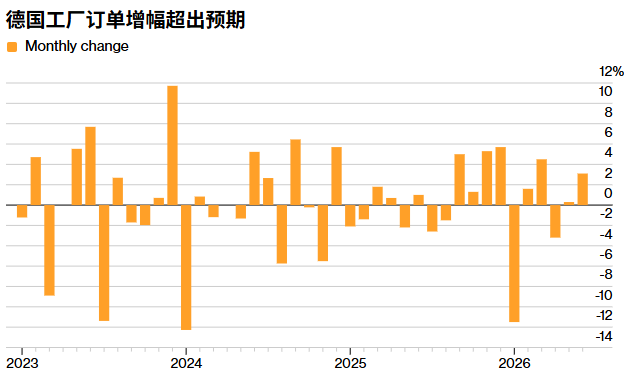
Data panorama: Domestic and foreign demand structures are clearly divided
The strong performance of factory orders in June was broadly based, and the year-on-year increase was also very impressive. Compared with the same period last year, factory orders increased by 6.5% in June, which is significantly higher than the 4.5% revised in May.
However, there is a marked difference in the quality of growth. The current surge in orders was mainly driven by large orders. If such orders were excluded, the actual decrease of new orders was 0.5% compared to the previous month. Judging from the less volatile three-month rolling data, orders from April to June increased by 1.3% compared to the previous three months, but remained flat after excluding large orders.
Looking at the subregions, domestic and foreign demand shows a pattern of “internal strength and external weakness.” Domestic orders surged 7.8% month-on-month, while foreign orders increased only slightly by 0.2%. Among them, orders from non-Eurozone countries increased sharply by 10.2%, strongly offsetting the deep 14.0% decline in orders within the Eurozone.
Growth structure: mechanical engineering and electronic equipment led the way, and defense orders became key variables
The driving force behind the increase in orders in June was highly concentrated. Mechanical engineering products, as well as data processing, electronics, and optical devices, led the growth. Specifically, orders for computer, electronics, and optical products surged 22.7% month-on-month, while orders for machinery and equipment increased 12.7%.
However, growth was mainly driven by large orders. Excluding large orders, new orders actually fell 0.5% month-on-month. Orders from the automotive industry increased by only 3.8%, while orders for other transportation equipment, including aircraft, ships, trains, and military vehicles, plummeted by 41.7% after experiencing strong growth in May.
The German Ministry of Economic Affairs clearly stated in a statement that the upward trend in new manufacturing orders is mainly due to strong domestic demand, and specifically mentioned: “The significant growth in capital goods producers may be related to public procurement projects for the modernization of the Bundeswehr and contracts under infrastructure and climate neutral special funds.”
Recovery Narrative: Fiscal Reforms and Defense Spending Ignite Economic Engines
This data, which exceeded expectations, continued the positive momentum of recent German economic data. Previously, Germany's economic growth in the second quarter was better than expected, and the output data for the first quarter was revised upward. Germany's GDP grew 0.2% month-on-month in the second quarter, exceeding market expectations; indicators of business activity and confidence were also stronger than expected.
German economic data has continued to strengthen in recent weeks. Massive fiscal spending and a package of government reforms in areas such as pensions and bureaucracy have boosted business activity and confidence indicators. The fiscal expenditure plan recently adopted by the German government is about 1 trillion euros (about 1.06 trillion US dollars), without a separate commitment of “more than 1 trillion US dollars.” The plan, promoted by German Chancellor-designate Mertz, aims to revive defense and infrastructure, and injects optimism into the continued recovery of the economy.
Economists generally attribute the momentum for economic recovery to large-scale fiscal stimulus and structural reforms by the government. Commerzbank economist Vincent Stamer said, “The increase in domestic orders is a positive development because the biggest driver so far comes from the Eurozone. “Hard data” shows that the uncertainty brought about by the Middle East conflict had less of an impact on German consumers and businesses than expected.”
Karsten Junior, chief economist at Bank J. Safra Sarasin, expressed optimistic expectations before the data was released: “I was pleasantly surprised by the reforms. Infrastructure and defense spending will have a significant impact on the German economy... Considering reforms and all capital investment, a cyclical rise over the next two years is almost inevitable.”
Risks remain: energy costs and Rhine water levels pose a double headwind
Despite the impressive data, the recovery path of the German manufacturing industry still faces significant risks. The rise in energy prices due to the conflict in the Middle East continues to put pressure on energy-intensive industries. Meanwhile, the water level of the Rhine River, an important cargo transportation route in Western Europe, has dropped to an all-time low, posing a new supply chain challenge. The actual revenue of the manufacturing industry fell 1.3% month-on-month, indicating that order growth has not been fully translated into actual economic activity.