
Infineon (XTRA:IFX) Stock Looks Stretched On Cash Flow And Earnings
Infineon Technologies stock has delivered an 81.1% return over the past five years, yet both the Discounted Cash Flow (DCF) intrinsic value estimate and earnings based multiples currently point to the shares trading at a premium rather than at a clear discount.
- Over 5 years, Infineon Technologies has returned 81.1%, which sets a high bar for any further upside to be justified by fundamentals.
- Record revenue supported by demand from AI data centres and automotive chips can support optimistic growth expectations. However, any slowdown in these end markets or in energy efficient semiconductor spending may put pressure on what investors are willing to pay for the stock.
- The company scores 0 out of 6 on Simply Wall St’s broader valuation checks, which suggests Infineon Technologies does not screen as a clear bargain across metrics such as value score.
The issue now is whether Infineon Technologies' current share price already reflects the good news on growth, given that both the intrinsic value estimate and market multiples indicate the stock may be overvalued.
Find out why Infineon Technologies' 76.2% return over the last year is lagging behind its peers.
Is Infineon Technologies Getting Expensive on Cash Flow?
The Discounted Cash Flow (DCF) method takes Infineon Technologies' projected cash flows and discounts them back to today to estimate what the stock might be worth. On the latest twelve month view, Infineon Technologies generated free cash flow of about €785 million, with the model assuming growing cash flows over the next decade rather than a shrinking profile.
Based on these assumptions, the DCF points to an estimated intrinsic value of around €53.58 per share. This sits below the current market price, which implies the stock trades about 12.6% above this intrinsic estimate, so the cash flow outlook no longer screens as cheap. Infineon hitting record revenue from AI data centres and automotive chips helps explain why investors are comfortable paying a premium to this cash flow based valuation.
On the DCF view, Infineon Technologies stock currently looks overvalued relative to its projected cash flows.
Our Discounted Cash Flow (DCF) analysis suggests Infineon Technologies may be overvalued by 12.6%. Discover 252 high quality undervalued stocks or create your own screener to find better value opportunities.

Has Infineon Technologies Run Too Far on Earnings?
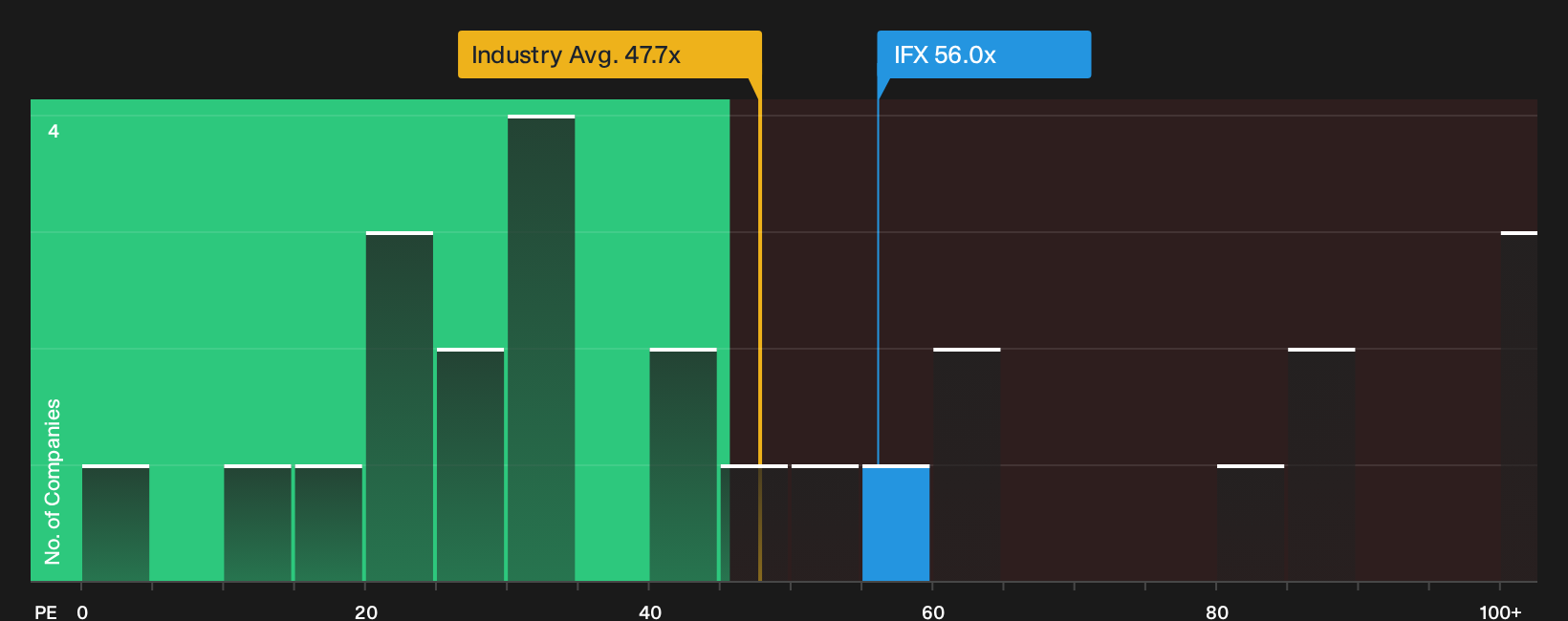
The P/E ratio is a useful way to see what investors are paying today for Infineon Technologies earnings power. On this measure, Infineon trades on about 64.7x earnings, which is well above the Semiconductor industry average of roughly 44.0x and also higher than the peer group average of around 43.0x.
The Simply Wall St model suggests a fair P/E of about 58.4x for Infineon Technologies, based on factors such as its growth outlook, margins, size and risk profile. The current 64.7x is therefore meaningfully higher than this fair ratio, so the stock screens on the expensive side compared with what the model implies investors might usually pay for these fundamentals.
On the P/E multiple, Infineon Technologies stock currently screens as overvalued relative to both industry norms and its own modelled fair ratio.
See what the numbers say about this price — find out in our valuation breakdown.
The Infineon Technologies Narrative: What Would Justify Today's Price?
Simply Wall St Narratives pick up where the valuation puzzle for Infineon Technologies leaves off by spelling out which paths for growth, margins and earnings would need to play out for the stock to be worth materially more or less than today’s price. Instead of a single output from a ratio or model, they describe the future that figure assumes, so you can watch how Infineon Technologies' actual progress lines up over time on the Community page.
Community views on Infineon Technologies sit far apart, with some investors focused on long term capacity and others worried about valuation and timing.
Bull case: 30% undervalued
"Infineon's power and sensor solutions are experiencing accelerating demand from AI data center build-outs, with projected revenues in this segment growing from approximately €600 million this year to €1 billion next year, reflecting a strong multi-year increase in high-margin revenue from the rapid proliferation of AI infrastructure and rising chip content per device…"
Read the full Bull Case to see why Infineon Technologies could be undervalued
Bear case: 20% overvalued
"But be aware, since IFX takes the money to invest from the earnings, instead of getting into debt, the earnings show a dip ahead…"
Read the full Bear Case to see why Infineon Technologies could be overvalued
Do you think there's more to the story for Infineon Technologies? Head over to our Community to see what others are saying!
The Bottom Line
Infineon Technologies currently screens as overvalued on both the Discounted Cash Flow (DCF) intrinsic value estimate and on earnings based multiples, so the valuation case is not built on a clear margin of safety. Broader checks also sit in the weaker tier, which reinforces the message that the stock is priced for a strong outcome rather than caution. From here, the key question for you is whether demand in areas like AI data centres and automotive chips can stay strong enough, for long enough, to justify that premium and keep investor confidence in the current multiple.
This article by Simply Wall St is general in nature. We provide commentary based on historical data and analyst forecasts only using an unbiased methodology and our articles are not intended to be financial advice. It does not constitute a recommendation to buy or sell any stock, and does not take account of your objectives, or your financial situation. We aim to bring you long-term focused analysis driven by fundamental data. Note that our analysis may not factor in the latest price-sensitive company announcements or qualitative material. Simply Wall St has no position in any stocks mentioned.
Have feedback on this article? Concerned about the content? Get in touch with us directly. Alternatively, email editorial-team@simplywallst.com