
Goldman Sachs refutes market concerns: US supports Japan's intervention in the foreign exchange market and does not hinder dollar hegemony, FIMA tools highlight the depth and resilience of the US dollar system
The Zhitong Finance App learned that Goldman Sachs Group said that US support for Japan's efforts to support the yen is unlikely to damage the US dollar's position as the world's most important reserve currency.
Japan is the largest foreign investor in the $31 trillion US Treasury bond market, and last month's joint monetary intervention raised some concerns that US support for the yen — which may be aimed at preventing unnecessary fluctuations in US bonds — could weaken confidence in dollar reserves. Goldman Sachs said that this argument assumes that the US may try to prevent other countries from selling US Treasury bonds in the future.
Strategists, including Michael Cahill, wrote in a report, “This seems a bit far-fetched,” and “we are skeptical about claims that this has a negative impact on the dollar's reserve position.”
The bank pointed out that Japan can use the Federal Reserve's Foreign and International Monetary Authority (FIMA) repurchase facility, which allows foreign central banks to raise dollars in US Treasury bonds without selling them. According to the report, this highlights one of the key advantages of the US dollar: having a deep capital market to build reserves during normal times, and access to liquidity in times of stress.
The strategist added, “We believe that the actions of the US Treasury and the availability and utility of FIMA tools help prove that no other currency can currently match the US dollar in terms of utility, network effects, and supporting infrastructure.”
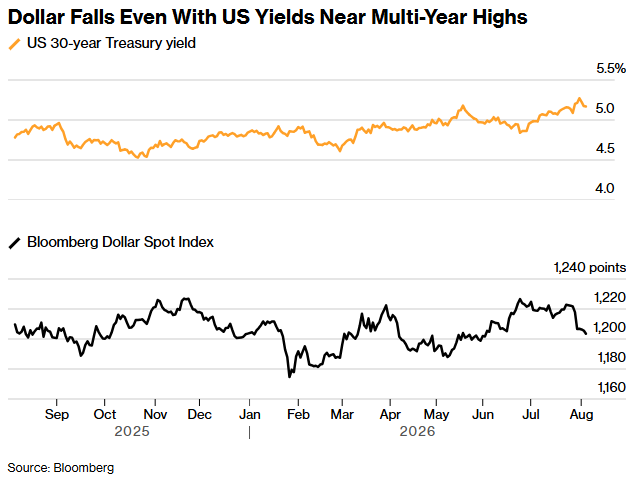
The dollar fell even though US Treasury yields were close to multi-year highs
This is the first time in nearly 30 years that Washington and Tokyo have jointly supported the yen. Although the operation was carried out through the euro to avoid disrupting the US Treasury bond market, some investors are concerned that direct US support for the yen may inadvertently weaken the dollar and reduce the attractiveness of US bonds as reserve assets.
The specific operating mechanism of the intervention has also drawn attention. The US bought yen by selling the euro last week without prior notice to the ECB, and only notified EU officials afterwards.
Strategist Kristine Aquino said, “The factors behind the dollar and bond markets seem to be more deeply rooted. For the US dollar, the ripple effect of the US and Japan's joint intervention in the yen is another major catalyst.”
That's not to say Goldman Sachs sees no risk in the dollar's dominance. The strategist acknowledged that policy uncertainty could weaken its global role — a concern at the core of their bearish view on the dollar in 2025. However, they said it is a bit far-fetched to apply these concerns to America's support for the Japanese yen.
The bank said that there was a precedent where countries used their US Treasury bonds to support their local currency without attracting opposition from Washington. For example, in March of this year, when signs of market pressure appeared, many countries sold large amounts of US Treasury bonds to support the local currency.
“We believe that events like this forced sell-off actually help to solidify the dollar's role over time,” the strategist wrote.