
The wave of Japanese bond sell-off hits Japan's top four life insurance giants! $96 billion of floating losses and forced depreciation peaked
The Zhitong Finance App learned that Japan's top four life insurance companies reported that in the three months up to the end of June, the total unrealized losses on Japanese domestic bonds held by them increased by 7%, highlighting the risks posed by soaring yields to the Japanese insurance industry.
According to the April to June quarterly earnings data, the book losses on bonds held by the four major life insurance companies Nippon Life Insurance Company, Dai-ichi Life Holding Group, Sumitomo Life Insurance Company, and Meiji Yasuda Life Insurance Company increased to 15.13 trillion yen (about 96 billion US dollars). However, with the exception of Nippon Life Insurance Company, all three other life insurance companies have experienced unrealized increases in losses on their bonds.
The fall in bond prices also causes some positions to trigger impairment accounting, that is, when the market value of bonds is less than 50% of the purchase cost, asset impairment losses need to be confirmed. Among them, Nippon Life Insurance Company confirmed an impairment loss of approximately 44 billion yen, while Meiji Yasuda Life Insurance Company confirmed an impairment loss of 25.3 billion yen.
Japanese life insurance companies usually hold Japanese treasury bonds and other debt securities and hold them until maturity to meet insurance liability requirements. However, if customers drop out of insurance in large numbers, insurers may need to sell these bonds to pay compensation payments, which may put pressure on their profitability and investment portfolios.
Japan's Financial Services Agency said in a regulatory report released on August 6 that the unrealized increase in bond losses is affecting insurance companies' financial accounting processing and liquidity conditions, and regulators are closely monitoring insurance companies' investment activities.
Japan's 30-year Japanese Treasury bond yield once rose above 4% in May, hitting a record high due to market concerns that Prime Minister Takaichi Sanae's government might support the economy by increasing fiscal spending. However, this type of ultra-long-term treasury bond is the main investment target of life insurance companies.
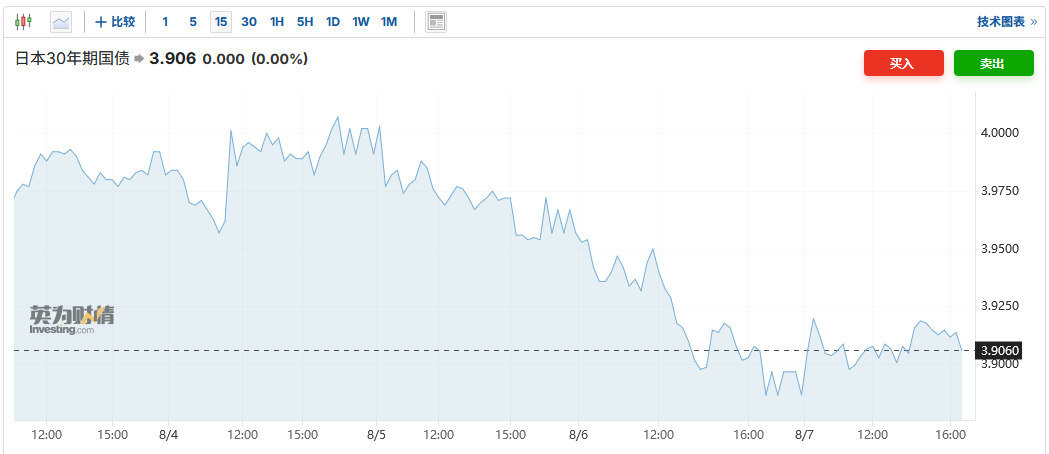
The sell-off in Japanese treasury bonds during the second quarter reflects two mutually reinforcing pressure lines. One is the transmission of global inflation — war-driven energy price increases are driving up borrowing costs for governments, making it difficult for Japan to stand alone. Second, there are hidden domestic financial concerns. Japanese Prime Minister Sanae Takaichi's policies have raised market concerns about the Japanese government's fiscal discipline.
Despite the recent decline in yield on Japan's 30-year treasury bonds, the Bank of Japan's gradual interest rate hike, the rise in global term premiums, and the Japanese government's huge bond issuance plan are expected to continue to suppress Japanese bond prices.
As the Bank of Japan gradually reduces the scale of bond purchases, investors are increasingly concerned about one question: Who will absorb the government's growing debt? The prospects for stronger domestic demand in Japan are therefore particularly important. Meanwhile, Société Générale's previous estimates showed that the Japanese Government Pension Investment Fund (GPIF) can purchase up to an additional 12.3 trillion yen (about 76 billion US dollars) of Japanese treasury bonds without changing the benchmark asset allocation framework.
This estimate by Societe Generale is based on a simple assumption: GPIF will gradually increase domestic bond holdings from 26.9% in March to the 31% limit allowed under the current system. In the medium term, GPIF can release potential purchases of 76 billion to 90 billion US dollars, even if the allocation of domestic bonds is only gradually increased within the existing allowable range. However, Societe Generale also warned that the fundamental problem with Japanese treasury bonds is an imbalance between supply and demand — “Stable bid supply and accelerated quantitative austerity have increased bond supply, while domestic investor demand has weakened, and global term premiums have risen.”