
The US non-agricultural accident turned a heavy burden in July, and the dollar market lowered expectations of interest rate hikes in September, and the Federal Reserve may remain on hold
The Zhitong Finance App learned that the US employment data for July was unexpectedly weak, further weakening market expectations for the Federal Reserve's recent interest rate hike, and the US dollar weakened on Friday. According to the data, the number of non-farm payrolls in the US unexpectedly declined in July, and the employment data for the previous two months was also drastically revised, causing investors to re-evaluate the prospects of the Federal Reserve's monetary policy.
Affected by this, the Bloomberg Dollar Spot Index fell 0.5% on Friday to its lowest level since May. The US dollar generally weakened against all major currencies, with the yen rising significantly against the US dollar.
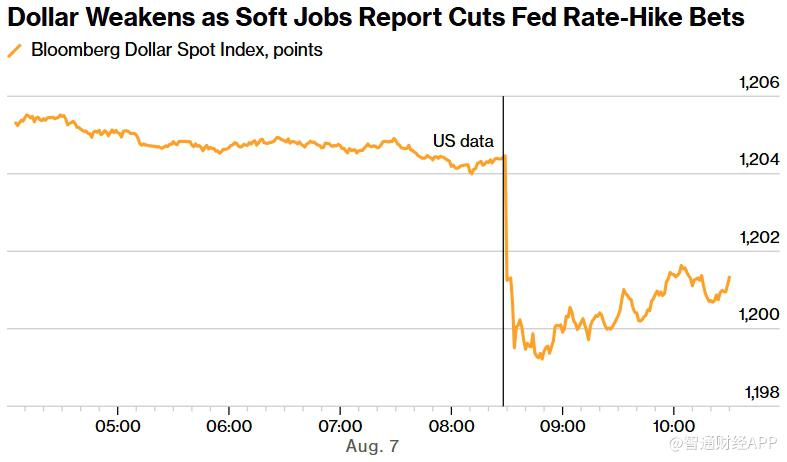
According to data released by the US Bureau of Labor Statistics, the number of people employed in non-farm payrolls fell by 23,000 in July, and the employment data for May and June were also revised down; at the same time, the unemployment rate fell to 4.1%, but the main reason was that the labor participation rate continued to decline. Furthermore, wage growth has also slowed, indicating a further cooling of the labor market.
Sarah Ying, head of foreign exchange strategy at CIBC Capital Markets, said that the employment data released on the same day “greatly weakened the market's confidence in the Fed's September rate hike.” She predicts that the US economic data will continue to cool down in the future, and that the Federal Reserve will eventually keep interest rates unchanged.
After the employment data was released, the interest rate swap market showed that traders' bets on the Federal Reserve's interest rate hike in September have clearly cooled down, and the probability of interest rate hikes has dropped from close to 60% to about 40% before the employment report was released.
Nathan Thooft, senior portfolio manager at Manulife Investment Management, said that the employment report further confirms the agency's long-standing view that the market's previous expectations for the Fed's interest rate hike were too high.
He said that if the job market continues to weaken, the Federal Reserve will have sufficient reasons to keep current interest rates unchanged.
Since the end of June, the US dollar as a whole has entered a downward trend as the market continues to weaken expectations of the hawkish stance of the Federal Reserve. At the same time, the market's bullish sentiment towards a further rise in the US dollar has clearly cooled down. According to the data, the cost of options used to hedge against the rising risk of the US dollar over the next six months has fallen to its lowest level since mid-May, reflecting the weakening of investors' confidence in the continued strengthening of the US dollar.
However, data from the US Commodity Futures Trading Commission as of July 28 shows that speculative funds have continued to increase long positions in the US dollar until now, and bullish sentiment once rose to the highest level since 2014. It is worth paying attention to whether there has been a position adjustment in the market after the latest employment data was released.
It is worth noting that since Federal Reserve Chairman Walsh took office, his communication method of weakening forward-looking guidance has made every economic data an important variable affecting market expectations, and has also increased market fluctuations.
Before the September interest rate meeting is held, the Federal Reserve will also welcome a non-farm payrolls report and two inflation data. These data will continue to influence the market's judgment on the Fed's next policy path.