
Maersk Stock And Two Trade Exposed Names Facing Fresh Geopolitical Pressure
When trade routes and energy supplies are in the headlines, companies tied to global flows can quickly swing from market favourites to potential trouble spots. That creates a window where risks and mispricing often sit side by side, and sitting out entirely can be its own risk. This article walks through three stocks exposed to the latest geopolitical shock and explains why each may now sit on the wrong side of that story.
A.P. Møller - Mærsk (CPSE:MAERSK B)
Overview: A.P. Møller - Mærsk is a global logistics company based in Copenhagen that runs container shipping lines, port terminals and end to end freight services across ocean, air and land for customers in sectors such as retail, autos, chemicals and healthcare.
Operations: Maersk generates most of its revenue from Ocean shipping at about US$34.2b, with US$15.4b from Logistics & Services and US$5.4b from Terminals, partly offset by eliminations and unallocated items.
Market Cap: DKK242.4b
Maersk sits at the sharp edge of today’s trade and energy shock, which is exactly why it deserves attention. Earnings have fallen sharply in the past year and analysts expect only about 1% annual revenue growth with profit margins shrinking, even as the stock still trades on a P/E similar to peers despite weaker forecasts and a DCF that suggests a valuation gap. At the same time, management is absorbing roughly US$500 million in extra monthly fuel and rerouting costs, while Q1 2026 net income of US$53 million highlights how fragile profitability can be when routes are disrupted. Investors who assume recent high freight rates and buybacks will be enough support may be missing what happens if trade flows stay volatile longer than expected.
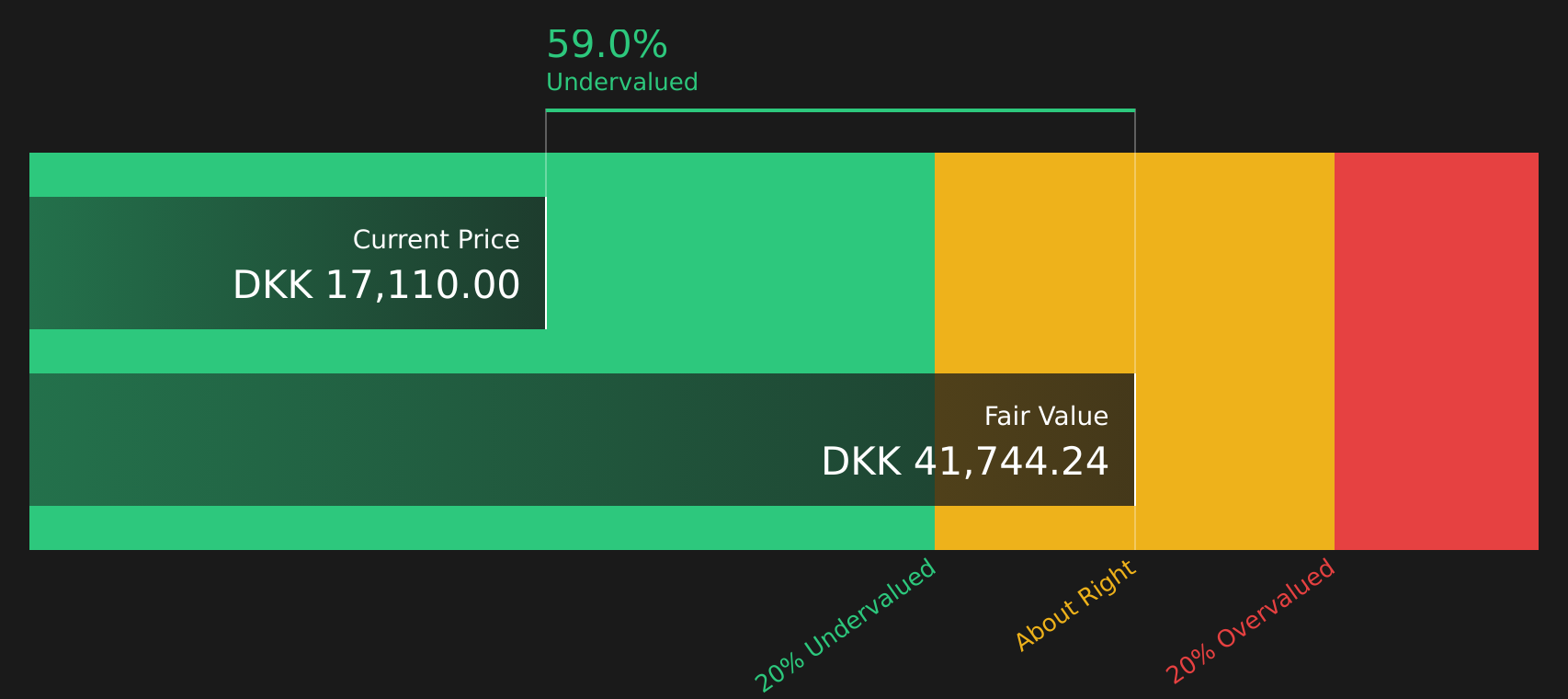
Maersk’s shrinking margins and fragile net income paint only part of the picture. The real question is what the current price already assumes about trade, fuel and disruption risk. The DCF valuation analysis for A.P. Møller - Mærsk may show why this story could still surprise investors.
Build your own disruption risk shortlist
A.P. Møller - Mærsk and the two other stocks in this article all surfaced from a single Simply Wall St screener, but the real edge comes from shaping your own filters. Use our customisable Screener to combine valuation, growth, balance sheet and risk checks in one place, or tap into any of our curated Investing Ideas for ready made starting points.
Glencore (LSE:GLEN)
Overview: Glencore is a Switzerland based commodities group that mines and processes metals, minerals and coal, and also trades and transports these raw materials and energy products to industrial customers worldwide.
Operations: Glencore generates most of its revenue from Marketing Activities at about US$274.7b, with around US$64.5b from Industrial Activities, partly offset by US$32.3b of inter segment eliminations.
Market Cap: £65.4b
Glencore deserves attention now because its size and reach into copper, coal and energy trading make it unusually exposed if trade routes and fuel supplies are disrupted for longer than expected. Marketing profits can benefit from short term volatility, yet management itself has flagged that tariffs and weaker commodity demand can hurt the industrial mining side and that working capital needs rise when routes lengthen and markets become less liquid. Earnings only recently swung back to profit. Revenue is forecast to decline over the next few years. Dividends plus buybacks already commit significant cash. If geopolitical shocks start to bite both volumes and funding costs at the same time, investors who focus only on recent H1 2026 strength may be underestimating how quickly this mix can turn.
Glencore’s rebound to profit and heavy capital returns can mask how exposed it is if trade routes clog and funding costs rise together. The 1 key reward and 2 important warning signs (1 is major!) could highlight where that pressure really hits

ExxonMobil Holdings (XOM)
Overview: ExxonMobil Holdings is a large global energy company that explores for and produces oil and gas, refines crude into fuels, and manufactures a range of chemicals and specialty products sold under the Exxon, Esso and Mobil brands. It also runs trading and transport operations and is building businesses in lower emission opportunities such as carbon capture, hydrogen, low emission fuels and lithium.
Operations: ExxonMobil Holdings generates most of its revenue from Energy Products at about US$333.9b across the United States and other regions, with a further US$112.1b from Upstream oil and gas, US$34.4b from Chemical Products and US$21.2b from Specialty Products, partly offset by US$140.6b of intersegment eliminations.
Market Cap: US$636.7b
ExxonMobil Holdings sits right in the crosshairs of today’s geopolitical shock. The company has been benefiting from a very high margin environment as Middle East supply routes tighten and refining markets stay tight. However, management itself has warned that this is not sustainable and that the market has not fully absorbed the impact of disruptions. Earnings growth is modest, revenue growth is slow, and the stock trades on a richer P/E than many peers even after a period of strong cash flow, buybacks and LNG expansion. At the same time, future growth leans heavily on hydrocarbons just as regulatory and decarbonisation pressures build. Investors who only see short term windfalls from disrupted supply may be missing how quickly this set up could change if trade routes or policy move against ExxonMobil Holdings.
ExxonMobil Holdings’ rich P/E and modest growth profile could be masking where the real pressure sits. The analyst forecasts for ExxonMobil Holdings outlines how future volumes, margins and hydrocarbon exposure might come into conflict next.

Seeking Alternatives Before Momentum Flies
Fresh ideas move first and get rewarded while the rest of the market plays catch up. Scan these under the radar lists before momentum breaks out and act now.
- Spot stronger balance sheets before they get crowded by using our curated list of solid balance sheet and fundamentals (422 results) that filters for quality cash flows and resilient fundamentals.
- Explore potential income opportunities with carefully selected 440 dividend fortresses that combine high yields with a focus on stability and consistent payouts.
- Track companies involved in transmission upgrades and grid technology demand through hand picked 36 power grid technology and infrastructure stocks.
This article by Simply Wall St is general in nature. We provide commentary based on historical data and analyst forecasts only using an unbiased methodology and our articles are not intended to be financial advice. It does not constitute a recommendation to buy or sell any stock, and does not take account of your objectives, or your financial situation. We aim to bring you long-term focused analysis driven by fundamental data. Note that our analysis may not factor in the latest price-sensitive company announcements or qualitative material. Simply Wall St has no position in any stocks mentioned.
Have feedback on this article? Concerned about the content? Get in touch with us directly. Alternatively, email editorial-team@simplywallst.com