
Walmart (WMT) Eyes A Tariff Refund, Is The Stock Still A Bargain?
Walmart (WMT) is back in focus after reports that it could receive roughly US$2.4b in tariff refunds following a Supreme Court ruling that invalidated certain import duties, drawing fresh attention to the stock.
See our latest analysis for Walmart.
For investors looking at the bigger picture, Walmart’s share price has eased over the past quarter, with a 90 day share price return of 12.34% in decline. This comes even as its 1 year total shareholder return of 8.73% and 5 year total shareholder return of 138.31% point to stronger longer term compounding. At the same time, the potential US$2.4b tariff refund sits alongside ongoing e commerce and product expansion announcements.
If this tariff story has you thinking about where else growth and disruption might appear, it could be worth scanning for other large platforms reshaping retail and logistics, starting with the 19 top founder-led companies
Bulls point to Walmart’s scale, e commerce traction and the potential US$2.4b tariff refund. Bears focus on the recent 12.34% share price decline. Which side does the current valuation evidence support next?
Most Popular Narrative: 27.6% Undervalued
According to the most followed narrative on Walmart, a fair value of $154.58 sits well above the last close of $111.85, which puts the recent tariff headlines in a different light.
Walmart’s “Other” SBU is poised for continued success, leveraging innovation and agility to capture new market share. While risks exist, the segment’s performance and strategic initiatives suggest a promising outlook. Investors and stakeholders should watch for further developments in digital integration and specialty category expansion as key drivers of future growth.
Curious what sits behind that fair value for Walmart? The narrative leans heavily on sustained growth in newer lines and a profit profile that looks very different from a classic big box retailer. Want to see which assumptions carry the most weight in that calculation? The full breakdown is where those numbers start to tell a very different story.
Result: Fair Value of $154.58 (UNDERVALUED)
Have a read of the narrative in full and understand what's behind the forecasts.
However, this Walmart narrative could be tested if the “Other” segment stalls or if competitive pressure in specialty and digital services compresses margins faster than expected.
Find out about the key risks to this Walmart narrative.
Another View on Walmart’s Valuation
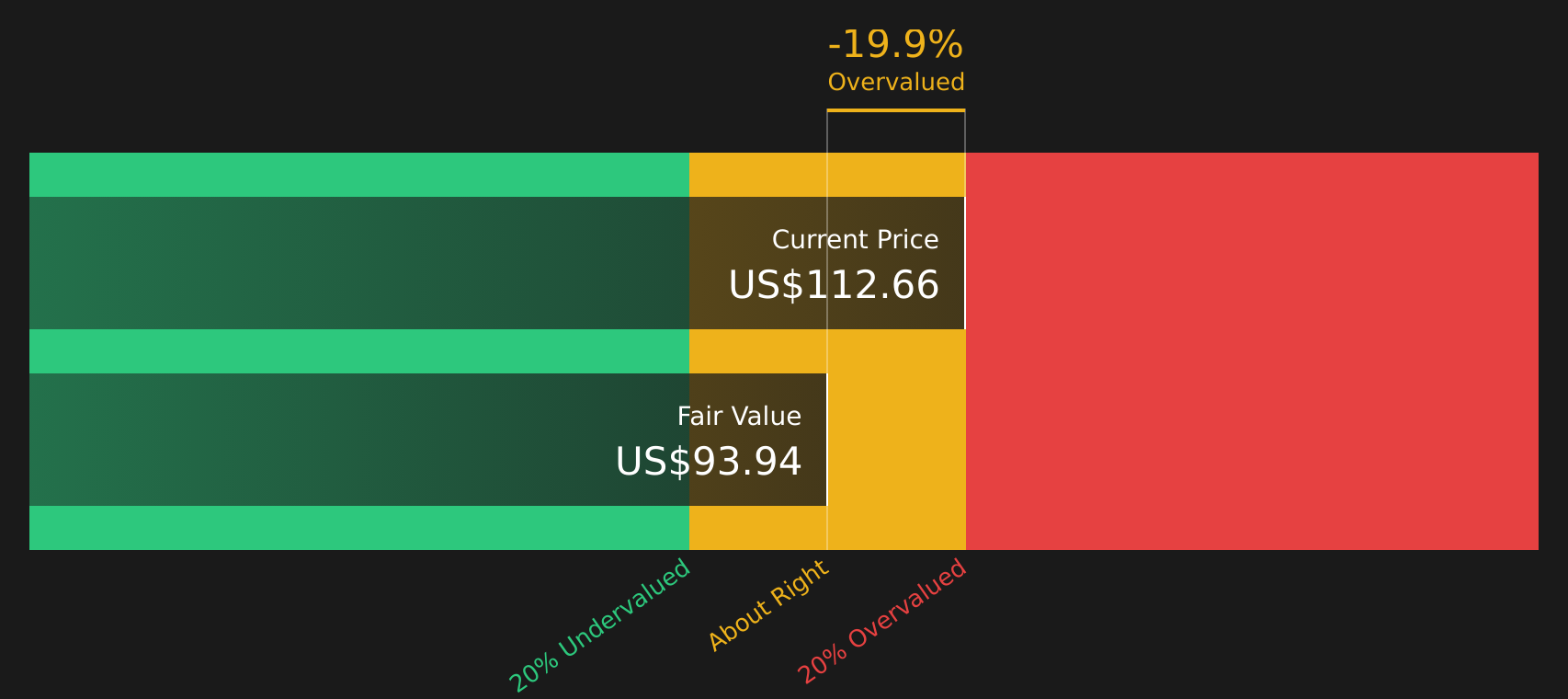
The narrative fair value of $154.58 suggests Walmart is undervalued, yet our DCF model points in a different direction. On that view, the stock at $111.85 sits above an estimated future cash flow value of $93.94, which frames Walmart as overvalued instead. Which perspective do you find more convincing?
Look into how the SWS DCF model arrives at its fair value.
Next Steps
If this mix of risks and rewards around Walmart leaves you undecided, now is a good time to review the details yourself and form a clear stance. To see how those concerns and potential upsides balance out, start with the 3 key rewards and 2 important warning signs.
Looking for more investment ideas beyond Walmart?
If you are weighing up your next move after Walmart, do not leave your capital sitting idle when fresh opportunities could be one screen away.
- Target potential growth stories that the market may be overlooking by scanning the screener containing 21 high quality undiscovered gems.
- Strengthen the defensive side of your portfolio by filtering for companies in the 83 resilient stocks with low risk scores.
- Zero in on quality and resilience by focusing on businesses in the solid balance sheet and fundamentals stocks screener (48 results).
This article by Simply Wall St is general in nature. We provide commentary based on historical data and analyst forecasts only using an unbiased methodology and our articles are not intended to be financial advice. It does not constitute a recommendation to buy or sell any stock, and does not take account of your objectives, or your financial situation. We aim to bring you long-term focused analysis driven by fundamental data. Note that our analysis may not factor in the latest price-sensitive company announcements or qualitative material. Simply Wall St has no position in any stocks mentioned.
Have feedback on this article? Concerned about the content? Get in touch with us directly. Alternatively, email editorial-team@simplywallst.com