
Index finger on Bursa’s pulse
SEVENTEEN years ago, Malaysia changed the way it measured its stock market.
The Kuala Lumpur Composite Index, which tracked 100 companies, was replaced by a leaner 30-stock FBM KLCI.
The idea was simple: to align Malaysia’s benchmark with international index standards, making it more attractive to global investors and better reflecting the economy at the time.
Nearly two decades later, the question is whether the benchmark has kept pace with the economy it is supposed to represent.
Malaysia today is not the same market it was in 2009.
The country has seen the rise of semiconductor-related industries, data centres, renewable energy, healthcare and technology-driven businesses.
Yet the FBM KLCI remains dominated by the traditional pillars of corporate Malaysia – banks, plantations and utilities.
FTSE Russell believes it may be time for another rethink.
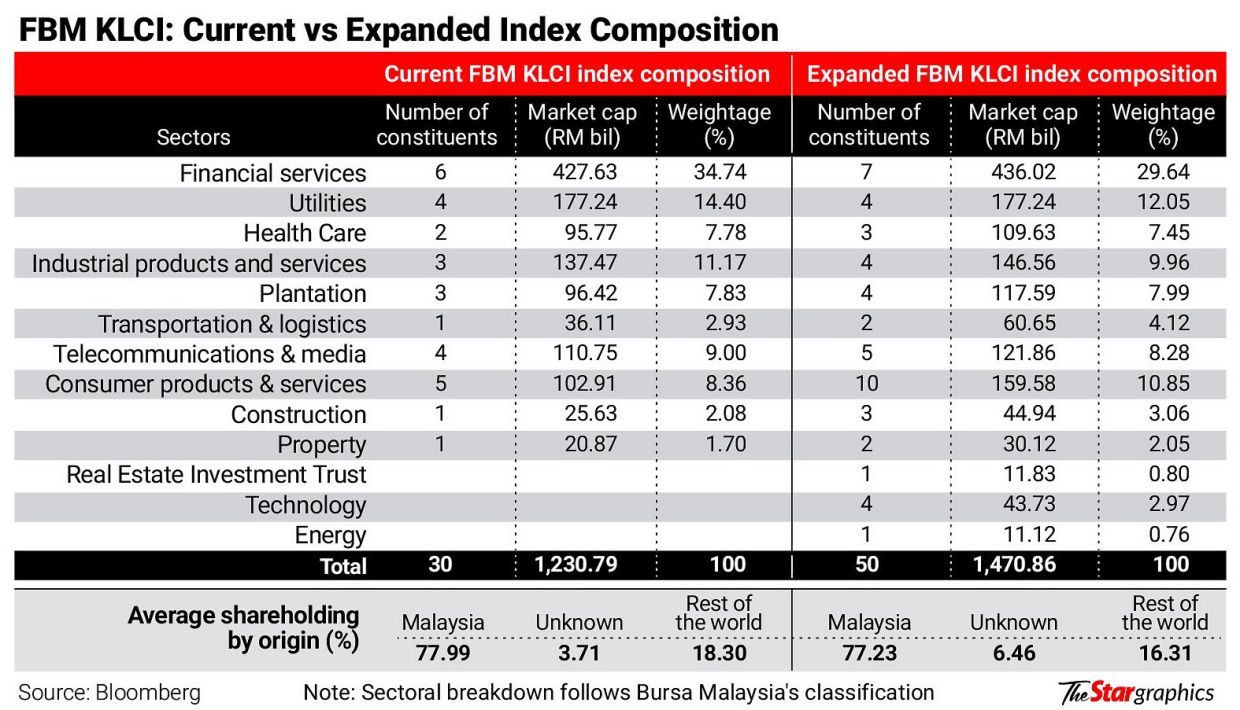
In March, the global index provider sought market feedback on expanding the FBM KLCI from 30 to 50 constituents, while introducing a 10% cap on the weighting of any individual company.
If approved, the changes could take effect on Dec 21 this year or June 21 next year, depending on the outcome of the market consultation.
Rather than simply adding 20 more companies, the proposal seeks to reshape how Malaysia’s equity market is represented.
More than a barometer of market performance, the FBM KLCI also serves as a benchmark for investment funds, influencing how passive funds, exchange-traded funds (ETFs) and institutional investors allocate capital.
The timing is notable, with foreign shareholding in Malaysian equities falling to around 19%, near multi-year lows.
Against this backdrop, the key question is whether a broader and more diversified benchmark can improve Malaysia’s appeal among global investors and help revive foreign participation in the local equity market.
For IPPFA Sdn Bhd investment strategy director and country economist Mohd Sedek Jantan, the proposed expansion is a positive structural enhancement, but not a silver bullet for Malaysia’s foreign investor challenge.
“The proposal is certainly a step in the right direction, but I would not expect it to be a game changer for foreign shareholding on its own,” he tells StarBiz 7.
Mohd Sedek says a broader FBM KLCI would improve market breadth, sector diversification and reduce concentration risk, making the benchmark a better reflection of Malaysia’s equity market.
“Global institutional investors increasingly favour benchmarks that offer broader diversification and better sector representation rather than being dominated by a handful of large-cap stocks,” he notes.
However, he cautions that foreign investors ultimately look beyond the benchmark, with allocation decisions driven by factors such as economic growth, corporate earnings, policy certainty, currency stability and valuations.
“Improving the benchmark addresses one structural limitation of Malaysia’s equity market, but it is unlikely to generate a sustained increase in foreign ownership unless accompanied by stronger economic fundamentals and earnings momentum,” he says.
“The proposal enhances the market’s attractiveness, but fundamentals will ultimately determine whether foreign investors increase their allocations,” Mohd Sedek adds.
Tradeview Capital Sdn Bhd founder and chief executive officer Ng Zhu Hann has a contrasting view.
He believes the index expansion would help spur foreign shareholding as it brings greater representation of Malaysia’s “new economy” sectors.
He says the expansion could address one of the long-standing criticisms of Malaysia’s benchmark – that it remains too heavily weighted towards the “old economy.”
“With an expansion, we are actually able to tap into more new economy stocks, including increasing the percentage and weightage of companies in the technology and semiconductor sectors,” he says.
“That is always the flavour of the day, which would encourage and attract fund flows.”
Although only four technology companies are currently among the potential 20 additional constituents, Ng expects more new economy firms to qualify for inclusion as their earnings and market capitalisations grow.
While the impact on foreign participation remains a longer-term question, the proposed changes are expected to trigger more immediate adjustments within the market itself.
Mohd Sedek says the first impact is likely to come through portfolio rebalancing, as funds tracking the benchmark adjust their holdings to reflect the new index composition.
Based on FTSE Russell’s simulation, he says about one-quarter of the index would require rebalancing under the proposed methodology.
“Index-tracking funds will therefore need to reduce exposure to existing heavyweight constituents while increasing allocations to newly admitted companies through a process of mechanical portfolio rebalancing,” he says.
The introduction of the 10% constituent cap would also reduce the weight of the largest stocks, resulting in temporary outflows from heavyweight constituents as index funds rebalance their portfolios, Mohd Sedek says.
However, he stresses these are technical adjustments rather than a reflection of fundamentals, with companies’ long-term performance continuing to depend on earnings and business execution.
Companies added to the expanded FBM KLCI, meanwhile, are likely to benefit from greater institutional interest, stronger research coverage and improved liquidity.
“Beyond the initial passive fund inflows, benchmark inclusion typically generates an index inclusion effect, whereby benchmark-aware active managers, institutional investors and sell-side research analysts allocate greater attention and research resources to newly included constituents,” he says.
“This generally increases institutional ownership, improves market liquidity, enhances price discovery and strengthens overall market efficiency.”
In its market consultation paper released in March, FTSE Russell notes that the financial sector has consistently accounted for more than 30% of the FBM KLCI, limiting diversification and underrepresenting faster-growing sectors such as technology and energy.
“This imbalance reduces the benchmark’s ability to reflect Malaysia’s shifting economic structure and broader market dynamics,” it says, adding that expanding the benchmark would improve market breadth and increase market capitalisation coverage to about 70% from around 60%.