
The price of gold rose above 4,400 dollars! The technical side and the central bank's gold purchases form a “double impetus”, and gold is expected to start a new recovery cycle
The Zhitong Finance App learned that before the release of the key US inflation report, which may provide new clues about whether the Federal Reserve is interested in raising interest rates, the price of gold continued to rise on Tuesday after a cumulative increase of 3.6% over the past two trading days. As of press release, the price of spot gold rose 0.67% to $4419.58 per ounce.
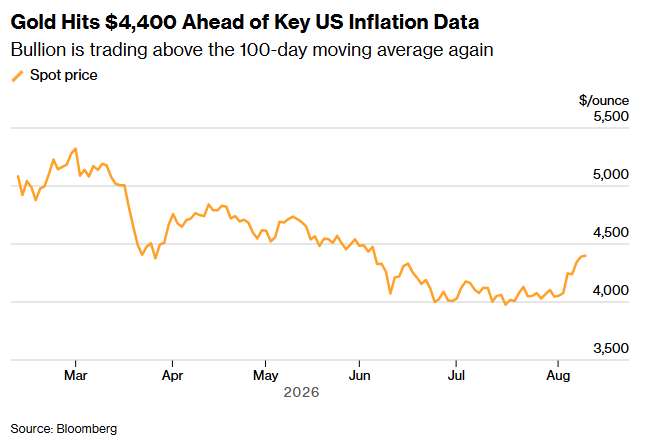
Over the past few weeks, the price of gold has once again broken through the key support level of $4,000 per ounce. Meanwhile, investors' demand for precious metals is heating up again, and central banks are increasing their purchases of gold, providing support for the rise in gold prices. Despite the recent rise in gold prices, the current price of gold is still about 17% lower than the level before the outbreak of the Middle East War at the end of February.
Technical buying was triggered after the gold price broke through the 100-day moving average on Monday, which further strengthened the signal of a recovery in gold prices. However, in the past few weeks, the market has seen dips buying capital, while capital inflows from China Gold Exchange Traded Funds (ETFs) have also increased.
Hebe Chen, an analyst at Vantage Markets, said, “The complex factors surrounding gold have finally begun to gradually form a synergy, making this recovery characteristic of entering the early stages of a new cycle.” “Since falling into a downward spiral in March, gold is now beginning to gradually break out of this pattern. More importantly, while oil prices rise and the dollar strengthens, gold can still rise, which indicates that traders are beginning to price gold from a different perspective.”
The data shows that since July, along with the fluctuation and recovery of gold prices, capital has once again flowed into Chinese gold ETFs. In the week of August 7, China's gold ETF had a net inflow of 5.469 billion yuan; since July 1, the cumulative amount of funds attracted by China's gold ETF has exceeded 10.5 billion yuan, and the total management scale has increased by nearly 25 billion yuan compared to the end of June, returning above 260 billion yuan.
It is worth mentioning that recently, overseas gold ETFs are also attracting capital inflows. According to the latest data released by the World Gold Council, global gold-linked ETFs recorded an inflow of 3 billion US dollars in July, ending two consecutive months of outflows. The global gold ETF asset management scale rose 1% to US$530 billion, and total holdings increased by more than 23 tons to 4,068 tons. Since the beginning of the year, global gold ETFs have accumulated inflows of 11 billion US dollars, corresponding increases in holdings by 39 tons.
The weak US non-farm payrolls report for July released on Friday cooled the market's bets on the Fed's interest rate hike, further contributing to the rise in gold prices. As a result, traders are now turning their attention to the latest US inflation data to be released on Wednesday.
According to the median forecast of the survey of economists, the US consumer price index (CPI) is expected to rise 0.1% month-on-month in July after falling 0.4% in the previous month. After the weak employment report was released last Friday, if the price growth rate slows down, it may help ease some of the inflation concerns faced by the Federal Reserve. However, if energy prices rise further inflationary pressure, the possibility that the Federal Reserve will raise interest rates will increase, and this will have a negative impact on the price of gold.
The central bank continues to buy money to build a solid bottom
In addition to the return of private investors, the official sector's gold purchase actions continue to provide structural support for gold prices. The People's Bank of China increased its gold reserves by 20 tons in July, the biggest monthly net increase since October 2023, and also extended the record of continuous holdings increase to 21 months.
World Gold Council analyst Krishan Gopaul said that the increase in holdings in July has brought China's official net purchases to 60 tons since this year, and the total reserves have risen to 2,366 tons. Other official agencies are following suit: the Czech National Bank increased its holdings by 1.7 tons in July, with a cumulative increase of 12 tons during the year. The Bank of Korea's restart of gold purchases after a lapse of 13 years has also attracted market attention.
According to the latest survey by the World Gold Council, 89% of reserve managers expect global official gold holdings to rise in the next year, while a record 45% of respondents expect their institutions to increase their gold holdings. Goldman Sachs senior trader Tony King said that the central bank's purchase of gold provided bottom support for the price of gold around 4,000 US dollars.
What is the next step for gold?
The short-term path is relatively clear. Gold needs to hold the $4,000 integer mark and stabilize the downward trend line that has already been broken through. On the upward side, its 200-day EMA (close to 4,500 US dollars) is an important resistance level, and it is also a technical threshold that must be crossed for further increases in gold prices.
The bond market remains the biggest obstacle. Gold does not generate interest, so rising real interest rates will increase the opportunity cost of holding gold. However, historical experience shows that when the market has deep concerns about the prospects for inflation, the expansion of fiscal deficits, or the statutory credit system, nominal yields and gold can break away from conventional logic and rise at the same time.
Some analysts pointed out that the pricing logic of gold is shifting from a detailed consideration of “opportunity cost” to a re-evaluation of the “value of sovereign credit insurance.” When the US is struggling between high debt and stubborn inflation, and when emerging market central banks are increasing their gold holdings day by day for decades to fill the gap in the reserve structure, every jump in gold prices is a silent vote on the long-term depreciation trend of fiat currencies.
Todd Thorne, ETF strategist at Baird Strategas, said: “ETF capital flows show that the threshold for tactical long exposure is very low.” As gold prices break through key technical levels, bears have huge potential to make up, and central bank purchases continue to bottom out, there is still room for the gold rebound.
UBS analysts pointed out that although short-term trading risks and volatility still exist, in the medium to long term, gold is expected to gradually approach 5,000 US dollars/ounce in 2027. Regarding medium- to long-term trends, UBS maintains an optimistic position. It believes that the structural drivers supporting the price of gold are still stable. Short-term transaction risks should be viewed separately from long-term investment logic, and the stage where the price falls back to 4,000 US dollars or less should be viewed as an opportunity to establish a strategic position.
Looking ahead to the future market, US inflation data, the progress of the US-Iran negotiations, the situation in the Strait of Hormuz, and subsequent remarks by Federal Reserve officials will be the focus of close attention from investors. Evolution beyond expectations in either direction may become a catalyst for the next phase of the trend in gold prices.