
Is HP (HPQ) Underpricing Margin Risk as AI Hardware Demand Lifts Memory and Storage Costs?
- Morgan Stanley recently upgraded the US IT hardware industry, highlighting artificial intelligence-driven demand and higher memory costs, while signaling spending headwinds for HP’s PC business.
- At the same time, analysts are questioning whether HP’s fundamentals and margin exposure to rising component costs are fully reflected in its current valuation, fueling debate over the company’s longer-term earnings quality.
- We’ll now examine how concerns about rising memory and storage costs affecting HP’s margins could reshape the company’s broader investment narrative.
This technology could replace computers: discover 26 stocks that are working to make quantum computing a reality.
HP Investment Narrative Recap
To own HP today, you need to believe its push into AI PCs, services and cost savings can offset slow, competitive PC and print markets. The Morgan Stanley hardware upgrade helps sector sentiment, but its warning on PC spending and higher memory costs hits HP right where the near term catalyst and risk sit: margin resilience as AI PC adoption and cost inflation collide.
Against that backdrop, HP’s June preview of new AI focused OmniBook, EliteBook and Z series workstations looks crucial. These devices tie directly into the AI PC growth thesis, yet also depend heavily on memory and storage components that are becoming more expensive, sharpening the tension between premium pricing as a catalyst and component cost inflation as a margin risk.
Yet beneath the AI PC excitement, investors should be aware that rising memory and storage costs could...
Read the full narrative on HP (it's free!)
HP's narrative projects $58.3 billion revenue and $2.7 billion earnings by 2029. This assumes fairly flat yearly revenue and about a $0.1 billion earnings increase from $2.6 billion today.
Uncover how HP's forecasts yield a $22.91 fair value, a 23% downside to its current price.
Exploring Other Perspectives
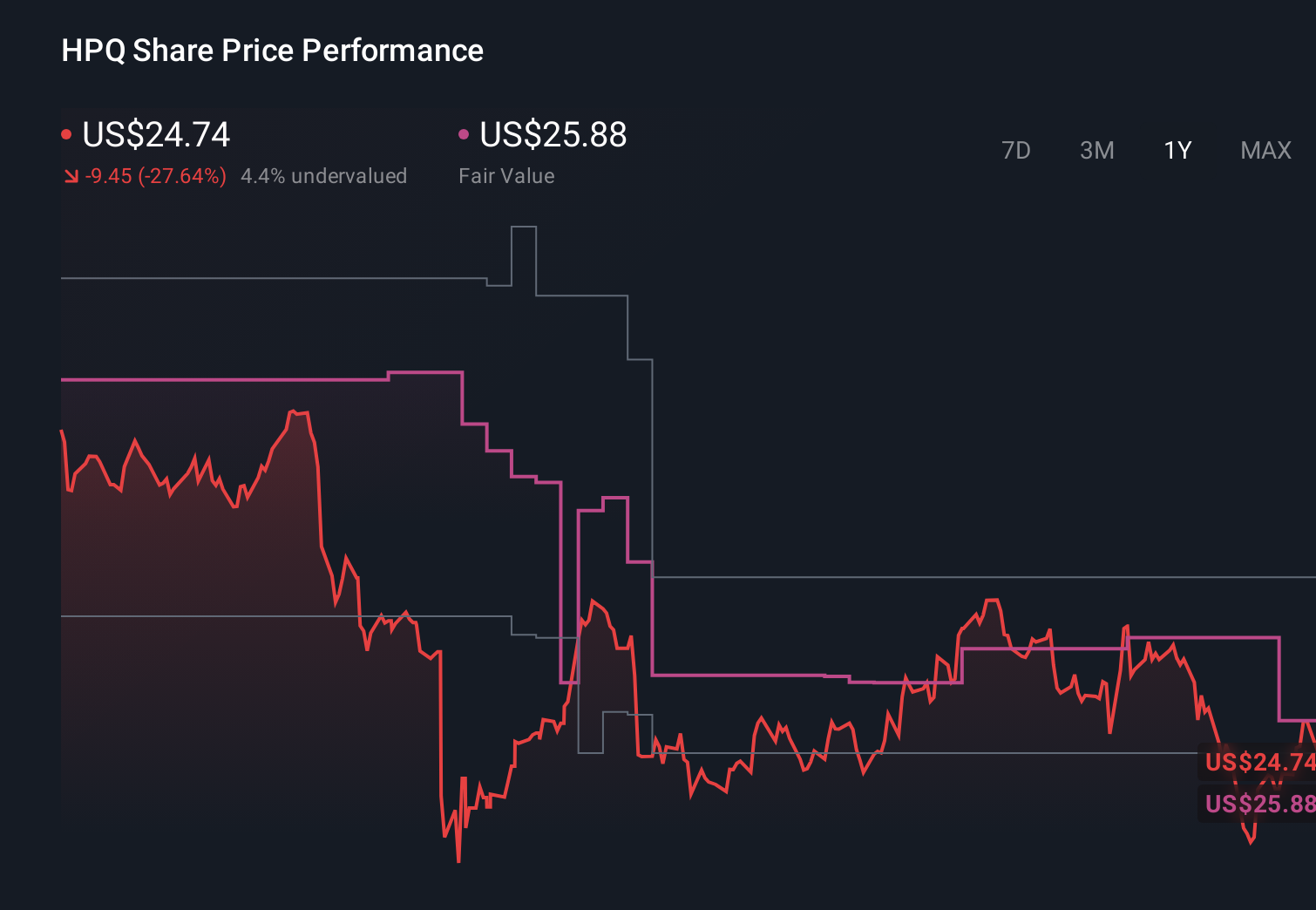
Before this AI driven hardware news, the most bullish analysts expected HP to reach about US$59.4 billion in revenue and roughly US$3.2 billion in earnings by 2029, a much more optimistic path than the more cautious consensus. As you weigh that view against execution risk in AI PCs and rising component costs, it is worth comparing these different assumptions and deciding which story you find more realistic.
Explore 7 other fair value estimates on HP - why the stock might be worth 40% less than the current price!
Decide For Yourself
Don't just follow the ticker - dig into the data and build a conviction that's truly your own.
- A great starting point for your HP research is our analysis highlighting 3 key rewards and 3 important warning signs that could impact your investment decision.
- Our free HP research report provides a comprehensive fundamental analysis summarized in a single visual - the Snowflake - making it easy to evaluate HP's overall financial health at a glance.
Ready For A Different Approach?
Our top stock finds are flying under the radar-for now. Get in early:
- Find 51 companies with promising cash flow potential yet trading below their fair value.
- Outshine the giants: these 16 early-stage AI stocks could fund your retirement.
- Rare earth metals are an input to most high-tech devices, military and defence systems and electric vehicles. The global race is on to secure supply of these critical minerals. Beat the pack to uncover the 28 best rare earth metal stocks of the very few that mine this essential strategic resource.
This article by Simply Wall St is general in nature. We provide commentary based on historical data and analyst forecasts only using an unbiased methodology and our articles are not intended to be financial advice. It does not constitute a recommendation to buy or sell any stock, and does not take account of your objectives, or your financial situation. We aim to bring you long-term focused analysis driven by fundamental data. Note that our analysis may not factor in the latest price-sensitive company announcements or qualitative material. Simply Wall St has no position in any stocks mentioned.
Have feedback on this article? Concerned about the content? Get in touch with us directly. Alternatively, email editorial-team@simplywallst.com